As electricity demand continues to rise in the evening, more Australian homeowners are looking for ways to store excess solar energy during the day and use it when they need it most.
Solar batteries can help households increase solar self-consumption, reduce reliance on grid electricity and gain greater control over their energy usage. However, choosing the right battery is about more than simply comparing storage capacity or upfront price.
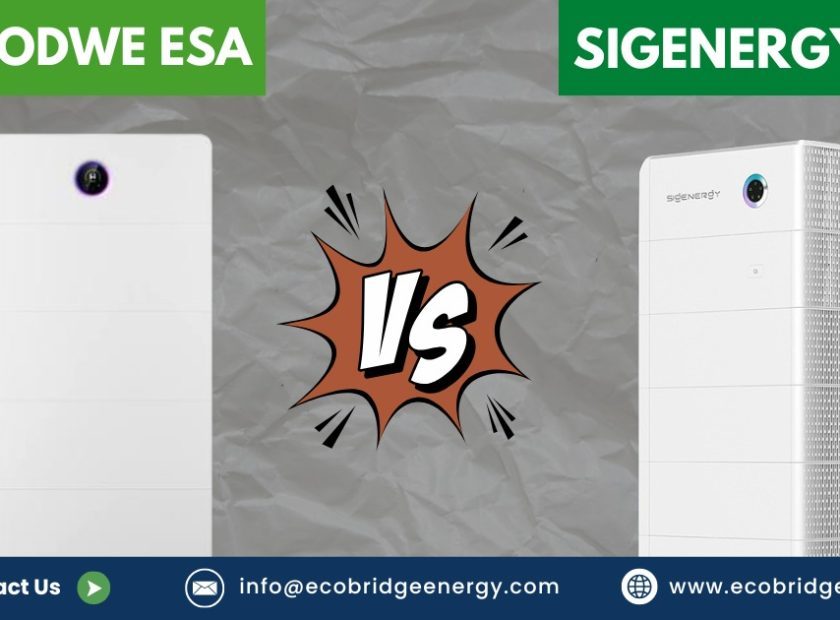
Two solutions attracting attention in the Australian residential energy market are the Compare GoodWe ESA vs Fox ESS CQ7 for Australian homes. Explore battery capacity, backup power, solar self-consumption, expandability and monitoring.. Both are designed for modern solar-plus-storage systems, but their suitability can vary depending on your household’s electricity consumption, solar system, backup requirements and future energy plans.
At EcoBridge Australia, we help homeowners understand their energy requirements and select energy storage solutions that are designed around how their homes actually use electricity.
What Is the GoodWe ESA?
The GoodWe ESA is an integrated energy storage solution designed to combine battery storage and power conversion in a streamlined system.
GoodWe offers a range of residential solar, inverter and energy storage products for the Australian market. Depending on the selected configuration, an integrated energy storage system can help homeowners make better use of excess solar generation while managing household energy consumption.
Potential benefits of an integrated battery system include:
- Better use of excess solar energy
- Increased solar self-consumption
- Reduced reliance on grid electricity
- Energy monitoring and management
- Stored energy for evening and overnight consumption
- Backup power capability where supported by the complete system configuration
The right GoodWe solution depends on several factors, including the home’s daily electricity consumption, solar PV capacity, electrical phase configuration, available installation space and backup requirements.
What Is the Fox ESS CQ7?
The Fox ESS CQ7 is part of Fox ESS’s residential battery storage range and is designed to work as part of a solar-plus-storage system.
Fox ESS systems can be paired with compatible hybrid inverters and configured to suit different household energy requirements. Depending on the system design, features can include LFP battery technology, modular storage capacity, smart monitoring and backup functionality.
One of the key advantages of a modular battery system is flexibility. Homeowners can select a configuration that suits their current electricity requirements while considering future changes such as:
- Electric vehicle charging
- Increased hot-water electricity consumption
- Heat-pump installation
- Air-conditioning use
- Larger solar PV systems
- Higher evening electricity demand
- Greater energy independence
For households planning to increase their electricity consumption in the future, choosing a battery system with appropriate expansion options can be an important part of long-term system design.
GoodWe ESA vs Fox ESS CQ7: What Are the Key Differences?
There is no universal winner between Compare GoodWe ESA vs Fox ESS CQ7 for Australian homes. Explore battery capacity, backup power, solar self-consumption, expandability and monitoring..
The better option depends on the complete energy system rather than the battery alone. Homeowners should consider storage capacity, inverter compatibility, backup requirements, system monitoring, installation requirements and future energy consumption.
1. Battery Capacity
Battery capacity is often the first specification homeowners compare, but choosing the largest available battery is not always the best approach.
A battery should be appropriately sized around factors such as:
- Average daily electricity consumption
- Evening and overnight electricity usage
- Solar PV generation
- Available excess solar energy
- Electricity tariffs
- Future energy requirements
A household with high evening consumption may benefit from greater storage capacity, while a smaller household with lower electricity usage may achieve better value from a smaller system.
Fox ESS provides modular battery configurations, while GoodWe offers a range of residential storage solutions that can be matched with compatible inverter and battery configurations.
The goal should be to select a battery that can store a useful amount of your excess solar energy without unnecessarily oversizing the system.
2. Solar Self-Consumption
One of the main reasons Australian homeowners install batteries is to use more of the solar electricity they generate themselves.
Solar panels generally produce the most electricity during the middle of the day. However, household electricity demand can increase later in the afternoon and evening, when solar generation begins to fall.
Without sufficient storage, excess daytime solar may be exported to the grid while the household later purchases electricity when solar production is low.
A battery can change this pattern.
During the day:
Solar panels generate electricity → The home uses electricity → Excess solar charges the battery.
During the evening:
Solar generation falls → The battery supplies stored energy → The home can rely less on grid electricity.
Both GoodWe and Fox ESS systems can be designed to support this type of energy management, subject to the exact equipment and installation configuration.
3. Backup Power
Backup capability is another important consideration when comparing home battery systems.
Depending on the selected inverter, battery, backup equipment and installation configuration, a solar battery system may be able to provide electricity during a grid outage.
However, backup functionality should never be assumed simply because a system includes a battery.
Before installation, homeowners should ask:
- Which appliances can operate during an outage?
- Which circuits will be backed up?
- Is whole-home backup available?
- Is additional backup equipment required?
- Can the system provide three-phase backup where required?
- What is the available backup power output?
EcoBridge Australia offers Fox ESS configurations designed for residential backup applications, including options suitable for certain three-phase installations.
The exact backup capability depends on the complete system design, so it is important to confirm the proposed configuration with your installer.
4. Expandability and Future Energy Needs
Household electricity consumption can change significantly over the life of a solar and battery system.
You may eventually purchase an EV, install a heat pump, add air conditioning, increase hot-water usage or expand your solar PV system.
For this reason, future energy requirements should be considered before selecting a battery.
Fox ESS offers modular and expandable configurations, while GoodWe also provides multiple battery and inverter combinations across its residential product range.
A properly designed system can give homeowners greater flexibility as their energy needs evolve.
5. Smart Energy Monitoring
Energy monitoring is becoming an increasingly important part of modern solar and battery systems.
Monitoring platforms can provide visibility into:
- Solar generation
- Household electricity consumption
- Battery charging
- Battery discharge
- Grid imports
- Solar exports
- Overall energy flows
Fox ESS systems can be monitored through the FoxESS Cloud platform, while GoodWe provides its own monitoring ecosystem for compatible products.
Monitoring your system can help you understand when electricity is being generated, stored and consumed. This information can also help identify opportunities to shift energy-intensive activities into periods when solar or stored energy is available.
GoodWe ESA vs Fox ESS CQ7: Practical Comparison
| Feature | GoodWe ESA | Fox ESS CQ7 |
|---|---|---|
| Residential energy storage | Yes | Yes |
| Solar self-consumption | Yes | Yes |
| Smart energy management | Yes | Yes |
| Modular options | Configuration dependent | Yes |
| LFP battery options | Available across GoodWe range | Yes |
| Backup capability | Configuration dependent | Configuration dependent |
| Monitoring | GoodWe monitoring ecosystem | FoxESS Cloud |
| Australian residential applications | Yes | Yes |
| Best suited system | Depends on household requirements | Depends on household requirements |
Specifications, compatibility, capacity, inverter options and backup functionality can vary according to the exact model and installation configuration. Always confirm the final system design and current specifications with a qualified Australian installer.
Which Battery Is Better for Australian Homes?
The best battery is the one that fits the way your household generates and uses electricity.
Rather than selecting a system based solely on battery capacity or purchase price, homeowners should consider the complete energy profile of the property.
Key considerations include:
- Average daily electricity consumption
- Evening and overnight electricity usage
- Existing solar PV capacity
- Single-phase or three-phase electricity supply
- Desired backup capability
- Future EV charging requirements
- Available installation space
- Future electricity consumption
- Warranty and manufacturer support
- Installer experience and after-sales service
For example, a household with high evening electricity consumption and an EV may need considerably more storage than a smaller home with modest energy usage.
Similarly, a homeowner who places a high priority on blackout protection may need to prioritise backup capability and inverter configuration rather than battery capacity alone.
How to Choose the Right Battery Size
Battery sizing should begin with your home’s actual energy consumption.
Look at your electricity bills and, where possible, review your hourly consumption data. Pay particular attention to how much electricity your household uses after solar production declines.
A useful assessment should consider:
Solar generation: How much electricity does your solar system produce during the day?
Daytime consumption: How much solar energy is used immediately by the household?
Excess solar: How much electricity is available to charge the battery?
Evening consumption: How much electricity is typically required after solar generation falls?
Overnight consumption: How much stored energy is likely to be required until solar generation resumes?
Future demand: Will an EV, heat pump, air conditioning or other electrical appliances increase consumption?
This approach can help prevent both under-sizing and unnecessary over-sizing.
Why Backup Power Should Be Considered Separately
Battery capacity and backup power are related, but they are not the same thing.
A battery may have sufficient stored energy but still require the appropriate inverter and backup configuration to power selected household circuits during a blackout.
If backup power is important to your household, discuss your priorities with your installer before choosing the equipment.
You may want to identify essential loads such as:
- Refrigeration
- Lighting
- Internet equipment
- Security systems
- Essential power outlets
- Selected kitchen appliances
- Medical or other essential equipment where applicable
Your installer can then determine whether the proposed system can support those loads and whether additional equipment is required.
Why Choose EcoBridge Australia?
At EcoBridge Australia, we believe choosing a solar battery should start with understanding how your home uses electricity.
A battery is a significant investment, so the right solution should be based on your property’s solar generation, electricity consumption, available space, electrical configuration and future energy goals.
EcoBridge can help homeowners assess suitable energy storage options and design systems around their individual requirements.
Our focus includes:
- Quality solar battery solutions
- Professional system design
- Australian installation support
- Residential energy storage solutions
- Smart energy management
- Backup power solutions
- Future-ready solar and battery systems
EcoBridge currently offers Fox ESS battery and inverter solutions for residential and higher-demand applications.
Contact EcoBridge Australia
If you’re considering a solar battery and aren’t sure whether GoodWe, Fox ESS or another solution is right for your home, EcoBridge Australia can help you understand your options.
Website:https://ecobridgeenergy.com/
Email: info@ecobridgeenergy.com
For more information about solar batteries and energy storage solutions, visit EcoBridge Australia’s website and speak with the team about your household’s energy requirements.
Final Thoughts
Both GoodWe ESA and Fox ESS CQ7 can be suitable options for Australian homeowners looking to increase solar self-consumption and make better use of their renewable energy.
However, the best battery isn’t necessarily the one with the largest capacity or the lowest upfront price.
The right system should balance:
- Solar generation
- Household electricity consumption
- Evening and overnight demand
- Battery capacity
- Inverter performance
- Backup requirements
- Installation considerations
- Future energy needs
- Warranty and support
If you’re comparing GoodWe ESA vs Fox ESS CQ7, start with your home’s energy profile rather than the battery specification alone.
EcoBridge Australia can help you assess your requirements and identify a suitable solar and battery solution for your property.
Frequently Asked Questions
1. What is the difference between GoodWe ESA and Fox ESS CQ7?
GoodWe ESA and Fox ESS CQ7 are energy storage solutions designed to help households store electricity and use it when required. The main differences depend on the specific battery, inverter, capacity, monitoring platform and system configuration selected.
2. Is GoodWe ESA suitable for Australian homes?
GoodWe offers residential energy storage products for the Australian market. Whether a particular ESA configuration is suitable depends on factors such as the home’s solar system, electricity supply, energy consumption and backup requirements.
3. Is Fox ESS CQ7 suitable for Australian homes?
Fox ESS provides residential battery storage solutions designed for different household energy requirements. A CQ7 system may be suitable for a range of homes, subject to the compatibility of the battery, inverter and other system components.
4. Can Fox ESS batteries provide backup power?
Certain Fox ESS configurations can provide backup power during grid outages. The available backup capacity and which household circuits can remain powered depend on the inverter, battery, backup equipment and overall system design.
5. Which is better: GoodWe or Fox ESS?
There is no universal winner. GoodWe may be the better fit for one household, while Fox ESS may be more appropriate for another. Storage capacity, inverter requirements, backup functionality, budget, installation conditions and future electricity demand should all be considered.
6. How much battery storage does my home need?
Battery capacity should be determined using your electricity consumption, solar generation and typical evening and overnight usage. Future requirements such as EV charging should also be considered. A professional system assessment can help determine an appropriate battery size.
7. Can I add an EV to a solar battery system?
Yes. However, EV charging can significantly increase household electricity demand. If you are planning to purchase an EV, it is worth considering its expected charging requirements when designing your solar and battery system.
8. Can a solar battery reduce electricity bills?
A battery can increase the amount of solar electricity your household consumes rather than exporting excess generation to the grid. Potential savings depend on factors including electricity tariffs, solar generation, household consumption, battery capacity and system performance.
9. Does EcoBridge install solar batteries in Australia?
EcoBridge Australia provides solar battery and energy storage solutions for Australian customers. Its current product range includes Fox ESS battery and inverter configurations designed for different residential and higher-demand applications.
10. Should I choose a larger battery?
Not necessarily. A larger battery is only beneficial if there is enough solar energy available to charge it and sufficient household demand to use the stored energy. Correct system sizing is generally more important than simply choosing the largest available capacity.
11. Is battery storage worth it for a home with solar panels?
Battery storage can be valuable for households that generate excess solar energy during the day and consume significant amounts of electricity later in the day or at night. The financial benefit depends on your electricity usage, tariffs, solar generation, battery cost and system performance.
12. What should I ask an installer before buying a battery?
Ask about battery capacity, usable energy, inverter compatibility, backup functionality, expansion options, warranty, monitoring, installation requirements and expected system performance. You should also confirm which appliances or circuits will operate during a blackout.
Ready to take greater control of your home’s energy? Contact EcoBridge Australia to discuss your solar battery and energy storage requirements.