Category: Uncategorized

Read More

Solar Farm & Battery Storage in Regional NSW: Opportunities for Landowners and Developers

Regional New South Wales is playing an increasingly important role in Australia’s renewable energy transition. With strong solar resources, large areas of rural land and significant investment in electricity infrastructure, the region is attracting solar farms, battery energy storage systems (BESS) and combined solar-plus-battery projects.

For rural landowners, renewable energy development may provide an opportunity to generate long-term income from suitable land. For developers, regional NSW offers opportunities to develop large-scale generation and storage projects in areas connected to existing or planned electricity infrastructure.

However, having a large rural property does not automatically make it suitable for a solar farm or battery project.

Land availability, grid connection, planning requirements, environmental constraints, access, surrounding land uses and project economics all need to be assessed before a project can proceed.

This guide explains the key considerations for landowners and developers exploring solar farm and battery storage opportunities across regional NSW.

What Is a Solar Farm With Battery Storage?

A solar farm uses photovoltaic (PV) panels to convert sunlight into electricity. A battery energy storage system can be installed alongside the solar generation facility to store electricity and discharge it when required.

A utility-scale solar and battery project may include:

  • Solar photovoltaic panels
  • Battery energy storage units
  • Inverters and power conversion systems
  • Transformers
  • Substations
  • Switchgear and electrical infrastructure
  • Grid connection equipment
  • Monitoring and control systems
  • Internal access roads
  • Security infrastructure
  • Fire detection and protection systems

The size and configuration of a project will depend on the available land, proposed generation capacity, battery capacity, grid connection requirements, environmental constraints and development objectives.

Projects can range from relatively small installations to major utility-scale renewable energy developments.

Why Regional NSW Is Attracting Solar and Battery Projects

Regional NSW offers many of the characteristics required for large-scale renewable energy development.

Large rural properties can provide space for solar generation, batteries and associated infrastructure. At the same time, existing and planned transmission infrastructure can create opportunities for connecting new generation and storage to the electricity network.

NSW also has several Renewable Energy Zones (REZs), which are intended to coordinate renewable generation, energy storage and transmission infrastructure.

For landowners, a property’s location can therefore be an important factor when assessing its renewable energy potential.

However, being located inside or near a REZ does not guarantee that a property is suitable for development. Each site must still be assessed for technical, environmental, planning, grid and commercial constraints.

Could Your Land Be Suitable for a Solar Farm?

One of the first questions many rural landowners ask is:

Could my property be used for a solar farm or battery project?

The answer depends on much more than the total size of the property.

A preliminary site assessment may consider the following.

Land Size and Usable Area

Large-scale solar projects generally require substantial areas of land. However, the total property area is not necessarily the area available for development.

Waterways, vegetation, environmental constraints, setbacks, existing infrastructure, terrain, drainage and access requirements can all reduce the usable development area.

Solar Resource

Solar exposure is an important consideration because it influences potential electricity generation.

Many parts of regional NSW have favourable solar resources, but solar conditions are only one component of a complete feasibility assessment.

Grid Connection

Access to the electricity network is one of the most important considerations for a utility-scale project.

A property may have excellent solar conditions and extensive available land but still face significant development challenges if there is no practical connection pathway.

Potential considerations include:

  • Nearby substations
  • Transmission and distribution infrastructure
  • Network capacity
  • Connection requirements
  • Required network upgrades
  • Proposed solar capacity
  • Proposed battery capacity

Grid connection should therefore be investigated as early as possible.

Road and Site Access

Construction and ongoing operation require suitable access for heavy vehicles, equipment and maintenance crews.

Existing roads, property entrances, local road conditions and the ability to transport large equipment to the site may all influence feasibility.

Terrain

Terrain can influence construction costs, site layout, drainage and engineering requirements.

Relatively suitable terrain may simplify development, although engineering solutions can accommodate a range of site conditions.

Why Add Battery Storage to a Solar Farm?

Solar generation is naturally concentrated during daylight hours. Battery storage provides a way to store electricity and discharge it at another time.

This can give a renewable energy project greater operational flexibility.

Depending on its configuration and commercial arrangements, battery storage may be used for purposes including:

  • Storing excess solar generation
  • Shifting energy availability to different periods
  • Supporting electricity supply
  • Participating in electricity markets
  • Providing certain grid services
  • Supporting the integration of renewable generation

Adding a battery does not automatically make a project financially viable.

Project economics can depend on battery size and duration, equipment costs, grid connection, financing, market conditions, operating strategy and commercial arrangements.

What Is a Utility-Scale Battery Energy Storage System?

A utility-scale Battery Energy Storage System, commonly known as a BESS, is significantly larger and more complex than a residential battery.

A large BESS may include:

  • Battery storage units
  • Battery management systems
  • Power conversion systems
  • Transformers
  • Switchgear
  • Cooling and thermal management systems
  • Fire detection and protection systems
  • Control and communications systems
  • Access roads
  • Security infrastructure

Battery projects are commonly described using MW and MWh.

What Does MW Mean?

MW refers to the battery’s power capacity.

For example, a 100 MW battery may be capable of discharging up to 100 MW at a given time, subject to its design and operating conditions.

What Does MWh Mean?

MWh refers to the amount of energy the battery can store.

For example, a 100 MW / 200 MWh battery has a 100 MW power capacity and 200 MWh of storage capacity.

The relationship between MW and MWh determines the battery’s potential operating duration at a particular output.

Solar Farm vs Solar Farm + Battery Storage

Whether battery storage should be included in a solar project depends on the technical and commercial characteristics of the site.

Solar FarmSolar Farm + Battery
Solar generationSolar generation
No large-scale batteryBattery energy storage
Primarily generates during daylightCan store and discharge electricity
Simpler project configurationMore complex infrastructure
Solar inverter infrastructureSolar and battery power conversion infrastructure
Grid connection requiredGrid connection required
Economics depend on solar generationEconomics depend on generation and storage strategy

There is no universal project configuration that applies to every site. The appropriate approach should be determined through project-specific technical and commercial analysis.

Renewable Energy Zones in NSW

Renewable Energy Zones are an important part of the NSW energy infrastructure strategy. They are intended to coordinate renewable generation, energy storage and transmission infrastructure.

NSW REZs include areas such as:

  • Central-West Orana
  • New England
  • Hunter-Central Coast
  • Illawarra
  • South West

For landowners, proximity to a REZ and associated transmission infrastructure may be relevant when assessing renewable energy potential.

However, REZ location alone does not determine whether a particular property can host a project. The site must still satisfy applicable technical, environmental, planning, grid and commercial requirements.

What Makes a Property Attractive for Solar Farm Development?

There is no single checklist that guarantees a property will be selected by a developer.

However, developers may investigate properties based on factors such as:

Large Usable Land Area

A larger usable development area can provide greater flexibility for project design.

Strong Solar Resource

Good solar conditions can support renewable electricity generation.

Suitable Grid Infrastructure

Access to appropriate electricity infrastructure can be critical to project feasibility.

Suitable Land Characteristics

Terrain, drainage, vegetation, waterways, soil and other site characteristics can affect project design and cost.

Good Road Access

Construction and maintenance activities require reliable access for vehicles and equipment.

Surrounding Land Uses

Nearby residences, agricultural activities, environmental areas and other land uses can influence project design and planning requirements.

Strategic Location

Proximity to existing or planned renewable energy and transmission infrastructure may be relevant when assessing a site’s development potential.

How Much Land Is Needed for a Solar Farm?

There is no universal acreage requirement for a solar farm.

Land requirements can vary depending on:

  • Solar generation capacity
  • Panel technology
  • Site layout
  • Terrain
  • Battery storage
  • Electrical infrastructure
  • Setbacks
  • Environmental constraints
  • Internal roads
  • Drainage
  • Existing infrastructure

A 10 MW project can have very different land requirements from a 100 MW or 500 MW project.

More importantly, developers need to consider the usable development area, rather than simply the total property size.

For example, owning 500 hectares does not necessarily mean that all 500 hectares can be used for renewable energy infrastructure.

Can Agricultural Land Be Used for Solar Farms?

Some rural properties may be suitable for renewable energy development while other parts of the property continue to support agricultural activities.

The relationship between renewable energy infrastructure and agriculture needs to be assessed on a site-by-site basis.

Important considerations may include:

  • Existing farming operations
  • Grazing
  • Cropping
  • Soil characteristics
  • Water infrastructure
  • Farm access
  • Livestock management
  • Agricultural productivity
  • Proposed solar layout

Before entering a long-term agreement, landowners should understand how the proposed development could affect existing and future agricultural operations.

What Does a Solar Farm Lease Mean for a Landowner?

Renewable energy projects can involve long-term leases, options, easements and other property agreements.

Depending on the project, an agreement may address:

  • Development rights
  • Access rights
  • Construction areas
  • Operational areas
  • Easements
  • Infrastructure locations
  • Lease terms
  • Extension options
  • Decommissioning
  • Land rehabilitation or restoration

Commercial terms can vary significantly between projects.

Landowners should obtain independent legal and financial advice before signing a long-term renewable energy agreement.

It is particularly important to understand what happens if:

  • The project does not receive approval
  • Grid connection cannot be secured
  • Development is delayed
  • The developer changes
  • The project is sold
  • The project does not proceed
  • The project reaches the end of its operating life

Solar Farm Planning and Development in NSW

A large-scale solar farm or battery project is a significant infrastructure development.

Depending on the project and location, assessment may involve issues such as:

  • Land use
  • Biodiversity
  • Environmental impacts
  • Agricultural impacts
  • Visual impacts
  • Noise
  • Glint and glare
  • Bushfire considerations
  • Traffic
  • Road access
  • Heritage
  • Water
  • Community consultation
  • Decommissioning

The applicable planning pathway depends on the project’s location, scale and characteristics.

For this reason, developers generally undertake extensive due diligence before committing to construction.

Environmental Considerations

Environmental assessment is an important component of renewable energy development.

Potential site constraints can include:

  • Native vegetation
  • Threatened species
  • Biodiversity
  • Watercourses
  • Wetlands
  • Flooding
  • Bushfire risk
  • Aboriginal and cultural heritage
  • Archaeological areas
  • Soil conditions
  • Drainage

Identifying potential constraints early can help developers determine whether a project can be appropriately designed.

A property that appears suitable during an initial desktop review may require substantial changes after detailed environmental investigations.

Battery Storage and Fire Safety

Utility-scale battery systems require specialist engineering and safety planning.

A BESS project may incorporate:

  • Battery management systems
  • Thermal monitoring and management
  • Fire detection
  • Fire protection systems
  • Emergency response procedures
  • Equipment separation
  • Controlled site access
  • Monitoring and safety systems

The final design must comply with applicable requirements and be appropriate for the specific project and site.

Battery storage should therefore be treated as specialist energy infrastructure rather than simply a larger version of a household battery.

How Much Does a Solar Farm Cost?

There is no standard price for developing a solar farm or solar-plus-battery project in NSW.

Costs can vary substantially depending on:

  • Project capacity
  • Solar equipment
  • Battery capacity
  • Battery duration
  • Grid connection
  • Substation requirements
  • Transmission infrastructure
  • Civil works
  • Road upgrades
  • Land conditions
  • Environmental requirements
  • Planning and development
  • Engineering
  • Financing
  • Construction conditions

Adding battery storage can significantly increase and change the project’s capital requirements.

Generic “$ per MW” estimates should therefore not be treated as a project quotation. A detailed technical and financial model is required for an individual development.

What Should Landowners Prepare Before Contacting a Developer?

If you own rural land and want to investigate its potential for renewable energy development, having basic property information available can help with an initial assessment.

Useful information includes:

  • Property location
  • Total land area
  • Approximate usable land area
  • Current land use
  • Existing electricity infrastructure
  • Nearby substations
  • Nearby transmission lines
  • Road access
  • Property boundaries
  • Existing buildings
  • Waterways
  • Known environmental constraints
  • Current agricultural activities

You do not need to have a complete renewable energy development proposal before making an enquiry.

A preliminary assessment can help determine whether the property warrants further investigation.

Questions Landowners Should Ask Before Signing an Agreement

If a renewable energy developer approaches you, consider asking the following questions.

What type of project is proposed?

Is it:

  • Solar only?
  • Solar plus battery?
  • Battery only?
  • Solar and battery with future expansion?
How much land will be required?

Understand the actual development footprint rather than relying solely on the total property area.

Where will infrastructure be located?

Ask about the proposed locations of:

  • Solar panels
  • Battery systems
  • Substations
  • Access roads
  • Cabling
  • Transmission infrastructure
Who is responsible for development costs?

The agreement should clearly identify which costs are the developer’s responsibility.

What happens if the project does not receive approval?

This should be addressed clearly in the agreement.

What happens at the end of the project?

Understand the proposed decommissioning, rehabilitation and land restoration arrangements.

Can the project or agreement be transferred?

Understand what happens if the developer sells the project or transfers its rights to another company.

Have you obtained independent advice?

A long-term renewable energy agreement can have significant legal and financial implications.

Independent legal, financial and property advice can help you understand the proposed terms before committing.

How Developers Assess a Solar Farm Site

A professional project assessment will generally progress through several stages.

Stage 1: Desktop Site Assessment

An initial review may examine:

  • Location
  • Land size
  • Solar resource
  • Grid infrastructure
  • REZ location
  • Terrain
  • Environmental constraints
  • Road access
  • Nearby properties
Stage 2: Technical Feasibility

More detailed investigation may examine:

  • Solar design
  • Battery configuration
  • Electrical infrastructure
  • Grid connection
  • Site layout
  • Civil requirements
Stage 3: Environmental Assessment

Specialist investigations may be required depending on the site’s characteristics.

Stage 4: Planning

The project can progress through the applicable planning and approval processes.

Stage 5: Grid Connection

Connection studies and technical requirements need to be addressed with the relevant network and market participants.

Stage 6: Commercial Assessment

Developers may assess:

  • Capital expenditure
  • Operating costs
  • Financing
  • Revenue opportunities
  • Energy market conditions
  • Grid costs
  • Project risks
Stage 7: Construction

Once the necessary agreements, approvals, grid arrangements and financing are in place, construction can proceed.

Large renewable energy projects can take considerable time to progress from initial investigation to operation.

Opportunities for Regional NSW Landowners

For rural landowners, renewable energy development may provide an alternative long-term use for suitable land.

Potential opportunities can include:

  • Solar farm development
  • Battery energy storage
  • Solar-plus-battery projects
  • Transmission infrastructure
  • Supporting infrastructure

Not every property will be suitable.

The most useful first step is to understand how the property’s location, land characteristics, electricity infrastructure and planning environment affect its potential.

Solar Farm & Battery Storage Opportunities for Developers

For developers, identifying suitable land is only one part of the process.

A successful project can require coordination between:

  • Landowners
  • Renewable energy developers
  • Engineers
  • Planning specialists
  • Environmental consultants
  • Grid specialists
  • Construction contractors
  • Financial partners
  • Energy market participants
  • Local communities

Solar and battery development is therefore a multidisciplinary process.

Early identification of major constraints can help determine whether a project should proceed to more detailed investigation.

Why Early Site Assessment Matters

One of the most important steps in renewable energy development is understanding major constraints before significant resources are committed to a site.

A preliminary assessment can identify potential issues involving:

  • Grid access
  • Usable land area
  • Environmental constraints
  • Road access
  • Terrain
  • Planning
  • Nearby residences
  • Development footprint

A preliminary assessment does not replace detailed engineering, environmental, legal or planning studies.

Instead, it provides an initial indication of whether a site may justify further investigation.

Could Your NSW Property Be Suitable?

If you own a large rural property in regional NSW, your land may have some of the characteristics developers investigate when looking for renewable energy sites.

But the key question is not simply:

“Do I have enough land?”

A more useful question is:

“Could my property support a technically, commercially, environmentally and legally viable renewable energy project?”

Answering that question requires consideration of the complete site.

Property location, usable land area, grid infrastructure, terrain, environmental characteristics, access and surrounding land uses can all influence development potential.

Explore Your Solar Farm or Battery Storage Opportunity

If you own land in regional NSW and are considering its potential for a solar farm, battery energy storage system or combined solar-and-battery project, a preliminary site assessment can be a practical first step.

You can provide basic information such as:

  • Property location
  • Approximate land size
  • Current land use
  • Nearby electricity infrastructure
  • Existing property access
  • Any information you already have about the site

An initial review can help determine whether the property may warrant further investigation.

Own Land in Regional NSW?

Your property may have potential for renewable energy development.

Speak with our team about your property and explore whether solar farm, battery storage or a combined solar-and-battery project could be considered for the site.

Website : https://ecobridgeenergy.com/

Gmail : info@ecobridgeenergy.com

Frequently Asked Questions

How much land do I need for a solar farm in NSW?

There is no universal land requirement. The amount of land depends on project capacity, technology, site layout, environmental constraints and associated infrastructure.

Can I lease my land for a solar farm?

Potentially. Suitable landowners may enter into long-term commercial arrangements with renewable energy developers, subject to project feasibility, planning, grid and commercial requirements.

Can a solar farm include battery storage?

Yes. Battery energy storage can be developed alongside solar generation, subject to technical, planning, environmental and grid requirements.

What is a BESS?

BESS stands for Battery Energy Storage System. A utility-scale BESS stores electrical energy and can discharge it at another time.

Are there solar farms in regional NSW?

Yes. Regional NSW hosts large-scale renewable energy projects and is also the focus of further renewable generation, storage and transmission development.

Does my property need to be inside a Renewable Energy Zone?

Not necessarily. Renewable energy projects can be considered outside REZs, although proximity to suitable transmission and electricity infrastructure can be an important consideration.

Does being inside a REZ guarantee that my property will be developed?

No. Each property and project must be assessed individually against technical, environmental, planning, grid and commercial requirements.

How close does a solar farm need to be to a substation?

There is no universal distance requirement. Connection feasibility depends on the electricity network, available capacity, connection requirements and the proposed project.

Can farming continue alongside a solar farm?

Potentially. The answer depends on the project design, land-use arrangement and agricultural activities. Each property needs to be assessed individually.

How long does a solar farm project take?

Large-scale renewable energy projects can take several years from initial investigation through planning, grid connection and construction. Timelines vary considerably between projects.

How do I find out if my land is suitable?

A preliminary site assessment is a practical starting point. It can examine the property’s location, land size, grid infrastructure, terrain, access and major site constraints.

Ready to Explore Your Property?

If you own land anywhere in regional NSW and are considering its potential for solar farm development, battery energy storage or a combined solar-and-battery project, start with a preliminary assessment.

Tell us where your property is, how much land you have and what you know about the site’s electricity infrastructure.
Read More

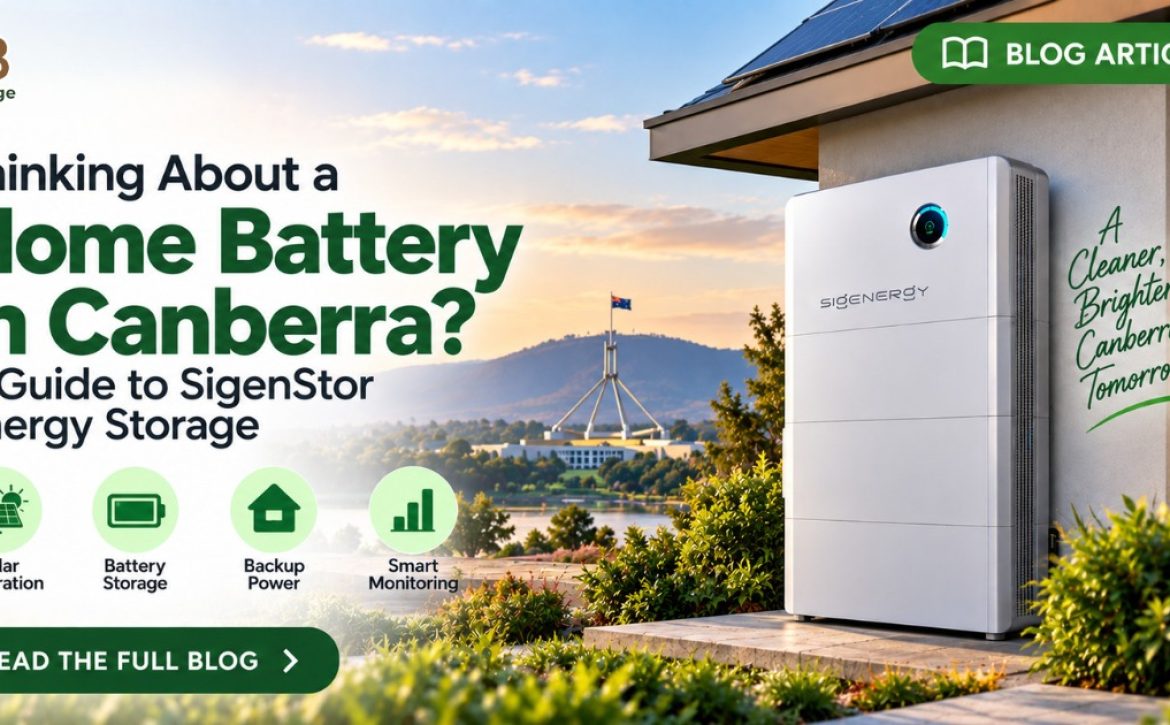
Thinking About a Home Battery in Canberra? A Guide to SigenStor Energy Storage

For many Canberra homeowners, installing solar panels is only the first step towards taking greater control of household energy use. Solar panels can generate electricity during the day, but much of a home’s electricity consumption can occur later in the afternoon and evening, when solar generation is falling or has stopped.

This is where battery storage can play an important role.

A home battery allows excess solar energy generated during the day to be stored and used later, helping households make greater use of the electricity their solar system produces.

One system attracting attention in the home energy storage market is SigenStor by Sigenergy.

SigenStor Battery Canberra is designed as an integrated energy system combining solar conversion, battery storage, energy management and EV charging in one platform. But what does that actually mean for a Canberra homeowner, and is an integrated system suitable for every home?

Let’s take a closer look.

What Is SigenStor?

SigenStor is a modular home energy storage system designed by Sigenergy.

Rather than treating the solar inverter, battery, energy management system and EV charger as completely separate products, SigenStor brings multiple functions together within an integrated platform.

The system can combine:

  • Solar inverter
  • Battery storage
  • Battery power conversion
  • Energy management
  • EV charging
  • Home energy monitoring
  • Backup power functionality

The EV charging component can be included depending on the homeowner’s requirements.

This integrated approach can be useful for homeowners who are thinking beyond simply adding a battery and want to coordinate solar generation, energy storage, household consumption and potentially EV charging.

How Does SigenStor Work With Solar?

A typical solar-only system works by converting sunlight into electricity that can be used by the home.

For example:

Solar panels → Home electricity consumption → Excess solar exported to the grid

The challenge is that solar production and household consumption don’t always occur at the same time.

A household might produce substantial solar energy around midday while nobody is home. Later in the evening, the household may be using electricity for lighting, cooking, heating, cooling, hot water or other appliances when the solar panels are producing little or no electricity.

With battery storage, the energy flow can become:

Solar panels → Home → SigenStor battery → Home

Instead of exporting all excess solar immediately, surplus generation can be stored and subsequently used when required.

SigenStor’s integrated energy management system is designed to coordinate energy generation, storage and consumption.

The system can also provide monitoring and energy management through its connected platform, allowing homeowners to understand how their solar, battery and household energy consumption are interacting.

Why Consider Battery Storage in Canberra?

Battery storage can be useful for households that already have solar but still purchase electricity from the grid.

The main concept is simple.

During the day

Solar panels generate electricity.

The home uses the electricity it needs first.

Excess solar can then be directed towards charging the battery.

During the evening

Solar production decreases.

The battery can supply stored energy to the home.

When solar and battery energy are insufficient

The home can continue drawing electricity from the grid according to the system’s configuration and operating conditions.

The objective isn’t necessarily to disconnect completely from the electricity grid.

Instead, battery storage can provide another source of household energy and give homeowners greater flexibility over when they use the electricity generated by their solar system.

Canberra’s Growing Interest in Home Batteries

Battery storage is becoming an increasingly important part of Canberra’s broader energy landscape.

More homeowners are looking at batteries as a way to make greater use of their solar generation, manage household energy consumption and prepare for increasing electrification.

The growth of electric vehicles, electric hot water systems, reverse-cycle heating and cooling and other electrical appliances can also increase the amount of electricity a household uses.

For homeowners considering multiple energy upgrades, battery storage can therefore become part of a larger home energy strategy.

How Much Battery Storage Does a Canberra Home Need?

There is no single battery size that is suitable for every Canberra home.

A common mistake is to choose a battery based only on the size of the solar system.

Instead, the battery should be considered alongside the household’s actual electricity consumption.

Important factors include:

1. Daily electricity consumption

How much electricity does the household normally use each day?

A home using 15 kWh per day will have different storage requirements from a home using 30 kWh or more.

2. Evening consumption

How much electricity is consumed after solar production falls?

This can include:

  • Lighting
  • Cooking
  • Television and entertainment
  • Heating and cooling
  • Hot water
  • Appliances
  • Home office equipment
  • EV charging
3. Solar system size

A larger solar system may generate more surplus energy available for charging the battery.

However, battery capacity should still be matched to actual energy consumption and expected solar generation.

4. Existing solar system

If you’re adding a battery to an existing solar installation, the existing inverter, system architecture and electrical configuration need to be assessed.

5. Backup requirements

Some homeowners primarily want to reduce grid purchases, while others also want backup power during outages.

These are different requirements and should be discussed during system design.

6. Future energy use

Think about what your household may look like in several years.

Are you planning to:

  • Buy an EV?
  • Install a heat pump?
  • Replace gas appliances with electric alternatives?
  • Add another air conditioner?
  • Increase your household’s electricity consumption?

A modular battery system may provide more flexibility where future expansion is important.

SigenStor’s Modular Battery Design

One of SigenStor’s key characteristics is its modular design.

Depending on the configuration, battery modules can be combined to increase overall storage capacity.

The advantage of modular storage is that homeowners can have greater flexibility when designing their energy system.

For example, a household may initially require a smaller system and later need additional storage because of:

  • EV ownership
  • Increased electricity consumption
  • Electrification of heating or hot water
  • Changes in household occupancy
  • Greater interest in backup power

The appropriate configuration still depends on the specific equipment, installation requirements and applicable Australian standards.

SigenStor and Home Backup Power

Battery storage and backup power are related, but they are not exactly the same thing.

A battery can store energy without necessarily providing backup power to the entire home during a grid outage.

A properly designed backup system needs to account for how the system detects an outage, isolates the home from the grid and supplies the selected loads.

For homeowners considering backup, it is important to ask:

What do you actually want to keep running during an outage?

You might want backup for selected essential loads such as:

  • Refrigeration
  • Lighting
  • Internet
  • Security systems
  • Selected power outlets
  • Essential appliances

Alternatively, you may want a larger backup system capable of supporting substantially more of the home’s electrical demand.

The required battery capacity, inverter capacity, switchboard configuration and backup equipment can vary considerably between properties.

A site assessment is therefore important before promising whole-home backup.

SigenStor and EV Charging

One of SigenStor’s distinguishing features is its integration with EV charging.

For households considering an electric vehicle, this can create an opportunity to connect several energy technologies together.

Instead of having separate systems for solar, battery storage and EV charging, an integrated system can coordinate these technologies around the home’s energy requirements.

The concept can look like this:

Solar → Home → Battery → EV

Depending on the equipment and configuration, the EV can also become part of the wider home energy ecosystem.

This makes SigenStor particularly relevant to homeowners who are considering both battery storage and EV ownership.

However, vehicle compatibility and supported charging functionality should always be confirmed before installation.

Solar + Battery + EV: Creating an Integrated Energy System

Consider a Canberra home with:

  • Rooftop solar
  • SigenStor battery
  • Electric hot water
  • Reverse-cycle heating and cooling
  • EV charging

The energy system could be designed around the following concept:

Solar generation → Household consumption → Battery storage → EV charging → Grid

The energy management system can then coordinate these energy flows according to the system configuration and operating priorities.

This is different from installing several completely independent products that each operate separately.

For households considering multiple energy upgrades, system integration can therefore become an important part of the discussion.

Can SigenStor Be Added to an Existing Solar System?

Potentially, yes — but the answer depends on the existing solar installation.

Before adding battery storage, an installer should assess factors such as:

  • Existing inverter
  • Solar panel capacity
  • Switchboard
  • Phase configuration
  • Metering
  • Available installation space
  • Existing protection equipment
  • Network requirements
  • Desired backup functionality
  • Battery location
  • Future EV charging requirements

A homeowner with an existing solar system should not assume that every battery can simply be connected to the existing installation without additional equipment or changes.

The most appropriate architecture should be determined during the site and electrical assessment.

Canberra Battery Incentives and Financing

For eligible Canberra households, government programs and financing options can be relevant when considering energy upgrades.

The ACT’s Sustainable Household Scheme provides eligible households with access to financing for a range of energy-efficient products and upgrades, including battery storage.

There may also be other battery-related incentives or federal programs available depending on the homeowner’s circumstances and the eligibility requirements at the time of installation.

Because government programs, eligibility criteria and incentive amounts can change, homeowners should always check the current requirements before making a purchasing decision.

Is SigenStor Suitable for Every Canberra Home?

Not necessarily.

A battery system should be selected based on the property’s energy requirements rather than simply choosing a particular brand.

SigenStor may be worth considering for homeowners who are looking for an integrated system that can combine:

  • Solar
  • Battery storage
  • Energy management
  • Backup functionality
  • EV charging
  • Future expansion

However, the right solution will depend on the home’s energy profile.

For example, a household with very low electricity consumption may have different requirements from a large home with electric heating, multiple air-conditioning systems, an EV and high evening consumption.

The important question isn’t simply:

“Which battery is best?”

Instead, consider:

“Which system configuration matches the way my home actually produces and uses energy?”

What Should You Compare Before Buying a Home Battery?

Before choosing a battery system in Canberra, consider more than just the advertised storage capacity.

Battery Capacity

How many usable kWh can the system store?

Power Output

How much power can the battery deliver at one time?

This matters when several appliances are operating simultaneously.

Solar Compatibility

Is the system suitable for your existing or planned solar configuration?

Backup Capability

Does the proposed system support backup, and which circuits will be backed up?

Expandability

Can additional battery modules be added later?

EV Integration

Are you planning to charge an EV at home?

If so, does the system support the charging approach you want?

Monitoring

Can you easily monitor solar production, battery state of charge, household consumption and grid imports?

Installation Requirements

Is there sufficient space, and does the proposed location meet the relevant installation and safety requirements?

Warranty and Support

Understand the battery warranty, performance warranty, installer support and manufacturer’s service arrangements.

Total Installed Cost

Don’t compare batteries purely on cost per kWh.

Installation, electrical work, backup equipment, switchboard modifications, monitoring equipment and other components can affect the total project cost.

SigenStor Battery Storage for New Solar Installations

If you don’t currently have solar, you have an opportunity to design the entire energy system together.

Instead of installing solar first and deciding about battery storage later, you can consider:

Solar + Battery + Backup + EV

as one overall energy strategy.

This can be particularly useful for new homes or households already planning several electrical upgrades.

The solar system can be sized around your electricity consumption, roof characteristics and future energy requirements, while battery storage can be considered alongside your expected evening consumption.

SigenStor Battery Canberra for Existing Solar Homes

For homeowners who already have solar, adding battery storage can be a different process.

Your existing system may already have:

  • Solar panels
  • String inverter
  • Microinverters
  • Hybrid inverter
  • Existing monitoring
  • Existing switchboard configuration

The compatibility and design options will depend on the equipment already installed.

An installer should therefore review your existing system before recommending a battery configuration.

A recent electricity bill, solar-system information and photographs of the switchboard and existing equipment can help provide an initial understanding of the property.

What Does a Battery Assessment in Canberra Involve?

A professional battery assessment should look at more than your roof.

A typical assessment may consider:

  • Electricity Usage

How much energy are you consuming?

  • Solar Generation

How much electricity is your existing or proposed solar system producing?

  • Consumption Profile

When are you using the most electricity?

  • Battery Requirement

How much storage could be useful?

  • Backup Requirement

Which appliances or circuits need to operate during an outage?

  • Electrical Infrastructure

Can the existing switchboard and electrical installation support the proposed system?

  • Future Requirements

Are you planning an EV, heat pump, electric hot water or other major electrical loads?

These factors help determine whether battery storage makes sense and what type of configuration should be considered.

Is a Larger Battery Always Better?

Not necessarily.

A larger battery provides more storage capacity, but that does not automatically mean it will provide a better financial outcome for every household.

The battery should have a realistic opportunity to charge and discharge based on the property’s solar generation and electricity consumption.

For example, if a household has limited surplus solar and relatively low energy consumption, a very large battery may not operate in the same way as it would in a high-consumption home with substantial solar generation.

This is why battery sizing should be based on actual energy data wherever possible.

Why the Right System Design Matters

A home battery is not simply a box that stores electricity.

The complete system can involve:

Solar panels
↓
Solar inverter / energy controller
↓
Battery storage
↓
Home loads
↓
EV charging
↓
Grid

How these components interact affects the overall performance and functionality of the system.

A properly designed installation should therefore consider the household’s current needs as well as potential future changes.

Getting a SigenStor Battery Canberra Assessment

If you’re considering a SigenStor Battery Canberra, the first step should be understanding your home’s energy requirements.

You don’t necessarily need to decide on a battery size before speaking with an installer.

Instead, start with your:

  • Recent electricity bill
  • Existing solar-system details
  • Typical household electricity consumption
  • Preferred battery capacity
  • Backup requirements
  • EV plans
  • Available installation space

From there, a solar and battery assessment can help determine the appropriate system configuration.

Ready to Explore Battery Storage for Your SigenStor Battery Canberra Home?

SigenStor brings solar generation, battery storage, intelligent energy management and EV charging into an integrated energy platform. Its modular design allows different system configurations depending on the property’s requirements, while its EV charging capability can make it relevant for households planning to electrify their transport as well.

But the right battery system ultimately depends on the individual home.

Whether you already have solar or you’re starting from scratch, the best place to begin is with an assessment of your electricity usage, solar generation, backup requirements and future energy plans.

Get a Personalised Solar & Battery Assessment

Thinking about installing a SigenStor Battery Canberra ?

Send us your recent electricity bill and details of your existing solar system, and we’ll help assess the battery capacity, solar configuration and backup options that may be suitable for your home.

Request Your Canberra Solar & Battery Assessment Today

Ready to Explore Battery Storage in Canberra?

Whether you’re installing a new solar system or adding battery storage to an existing one, EcoBridge Solar can help you design a SigenStor solution tailored to your home’s energy usage, backup needs, and future electrification plans.

Contact EcoBridge Solar

Looking for a personalised solar and battery assessment in Canberra?

EcoBridge Solar can help assess your home’s electricity usage, existing solar system, battery sizing, backup options, and EV charging requirements.

Email : info@ecobridgeenergy.com

Website : https://ecobridgeenergy.com/

Service Area

Canberra, ACT and surrounding regions.

Contact EcoBridge Solar today for a personalised solar and battery assessment in Canberra.

Frequently Asked Questions (FAQs)

1. What is SigenStor?

SigenStor is an all-in-one home energy storage system by Sigenergy that combines a solar hybrid inverter, battery storage, smart energy management, optional EV charging, and backup power capabilities into a single integrated platform.

2. Can I add a SigenStor battery to my existing solar system in Canberra?

Yes, in many cases. Compatibility depends on your existing inverter, switchboard, solar system design, metering, and backup requirements. A site assessment is recommended before installation.

3. How do I know what battery size I need?

The ideal battery size depends on your daily electricity consumption, evening energy usage, solar generation, future EV plans, and whether you want backup power—not just the size of your solar system.

4. Does SigenStor provide backup power during a blackout?

It can, if the system is designed with backup functionality. Backup can be configured for essential circuits or, in some homes, a larger portion of the home’s electrical load depending on the installation design.

5. Can SigenStor charge an electric vehicle using solar power?

Yes. SigenStor supports integrated EV charging, allowing compatible EV charging to be coordinated with your home’s solar generation and battery storage.

6. Is SigenStor suitable for single-phase and three-phase homes?

SigenStor is available in configurations suitable for different electrical supply types, but the appropriate setup depends on your home’s electrical infrastructure and installation requirements.

7. Can I expand my SigenStor battery later?

Yes. SigenStor uses a modular battery design, allowing additional battery modules to be added later if your household’s energy requirements increase.

8. Will a battery eliminate my electricity bill?

Not necessarily. A battery can help reduce grid electricity usage by storing excess solar energy, but most homes still remain connected to the electricity grid and may continue importing electricity when needed.

9. Are there battery incentives available in Canberra?

Eligible ACT households may be able to access financing through the ACT Sustainable Household Scheme for battery storage and other energy-efficient home upgrades. Eligibility should be confirmed at the time of application.

10. How long does a home battery installation take?

Most residential battery installations are completed within a day, although the total project timeline depends on system design, approvals, equipment availability, and any required switchboard upgrades.

Read More

Commercial Solar Cost in Australia: Pricing, ROI & Payback Period in 2026

For Australian businesses, electricity is more than another monthly expense. Rising energy costs can directly affect operating margins, cash flow and long-term business performance.

That is why commercial solar power has become an increasingly attractive investment for warehouses, factories, offices, retail stores, farms, schools, hospitality venues and other commercial properties.

But one of the first questions business owners ask is:

How much does commercial solar cost in Australia in 2026, and how quickly can the investment pay for itself?

The answer depends on several factors, including system size, electricity consumption, roof conditions, equipment quality, installation requirements, electricity tariffs and how much of the solar energy your business uses during the day.

This guide explains commercial solar pricing, potential savings, return on investment (ROI), payback periods, government incentives and the key factors Australian businesses should consider before investing.

What Is Commercial Solar Cost in Australia?

Commercial solar is a solar photovoltaic (PV) system designed to generate electricity for a business or commercial property.

Solar panels convert sunlight into electricity, which can be used by your business during operating hours. Depending on the system design and electricity connection, excess electricity may also be exported to the grid.

For many businesses, this is particularly valuable because commercial electricity consumption often occurs during daylight hours — when solar panels are producing electricity.

The Australian Government notes that rooftop solar can help businesses reduce electricity bills, protect against future electricity price rises, reduce emissions and potentially access tax incentives.

How Much Does Commercial Solar Cost in Australia in 2026?

There is no single price for commercial solar because every project is different.

As a broad industry benchmark, a SolarQuotes commercial solar guide has previously placed good-quality systems in the 30–100kW range at approximately $1,000–$1,300 per kW installed, while some 20–30kW systems can be closer to $800 per kW depending on the project. These figures should be treated as indicative benchmarks rather than current guaranteed pricing.

For example, using an illustrative $1,000–$1,300 per kW range:

System SizeIndicative Installed Cost*
20kW$20,000–$26,000
30kW$30,000–$39,000
50kW$50,000–$65,000
100kW$100,000–$130,000
200kW$200,000–$260,000

*Illustrative calculations based on the published benchmark above. Actual 2026 project pricing can be higher or lower depending on equipment, roof structure, electrical works, engineering, grid requirements, location, installation complexity and applicable incentives.

The Australian Government also highlights that solar system cost depends on factors such as system size, hardware quality, installation quality, roof access, switchboard upgrades, mounting requirements, cabling and whether a battery is included.

What Determines the Commercial Solar Cost in Australia ?

Several factors can significantly influence your final quote.

1. Solar System Size

A larger system generally requires more panels, inverters, mounting equipment, cabling and installation labour.

However, larger commercial projects can sometimes achieve a lower cost per installed kilowatt because certain project costs are spread across a larger system.

The correct system size should not simply be based on the amount of roof space available.

Your electricity consumption profile is equally important.

2. Solar Panel Quality

Solar panels come in different technologies, efficiency levels, warranties and price points.

Choosing the cheapest panel is not necessarily the best financial decision.

A commercial system should be assessed on:

  • Panel efficiency
  • Product warranty
  • Performance warranty
  • Manufacturer reputation
  • Temperature performance
  • Degradation rate
  • Suitability for Australian conditions
3. Inverter Selection

The inverter converts the DC electricity produced by solar panels into AC electricity that your business can use.

Commercial systems may use string inverters, larger central inverters or other configurations depending on the project.

The right choice depends on system size, roof layout, shading, monitoring requirements, redundancy and electrical design.

4. Roof Condition and Accessibility

A straightforward warehouse roof may be relatively simple to install on.

A project involving multiple roof levels, difficult access, fragile roofing materials or structural reinforcement can cost considerably more.

Before installation, your installer may need to assess:

  • Roof condition
  • Structural capacity
  • Roof orientation
  • Shading
  • Access
  • Mounting requirements
  • Existing electrical infrastructure
5. Switchboard and Electrical Upgrades

Some commercial properties require electrical upgrades before solar can be connected.

This can include switchboard modifications, protection equipment, cabling, metering changes and other electrical works.

These requirements can materially affect the project cost.

6. Grid Connection Requirements

Larger commercial solar systems may have additional network and engineering requirements.

The exact requirements depend on the system size, location, distribution network and existing electrical infrastructure.

For this reason, a solar quote should clearly identify what is included in the installation price and what additional costs may arise.

Commercial Solar and Government Incentives

Government incentives can reduce the upfront cost of eligible solar installations.

The Australian Government’s Small-scale Renewable Energy Scheme (SRES) provides small-scale technology certificates (STCs) for eligible rooftop solar systems, including many business installations.

The current SRES eligibility limit for rooftop solar is generally up to 100kW, with the value of certificates depending on factors including system size and climate zone. Accredited installers generally arrange the STCs and apply their value as a discount to the system price.

For systems larger than 100kW, different renewable energy certificate arrangements may apply, so businesses should obtain project-specific advice.

What About Tax Benefits?

Solar equipment is a business asset, so tax treatment may provide additional benefits depending on your business structure, asset use and the tax rules applying when the system is installed and brought into use.

Tax rules change over time, and eligibility can depend on the business and asset.

Always speak with your accountant or tax adviser before relying on a particular tax deduction or depreciation treatment.

What Is the ROI of Commercial Solar?

Return on investment measures the financial benefit generated by the solar system compared with the investment required.

A simple way to think about commercial solar ROI is:

Solar ROI = Financial benefits from solar ÷ Solar investment

The financial benefits can come from:

  • Reduced electricity purchases
  • Reduced exposure to electricity price increases
  • Revenue or credits from eligible excess electricity exports
  • Applicable government incentives
  • Potential tax benefits
  • Potential battery-related savings
  • Reduced exposure to future energy price volatility

The biggest financial benefit for many businesses comes from using solar electricity on-site rather than exporting it.

Why?

If your business avoids buying 1kWh from the grid, the value of that electricity is based on the electricity cost you would otherwise have paid.

If you export that 1kWh, the value is based on the applicable feed-in or export rate.

The Australian Government explains that electricity tariffs and feed-in tariffs can significantly affect the economics of a solar investment.

Why Daytime Energy Consumption Matters

Commercial solar can be particularly attractive for businesses that operate during daylight hours.

Consider businesses such as:

  • Warehouses
  • Manufacturing facilities
  • Workshops
  • Supermarkets
  • Retail stores
  • Offices
  • Medical centres
  • Schools
  • Farms
  • Restaurants
  • Cold-storage facilities

If electricity consumption is high while the sun is shining, a larger proportion of solar generation can potentially be consumed directly by the business.

This can improve the economics of the system because self-consumed solar can offset grid electricity purchases.

Recent commercial solar analysis has also highlighted the natural fit between business operating hours and daytime solar generation.

What Is the Commercial Solar Payback Period?

The payback period is the estimated amount of time required for the financial savings generated by the solar system to recover the initial investment.

For example:

If a system costs $60,000 and generates an average of $15,000 in annual financial benefits:

$60,000 ÷ $15,000 = 4 years

The simple payback period would be approximately 4 years.

However, real-world calculations should consider more than the upfront price.

Important variables include:

  • Annual solar generation
  • Business electricity consumption
  • Self-consumption
  • Electricity tariffs
  • Export rates
  • System degradation
  • Maintenance
  • Financing costs
  • Future electricity prices
  • Government incentives
  • Battery costs and benefits

The Australian Government’s SunSPOT calculator provides estimates for installation cost, annual savings and payback period for business solar systems.

Is a 3–5 Year Payback Possible?

It can be, but it should never be treated as a guarantee.

Some commercial solar projects can achieve attractive payback periods, particularly when a business has substantial daytime electricity consumption and favourable project conditions.

However, two businesses with identical 100kW systems can have very different financial outcomes.

For example, a business that consumes most of its solar electricity during the day may achieve stronger savings than a business that produces large amounts of solar energy when its premises are closed.

The right approach is to calculate the payback using your actual electricity bills and interval consumption data.

How to Calculate Commercial Solar Savings

A basic calculation can help demonstrate the principle.

Suppose a business installs a solar system for $100,000.

If the system generates electricity that produces an average financial benefit of $25,000 per year, the simple payback is:

$100,000 ÷ $25,000 = 4 years

After the payback point, the system can continue producing electricity and generating financial benefits for many additional years, subject to system performance, maintenance and future energy prices.

However, this is only a simplified example.

A professional financial model should account for the expected annual generation, consumption profile, tariffs, export revenue, degradation, maintenance and financing.

Should Your Business Install a Battery?

Solar panels generate electricity during the day, but some businesses also consume significant amounts of electricity outside solar production hours.

A battery can store surplus solar energy and make it available later.

This can potentially help businesses:

  • Increase solar self-consumption
  • Reduce grid purchases during expensive periods
  • Manage demand
  • Improve energy resilience
  • Reduce reliance on grid electricity

However, batteries add substantial upfront cost and are not automatically the best investment for every commercial property.

The Australian Government specifically recommends considering factors such as electricity usage, solar system size, electricity pricing and battery cost when assessing whether storage makes financial sense.

A battery should therefore be assessed using your actual load profile rather than being added simply because it is available.

How to Maximise Your Commercial Solar ROI

1. Analyse Your Electricity Bills

Before choosing a system, understand:

  • Annual electricity consumption
  • Monthly usage
  • Peak demand
  • Electricity tariff
  • Export arrangements
  • Operating hours
  • Weekend usage
2. Use Interval Meter Data

Interval data can provide a much clearer picture of when your business uses electricity.

The Australian Government’s SunSPOT guidance recommends using interval meter data where available to improve the accuracy of solar system estimates.

3. Focus on Self-Consumption

Don’t automatically choose the largest system that will fit on your roof.

The ideal system is often the one that delivers the best combination of:

Solar generation + self-consumption + export value + project cost

4. Compare Complete Quotes

Don’t compare installers solely on the price per panel.

Look at:

  • Total system capacity
  • Panel brand and model
  • Inverter brand and model
  • Installation scope
  • Structural engineering
  • Electrical work
  • Monitoring
  • Warranties
  • Maintenance
  • Grid connection
  • Expected annual generation
  • Estimated savings
  • Payback assumptions
5. Consider the Long-Term Cost

A cheaper system may not necessarily provide the best long-term value.

A quality commercial solar system should be evaluated over its expected operating life, not simply by its initial purchase price.

Financing Options for Commercial Solar

Businesses do not necessarily have to pay the entire solar cost upfront.

Depending on eligibility and project size, options can include:

Solar Loans

A business may finance the solar system through a commercial or green loan.

Solar Leasing

A solar provider may install the system and the business repays the cost through scheduled payments.

Power Purchase Agreements

Under a solar PPA, a provider generally installs and maintains the solar system while the business purchases the generated electricity at an agreed rate.

The Australian Government notes that PPAs, leasing and other commercial financing arrangements can reduce or eliminate upfront expenditure, but businesses should carefully assess interest, fees, contract terms and total costs.

Commercial Solar: Cash Purchase vs Financing

A cash purchase can provide a straightforward investment structure and avoids loan interest.

Financing, however, may allow a business to preserve capital for other priorities while still benefiting from solar generation.

The best option depends on:

  • Available business capital
  • Cost of finance
  • Expected solar savings
  • Tax treatment
  • Business growth plans
  • Cash-flow requirements
  • Ownership structure

A financial adviser and accountant can help determine which structure is appropriate.

What Should You Look for in a Commercial Solar Installer?

Choosing the right installer is just as important as choosing the right equipment.

Look for a company that can provide:

  • Appropriate accreditation
  • Commercial installation experience
  • Detailed system design
  • Transparent pricing
  • Clear warranties
  • Performance estimates
  • Monitoring
  • After-sales support
  • Electrical and grid-connection expertise
  • References or examples of completed commercial projects

Avoid quotes that make unrealistic savings or payback promises without showing the assumptions behind the calculation.

Is Commercial Solar Worth It in Australia in 2026?

For many Australian businesses, commercial solar can be a compelling long-term investment.

The strongest candidates typically have:

  • High daytime electricity consumption
  • Large usable roof areas
  • Good solar exposure
  • High electricity costs
  • Limited shading
  • Long-term occupancy of the premises
  • Suitable electrical infrastructure
  • A strong desire to reduce operating costs

But solar is not a one-size-fits-all investment.

Final Thoughts

Commercial solar can transform unused rooftop space into an energy-generating business asset.

By reducing reliance on grid electricity, businesses may be able to lower operating costs, improve cash flow and increase protection against future electricity price volatility. Solar can also support broader sustainability and emissions-reduction goals.

However, the cheapest solar quote is not always the best investment.

The right commercial solar system should balance:

Upfront cost + energy generation + self-consumption + electricity prices + system quality + long-term performance.

If you’re considering solar for your business, start by reviewing your electricity bills and consumption profile. From there, obtain a professionally designed proposal that clearly explains system capacity, total installed cost, expected annual generation, estimated savings and projected payback.

Ready to explore commercial solar for your business? Contact EcoBridge Australia for a consultation and discuss a solar solution designed around your energy needs.

EcoBridge Australia:

Email: info@ecobridgeenergy.com
Website: https://ecobridgeenergy.com/


Frequently Asked Questions About Commercial Solar in Australia

1. How much does commercial solar cost in Australia?

Commercial solar pricing varies according to system size, equipment, roof conditions, electrical requirements, location and installation complexity. As an indicative industry benchmark, good-quality 30–100kW systems have previously been estimated at around $1,000–$1,300 per kW installed, although actual 2026 pricing can vary significantly.

2. How much does a 50kW commercial solar system cost?

Using an illustrative $1,000–$1,300 per kW benchmark, a 50kW system would be approximately $50,000–$65,000 before considering the specific project’s incentives, additional electrical work and other site requirements.

The actual quote may be different.

3. How much does a 100kW commercial solar system cost?

Using the same indicative benchmark, a 100kW system could be around $100,000–$130,000 before project-specific adjustments.

Businesses should obtain a detailed quote rather than relying on a per-kW estimate alone.

4. What is the average payback period for commercial solar?

There is no universal average payback period. Some projects may achieve payback in around 3–5 years, while others take longer.

The result depends heavily on electricity consumption, daytime usage, electricity tariffs, solar generation, system cost and export arrangements.

5. Can commercial solar pay for itself?

Yes. If the financial savings generated by the system eventually exceed the initial investment, the system has effectively paid for itself.

The exact payback period depends on the project’s financial assumptions.

6. Is commercial solar worth it for a small business?

It can be, particularly if the business uses significant electricity during daylight hours.

Small businesses should compare system cost, expected savings, available incentives, financing costs and the length of time they expect to occupy the premises.

7. What size solar system does my business need?

There is no standard system size for every business.

The ideal size depends on electricity consumption, operating hours, roof space, solar resource, budget, electricity tariff, export limitations and the amount of electricity you can use directly.

8. Is a bigger commercial solar system always better?

No.

A larger system produces more electricity, but if your business cannot use much of that electricity and receives a relatively low value for exports, the additional panels may not provide the best return.

System sizing should be based on financial performance, not just available roof space.

9. Does commercial solar work when the weather is cloudy?

Yes. Solar panels can still generate electricity in cloudy conditions, although output is generally lower than on a clear sunny day.

Annual solar production estimates take local solar conditions into account.

10. What happens to excess solar electricity?

If your solar system produces more electricity than your business is using, excess electricity may be exported to the electricity grid, subject to your connection and retailer arrangements.

The value of exported electricity depends on the applicable export or feed-in tariff.

11. Should my business install a solar battery?

Not necessarily.

A battery may be worthwhile when it allows the business to store excess solar and use it later, reduce expensive grid purchases or manage demand.

However, the additional cost needs to be compared with the expected financial benefits.

12. Can solar reduce my business electricity bills?

Yes.

Solar can reduce the amount of electricity your business needs to purchase from the grid. The potential savings depend on how much electricity the system generates and how much of that electricity your business uses.

13. Can commercial solar protect my business from electricity price increases?

Solar can reduce exposure to grid electricity prices because some of your electricity is generated on-site rather than purchased from the grid.

It cannot necessarily eliminate electricity costs completely, because most grid-connected businesses continue to have grid supply, fixed charges and other costs.

14. Are commercial solar systems eligible for government incentives?

Many eligible rooftop solar systems can receive support through Australia’s Small-scale Renewable Energy Scheme, subject to eligibility requirements. The SRES generally applies to eligible systems up to 100kW.

Other incentives may apply depending on the system, business and state or territory.

15. Can businesses claim tax benefits from commercial solar?

Potential tax deductions or depreciation benefits may apply depending on the business, asset, installation date and current tax legislation.

Because tax rules can change, businesses should speak with their accountant or tax adviser before making financial decisions based on a particular tax benefit.

Lower energy costs. Higher returns. Stronger business.

If your business is considering commercial solar in 2026, arrange a consultation to discuss your requirements and determine whether solar can deliver a strong return on your energy investment.