


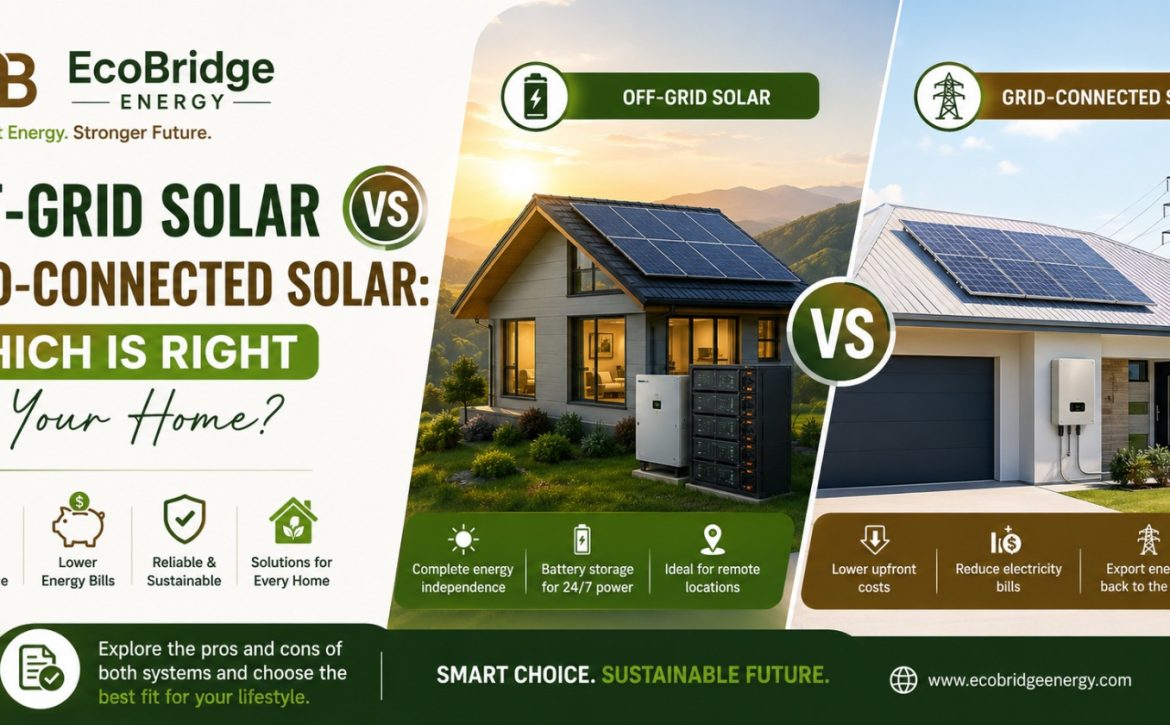
Off-Grid Solar vs Grid-Connected Solar: Which Is Right for Your Home?
Thinking about installing solar but unsure whether you should stay connected to the electricity grid or become completely energy independent?
Choosing between Off-Grid Solar vs Grid-Connected Solar depends on your location, energy consumption, budget, battery requirements and how much independence you want from the electricity grid.
For some homeowners, a grid-connected solar system with battery storage can provide excellent savings while keeping the grid available as a backup. For remote properties, farms and homes where grid access is limited or expensive, an off-grid solar system may be a better solution.
What Is Off-Grid Solar?
An off-grid solar system operates independently from the electricity grid.
A typical system includes:
- Solar panels
- Battery storage
- An off-grid or hybrid inverter
- Battery management equipment
- Backup generation where required
The solar panels generate electricity during the day, while batteries store excess energy for use at night or during periods of low solar production.
Because there is no grid available as a backup, the system needs to be carefully designed around your household’s electricity consumption.
What Is Grid-Connected Solar?
A grid-connected solar system remains connected to the electricity network.
Solar panels generate electricity during the day, and your home can use that energy directly. Excess electricity can be exported to the grid, depending on your electricity plan and local requirements.
Adding a battery can allow you to store surplus solar energy and use it later when your panels aren’t producing enough electricity.
This can provide a balance between energy savings, battery storage and grid reliability.
Off-Grid Solar vs Grid-Connected Solar:
- Feature Off-Grid Solar Grid-Connected Solar
- Electricity grid Not required Required
- Battery Essential Optional
- Energy independence Very high Moderate to high
- Backup during grid outage Built into system Depends on system design
- System complexity Higher Generally simpler
- Upfront investment Usually higher Usually lower
- Suitable for remote properties Excellent Depends on grid availability
- Generator backup Sometimes recommended Usually unnecessary
Which System Costs More?
An off-grid system generally requires more equipment because it needs enough solar generation and battery capacity to meet your electricity requirements without relying on the grid.
The cost can increase further if you need:
- Larger battery storage
- Additional solar panels
- High-capacity inverters
- Generator backup
- Special installation requirements
- Larger backup reserves for periods of poor weather
A grid-connected solar system can often be smaller because the electricity grid remains available when solar production isn’t enough.
However, the cheapest system isn’t necessarily the best system.
The right solution should be based on your actual electricity consumption and energy goals.
How Much Battery Storage Do You Need for Off-Grid Solar?
Battery sizing is one of the most important parts of an Off-Grid Solar vs Grid-Connected Solar .
A home using relatively little electricity may require a smaller battery bank, while a larger household running air conditioning, pumps, refrigeration, electric hot water or other high-consumption appliances may require significantly more storage.
You also need to consider how many hours or days of backup energy you want.
For example, designing a system only around average daily consumption may not provide enough energy during several cloudy days.
That’s why professional system design should consider:
Daily consumption + peak demand + solar production + battery capacity + backup requirements.
What Happens During Cloudy Weather?
This is one of the biggest considerations when going off-grid.
Solar production can fall significantly during periods of heavy cloud or poor weather. An off-grid system therefore needs enough battery storage and solar generation to maintain reliable power.
Some properties may also benefit from a backup generator.
A properly designed system should account for seasonal changes rather than relying only on average summer solar production.
Who Should Consider Off-Grid Solar?
Off-grid solar can be particularly attractive for:
- Rural properties
- Farms
- Remote homes
- Properties with limited grid access
- New developments where grid connection is expensive
- Homeowners seeking greater energy independence
- Properties where extending the electricity network isn’t practical
If your property already has a reliable and affordable grid connection, completely disconnecting from the grid may not always provide the best financial return.
Who Should Choose Grid-Connected Solar?
Grid-connected solar may be more suitable if:
- You already have a reliable grid connection
- You want to reduce electricity bills
- You don’t want to manage a completely independent energy system
- You want solar without a large battery investment
- You want the grid available during periods of low solar generation
You can also add battery storage later if your energy needs change.
What About Solar + Battery Instead of Going Completely Off-Grid?
For many homeowners, this can be the middle ground.
A grid-connected solar + battery system can provide significant energy independence while maintaining access to the electricity grid when required.
During the day, solar can power your home and charge the battery. At night, stored energy can be used instead of purchasing as much electricity from the grid.
Depending on the system and installation, battery backup can also provide power to selected loads during a grid outage.
So, Which One Is Right for You?
There isn’t one answer for every property.
Choose off-grid solar if your priority is maximum energy independence and your property is remote or unsuitable for a practical grid connection.
Choose grid-connected solar if your priority is reducing electricity costs while keeping the grid available as a reliable energy source.
Consider solar + battery if you want to reduce your reliance on the grid without completely disconnecting from it.
The most important step is understanding how much energy your property actually uses before deciding on system size.
Get a Solar & Battery System Designed for Your Property
Not sure whether off-grid, grid-connected or solar + battery makes the most sense for you?
Our team can assess your electricity usage, property requirements and energy goals to help determine the right system size and battery capacity.
Get your personalised solar assessment today.
Request a Free Solar & Battery Quote →
No two properties have the same energy requirements. Get a system designed around your consumption, your property and your energy goals rather than choosing a system based only on its advertised size.
Why Choose EcoBridge Australia?
EcoBridge Australia provides customised renewable energy solutions including solar panels, battery storage, and clean energy systems for homes and businesses. Their team helps homeowners assess their energy requirements and select a system designed for efficiency, reliability, and long-term value.
Contact EcoBridge Australia
EcoBridge Australia
Website: https://ecobridgeenergy.com/
Email:info@ecobridgeenergy.com
Frequently Asked Questions (FAQs)
1. Is off-grid solar better than grid-connected solar?
Neither option is better for every homeowner. Off-grid solar provides complete independence but requires a higher investment, while grid-connected solar is usually more affordable and suitable for most homes.
2. Can I install batteries with a grid-connected solar system?
Yes. Many homeowners add battery storage to grid-connected solar systems to store excess energy and use it at night or during outages.
3. Does off-grid solar work during cloudy weather?
Yes, but energy production is reduced during cloudy conditions. A correctly sized battery system helps maintain power availability.
4. How long do solar panels last?
Quality solar panels are generally designed to provide reliable performance for 25 years or more with proper installation and maintenance.
5. Is off-grid solar expensive?
Off-grid solar usually has a higher upfront cost because it requires batteries and additional equipment. However, it can save money in locations where grid connection costs are high.
6. Can solar batteries provide backup power during blackouts?
Yes, solar batteries with backup functionality can keep essential appliances running during power outages.
7. Which solar system is most common in Australia?
Grid-connected solar systems are the most common choice because they provide energy savings while maintaining access to the electricity grid.
8. How do I choose the right solar system size?
The ideal system size depends on your electricity usage, roof space, location, future energy plans, and whether you want battery storage.
