Category: NSW commercial battery

Read More

Solar + Battery for Retail Businesses in NSW: Reducing Electricity Costs Without Disrupting Operations

For retail businesses across New South Wales, electricity is an essential operating expense. From refrigeration and air conditioning to lighting, point-of-sale systems, security equipment and other electrical appliances, energy consumption can have a significant impact on monthly overheads.

With electricity costs remaining an important concern for Australian businesses, more NSW retailers are exploring commercial solar and battery storage as a way to generate and use more of their own electricity.

The right commercial solar and battery storage NSW can help a retail business reduce its reliance on grid electricity while making better use of available roof space.

However, every retail business is different. The right system depends on how much electricity you use, when you use it and how your property operates.

Why Retail Businesses Are Considering Solar

Unlike many residential properties, retail businesses often consume electricity throughout the day.

Lighting, refrigeration, air conditioning, computers, POS systems and other equipment may operate continuously during trading hours. This can make daytime solar generation particularly useful.

Instead of purchasing all of that electricity from the grid, a commercial solar system can generate electricity on-site and allow the business to use that energy as it is produced.

Depending on the system design and the business’s electricity usage, solar can help reduce the amount of electricity purchased from the grid.

Common retail electricity loads include:

  • Refrigeration and freezers
  • Air conditioning
  • Lighting
  • POS systems
  • Computers and IT equipment
  • Security systems
  • Hot water systems
  • Kitchen equipment
  • Display equipment
  • Warehouse equipment

The higher the electricity consumption, the more important it becomes to understand exactly when and how that energy is being used.

How Battery Storage Can Add Value

Solar panels generate electricity during daylight hours, but many retail businesses continue consuming electricity after solar production starts to fall.

This is where battery storage can become useful.

A commercial battery can store excess solar energy generated during the day and make that stored energy available later, depending on the system configuration and energy management strategy.

For example, a retailer may have strong solar production around midday but continue operating into the evening.

Instead of exporting surplus solar energy, a battery may allow some of that energy to be stored for later use.

This can help businesses increase their use of the electricity they generate themselves and potentially reduce their reliance on grid electricity outside peak solar production hours.

Solar + Battery for Retail Businesses: How It Works

A typical commercial solar and battery storage NSW works around three main components:

Solar panels → Inverter → Battery storage

During daylight hours, the solar panels generate electricity.

The business can use that electricity according to the system’s energy management configuration. If solar generation exceeds immediate consumption, surplus energy can potentially be stored in the battery.

Later, when solar generation decreases, stored energy can be used to supply the business.

The exact operation depends on the system design, battery capacity, electricity tariff, network requirements and energy management settings.

Which Retail Businesses Can Benefit From Commercial Solar?

Commercial solar and battery storage can be considered by a wide range of NSW retail businesses.

Supermarkets and Grocery Stores

Refrigeration, freezers, lighting and air conditioning can create significant electricity demand.

Solar generation can potentially offset some of this daytime consumption, while battery storage may provide additional flexibility.

Convenience Stores

Convenience stores often have extended operating hours, refrigeration and lighting requirements.

A properly designed solar and battery system can be assessed against the business’s daytime and evening consumption.

Cafés and Restaurants

Commercial kitchens, refrigeration, hot water, air conditioning and lighting can all contribute to energy costs.

Solar can help offset daytime consumption, while battery storage can be assessed where electricity demand continues into the evening.

Pharmacies

Pharmacies can have consistent electricity requirements from lighting, cooling, refrigeration and other equipment.

Retail Showrooms

Large showrooms can have substantial lighting and air-conditioning requirements, making energy consumption an important operating cost.

Retail Warehouses

Businesses with large warehouse roofs may have significant potential for commercial solar generation.

However, roof condition, structural considerations, shading and electrical infrastructure should all be assessed before installation.

How Much Solar Does a Retail Business Need?

There is no single solar system size that works for every retailer.

A small independent shop may require a completely different system from a supermarket, showroom or large warehouse.

The appropriate system size can depend on:

  • Annual electricity consumption
  • Electricity usage during daylight hours
  • Trading hours
  • Roof size and orientation
  • Available roof space
  • Shading
  • Electricity tariffs
  • Existing electrical infrastructure
  • Desired battery capacity
  • Future energy requirements

This is why a commercial energy assessment should be completed before deciding on a system.

The objective isn’t simply to install as many solar panels as possible.

The objective is to design a system around the business’s actual electricity requirements.

Can Solar Be Installed Without Disrupting Retail Operations?

For many retailers, one of the biggest concerns is disruption.

A shop, supermarket, café or showroom cannot simply stop trading for an extended period while an energy project is completed.

Commercial solar installations can therefore be planned around the property’s operating requirements.

Before installation, the site can be assessed for:

  • Solar panel locations
  • Inverter placement
  • Battery location
  • Switchboard condition
  • Cable routes
  • Metering requirements
  • Site access
  • Roof access
  • Electrical infrastructure
  • Installation requirements

Understanding these factors beforehand allows the installation to be planned more effectively.

For larger commercial properties, additional electrical work may also need to be considered.

Commercial Battery Storage and Peak Electricity Usage

Electricity costs aren’t determined solely by how much electricity a business uses.

Depending on the business’s tariff and connection arrangement, when electricity is consumed can also be important.

A battery can provide the ability to shift some stored energy to periods when solar generation is lower.

However, battery economics vary from site to site.

The best approach is to examine the business’s actual electricity bills and consumption profile before recommending a battery size.

How Much Can a Retail Business Save With Solar?

There is no universal savings figure for commercial solar.

A retailer’s potential savings can depend on:

  • Current electricity rates
  • Annual consumption
  • Daytime electricity usage
  • Solar system size
  • Battery capacity
  • Solar self-consumption
  • Export arrangements
  • Business operating hours
  • Future electricity requirements

For this reason, generic claims such as “solar will cut your electricity bill by X%” may not accurately represent what a particular business could achieve.

A better approach is to assess the business using its actual electricity data.

What Should a Business Provide for an Energy Assessment?

Getting started can be straightforward.

A commercial energy assessment may begin with:

1. A Recent Electricity Bill

This provides important information about the property’s electricity consumption and tariff.

2. Switchboard Photos

Photos can help identify the existing electrical infrastructure and potential upgrade requirements.

3. Meter Box Photos

Metering arrangements can be important when assessing a commercial solar project.

4. Property Information

Roof size, access, operating hours and business requirements can help determine an appropriate system design.

Once this information is reviewed, an energy assessor can determine whether solar, battery storage or a combination of both is worth exploring.

Is Solar + Battery Right for Your NSW Retail Business?

There is no one-size-fits-all answer.

For a business with significant daytime electricity consumption, commercial solar may provide an opportunity to generate electricity on-site.

For a business that continues using substantial electricity later in the day, battery storage may also be worth assessing.

The key is to understand your actual energy consumption before investing in a system.

A properly designed solar and battery system should work around your business operations rather than forcing your business to change how it operates.

Book a Complimentary Commercial Energy Assessment

If you operate a retail business anywhere in NSW and want to understand whether solar and battery storage could help reduce your electricity costs, start with a complimentary commercial energy assessment.

Our energy assessor can review your electricity usage, bills, property and existing electrical infrastructure to identify potential opportunities for commercial solar and battery storage.

You don’t need to know how many panels you need or what size battery to buy.

We’ll assess your energy requirements first and then discuss the options that may suit your business.

Ready to Explore Solar for Your Business?

Book your complimentary commercial energy assessment today.

Simply provide your latest electricity bill, along with photos of your switchboard and meter box, and we can start assessing your property’s solar and battery potential.

Reduce grid reliance. Take control of your energy. Power your business with smarter energy.

Contact EcoBridge

Ready to explore commercial solar and battery options for your retail business?

EcoBridge helps Australian businesses assess their energy requirements, explore commercial solar and battery solutions, and connect with suitable energy providers.

EcoBridge Australia


Email: info@ecobridgeenergy.com
Website: https://ecobridgeenergy.com/

EcoBridge provides energy solutions and assessment services across New South Wales, including Sydney, Newcastle, Wollongong, the Central Coast, Western Sydney and regional NSW.

Frequently Asked Questions

1. Is commercial solar suitable for retail businesses in NSW?

Commercial solar can be suitable for many retail businesses, particularly those with significant daytime electricity consumption and suitable roof space. The potential benefits depend on factors such as electricity usage, operating hours, tariffs, roof space and the property’s electrical infrastructure.

2. Can a retail business install solar and a battery together?

Yes. Solar panels and battery storage can be designed as an integrated system, subject to the property’s electrical infrastructure, network requirements, available space and the business’s energy requirements.

3. How does solar help reduce electricity costs for a retail business?

Solar generates electricity on-site that a business can use to meet some of its electricity demand. This can reduce the amount of electricity that needs to be purchased from the grid. The actual savings depend on the system size, electricity consumption, tariff, solar generation and how much solar energy the business uses.

4. Does a retail business need a battery if it has solar?

Not necessarily. A battery may be useful when a business continues to consume significant electricity after solar production decreases. Whether a battery is worthwhile depends on the business’s electricity consumption profile, tariff structure, solar system and energy objectives.

5. What size solar system does a retail business need?

There is no standard system size for every retailer. The appropriate size can depend on annual electricity consumption, daytime usage, trading hours, roof space, shading, electrical infrastructure, tariffs and future energy requirements.

6. What size commercial battery does a retail business need?

Battery capacity should be determined using the business’s actual electricity consumption and operating profile. Factors such as peak demand, solar generation, trading hours, tariff structure and the amount of energy the business wants to shift from daytime to later periods can all influence battery sizing.

7. Will installing solar disrupt my retail business?

Solar projects can be planned around a business’s operating requirements. Before installation, the site can be assessed for roof access, panel locations, inverter and battery placement, switchboard condition, cable routes and other installation requirements. Planning these details in advance can help minimise disruption.

8. What information does EcoBridge need for a commercial solar assessment?

A recent electricity bill is a useful starting point. Depending on the project, businesses may also provide electricity usage or interval data, property information, roof photos, switchboard photos, meter photos, existing solar information and details about the proposed battery location.

9. Can EcoBridge help businesses compare commercial solar and battery options?

Yes. EcoBridge describes itself as an independent energy solutions and comparison platform that helps Australian businesses understand commercial solar, battery, PPA, finance and other energy options and, where appropriate, connect with suitable accredited providers.

10. Can a business explore a PPA instead of purchasing a solar system?

Yes. A Power Purchase Agreement (PPA) can be one of the commercial energy structures businesses may explore. The suitability of a PPA depends on the property’s circumstances, energy consumption, contract terms and financial objectives.
Read More

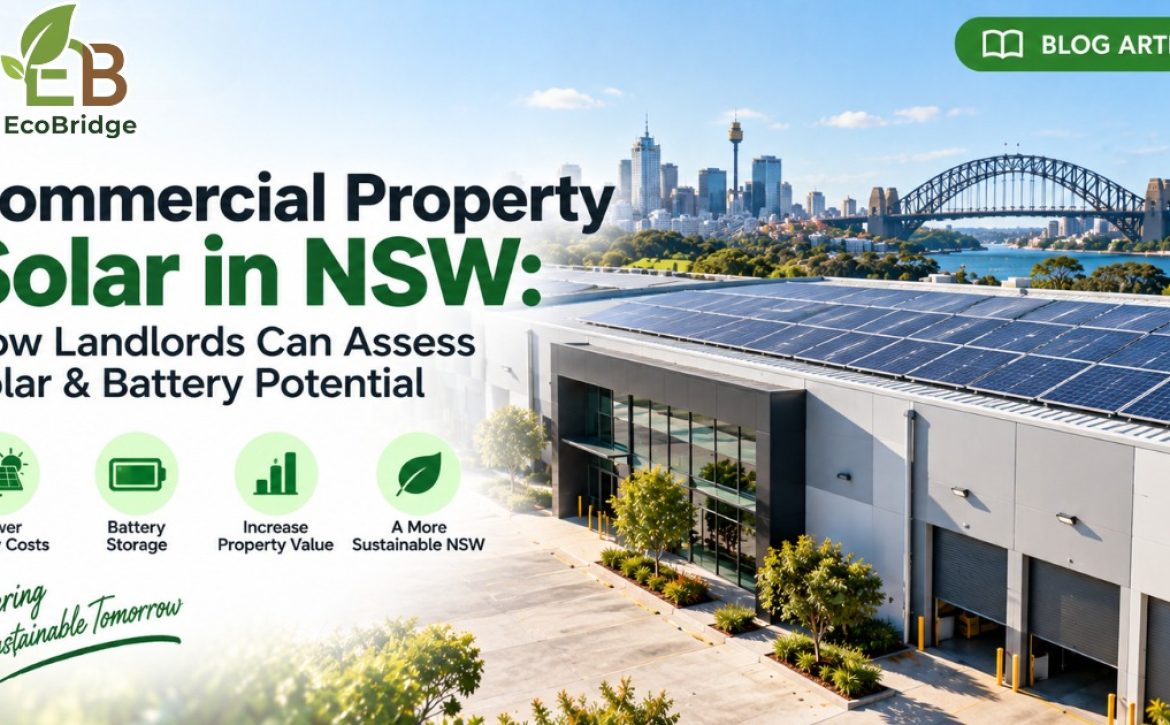
Commercial Property Solar in NSW: How Landlords Can Assess Solar & Battery Potential

As electricity prices continue to rise across New South Wales, commercial property owners are increasingly looking at solar panels and battery storage as a long-term investment. For landlords, installing solar on commercial buildings is no longer just a sustainability initiative—it can improve property value, attract quality tenants, reduce operating costs in common areas, and create new revenue opportunities.

However, not every commercial property is suitable for the same solar and battery solution. Before investing, landlords should assess the building’s energy usage, roof suitability, electrical infrastructure, and financial returns.

This guide explains how NSW commercial landlords can evaluate the solar and battery potential of their properties and make informed energy decisions.

Why Commercial Landlords in NSW Are Investing in Solar

Commercial solar adoption is growing across NSW because many commercial properties use significant electricity during daylight hours—the same time solar panels generate the most energy. Solar can help reduce reliance on grid electricity while improving the property’s environmental credentials. Commercial landlords are increasingly exploring solar and battery solutions to reduce electricity costs, improve energy resilience, and increase control over energy consumption.

Benefits of Solar for Commercial Property Owners
  • Lower electricity costs for shared building services.
  • Increased property value and tenant appeal.
  • Reduced exposure to rising electricity prices.
  • Better sustainability and ESG performance.
  • Potential eligibility for available commercial solar incentives.
  • Opportunity to integrate battery storage for greater energy flexibility.

Whether you own an office building, warehouse, retail centre, industrial facility, or mixed-use commercial property, a properly designed solar system can support long-term operating savings.

Step 1: Assess Your Commercial Roof Space

The roof is one of the most valuable assets for a commercial solar installation.

Frenchs Forest NSW 2086 - Office(s) For Lease by One Commercial Northern Sydney
BORG - Locations

Sorry, this page cannot be found.

What to Check
Roof Assessment FactorWhy It Matters
Available roof areaDetermines how many solar panels can be installed.
Roof orientationNorth-facing roofs generally maximise solar generation in NSW, although east and west roofs can also perform well depending on energy demand.
Roof pitchInfluences solar panel efficiency and mounting design.
ShadingTrees, neighbouring buildings, HVAC equipment, and signage can reduce energy production.
Roof conditionAn older roof may require repairs before solar installation.
Roof materialMetal, Colorbond, concrete tile, and membrane roofs each require different mounting systems.
Roof Suitability Checklist
  • Large unobstructed roof sections.
  • Minimal daytime shading.
  • Structurally suitable roof.
  • Enough clearance around equipment and access pathways.
  • Remaining roof lifespan aligns with solar panel lifespan.

Step 2: Understand the Building’s Electricity Usage

The best commercial solar system starts with electricity data—not roof size alone. A professional assessment should consider the property’s actual consumption profile, operating hours, tariffs, and future electricity needs.

Collect Recent Electricity Bills

A recent electricity bill helps identify:

  • Total electricity consumption.
  • Peak demand charges.
  • Time-of-use tariffs.
  • Daily usage patterns.
  • Meter type.
  • Network charges.
Questions Landlords Should Ask
  • Who pays the electricity bill?
  • Is electricity separately metered for tenants?
  • Are common areas landlord-funded?
  • Are there multiple tenancies?
  • Are operating hours mostly during the day?

Understanding these answers helps determine how much solar energy can be consumed on-site versus exported.

Step 3: Evaluate Tenant Energy Consumption

Different tenants consume electricity differently.

Commercial Tenant TypeTypical Daytime Solar Usage
Office buildingsHigh weekday daytime consumption.
Retail storesStrong daytime usage during trading hours.
WarehousesOften consistent daytime operational loads.
Industrial facilitiesCan have large daytime equipment loads.
Medical centresLong daytime operating hours.
Shopping centresShared common area loads plus tenant usage.

The closer solar production matches daytime electricity demand, the greater the potential financial benefit.

Step 4: Check Electrical Infrastructure

Metering Services | Electric & Energy Meter Installations in Sydney
Switchboard Electrician Inner West Sydney | Westcork Electrical

Solar Battery Storage: Energy Independence

Commercial solar may require assessment of existing electrical infrastructure.

Key Items to Review
  • Main switchboard capacity.
  • Metering configuration.
  • Distribution boards.
  • Existing solar system compatibility.
  • Grid connection requirements.
  • Available inverter location.
  • Cable pathways.
  • Fire and safety compliance.

Older buildings may need electrical upgrades before installing a larger solar system.

Step 5: Determine the Right Solar System Size

There is no universal best commercial solar size.

System capacity depends on:

  • Annual electricity consumption.
  • Daytime load.
  • Roof size.
  • Budget.
  • Export limits.
  • Future expansion plans.
  • Battery integration.
Typical Commercial Solar Sizes
Property TypeIndicative Solar Range
Small office20–30 kW
Retail building30–60 kW
Warehouse50–150 kW
Industrial facility100–500+ kW
Shopping centre100 kW to multi-megawatt

A professional assessment should size the system around energy consumption rather than installing the maximum number of panels.

Step 6: Assess Whether Battery Storage Makes Sense

Solar panels generate electricity during the day.

A commercial battery stores excess solar energy for later use.

Is Commercial Battery Storage Worth it in NSW? ⚡2025
Ess Renewable Energy Solar/Wind All in One System 215kwh Integrated Cabinet for Commercial Power - Energy Storage Battery and Solar Energy Storage Battery

JMHPower | 200 kWh Commercial Solar Batteries | Solar Storage System Datasheet | ENF Storage System Directory

Battery Storage Can Help With
  • Evening electricity use.
  • Peak demand reduction.
  • Time-of-use tariff optimisation.
  • Backup power for selected circuits.
  • Greater solar self-consumption.
  • Energy resilience during outages.

Factors

FactorImportance
Daytime solar surplusDetermines charging potential.
Evening electricity demandDetermines battery usage.
Peak demand chargesMay improve battery value.
Battery capacity (kWh)Should match property load profile.
Power output (kW)Determines how much load battery can support.
Backup requirementsOptional feature depending on business needs.

Battery storage should be designed around the property’s actual electricity profile rather than selecting the largest battery available.

Step 7: Review NSW Solar Incentives and Financing Options

Commercial landlords should understand available financial pathways before investing.

Possible Options Include
  • Small-scale Technology Certificates (STCs) for eligible systems.
  • Large-scale Generation Certificates (LGCs) for qualifying projects.
  • Commercial battery incentive programs where applicable.
  • Power Purchase Agreements (PPAs).
  • Equipment finance.
  • Operating leases.
  • Outright purchase.

The most suitable option depends on property ownership, electricity usage, and investment objectives. EcoBridge helps businesses compare commercial solar, battery, and PPA options across Australia.+1

Step 8: Calculate Potential ROI

Commercial solar is a long-term investment.

Factors That Affect ROI
  • Electricity prices.
  • Solar system size.
  • Battery inclusion.
  • Daytime self-consumption.
  • Export tariffs.
  • Installation complexity.
  • Maintenance costs.
  • Financing structure.

Typical Financial Assessment Includes

Assessment ItemPurpose
Annual electricity savingsEstimate reduced grid consumption.
Solar generation forecastEstimate yearly production.
Battery savings analysisEvaluate load shifting benefits.
Payback estimateUnderstand investment timeframe.
Cash flow projectionReview long-term savings potential.

Step 9: Consider Future Energy Needs

Solar systems should be designed with future expansion in mind.

Future-Proof Your Commercial Property

Think about future additions such as:

  • EV charging stations.
  • Heat pumps.
  • Additional tenancy.
  • Building extensions.
  • Battery expansion.
  • Increased operating hours.

Planning ahead can reduce future upgrade costs.

Common Commercial Properties Suitable for Solar in NSW

Commercial solar is suitable across many industries.

Property TypeSolar Potential
Office buildingsExcellent
WarehousesExcellent
FactoriesExcellent
Retail centresHigh
Medical centresHigh
SchoolsHigh
HotelsHigh
Agricultural propertiesHigh
Mixed-use commercial buildingsHigh

Each property requires an individual assessment of energy usage, roof space, and electrical infrastructure.

A Commercial Solar Assessment Checklist for NSW Landlords

Before requesting quotes, gather:

  • Last 12 months of electricity bills.
  • Property address.
  • Roof photos.
  • Switchboard photo.
  • Meter box photo.
  • Roof dimensions (if available).
  • Information about tenants and operating hours.
  • Details of any existing solar system.
  • Interest in battery storage or finance options.

Providing this information helps create a more accurate commercial solar assessment.

Why Choose EcoBridge Australia?

EcoBridge provides guidance on commercial solar systems, battery storage, PPAs, financing pathways, and energy solutions tailored to Australian commercial properties.

EcoBridge Can Help You Assess
  • Commercial roof suitability.
  • Solar system sizing.
  • Battery storage potential.
  • Electricity bill analysis.
  • PPA and finance options.
  • NSW commercial solar opportunities.
  • Expansion of existing commercial solar systems.

Whether you’re managing a single commercial property or a multi-site portfolio across NSW, EcoBridge can help you evaluate suitable renewable energy options.

Contact EcoBridge Australia

Get a Free Commercial Solar & Battery Assessment

EcoBridge Australia helps businesses and commercial property owners explore smarter solar and battery solutions across New South Wales and Australia.

Website : https://ecobridgeenergy.com/

Email : info@ecobridgeenergy.com

Service Areas

New South Wales (NSW), Victoria (VIC), Queensland (QLD), South Australia (SA), Tasmania (TAS), and Western Australia (WA).

Frequently Asked Questions (FAQs)

1. Can landlords install solar on a commercial property with tenants?

Yes. Commercial landlords can install solar on tenanted properties, but the structure depends on lease arrangements, metering configuration, and who pays for electricity. Shared-area solar, tenant-funded arrangements, or PPAs may all be possible depending on the property setup.

2. How do I know if my commercial property is suitable for solar?

A commercial solar assessment typically reviews roof space, orientation, shading, structural condition, electricity bills, switchboard capacity, and tenant energy usage to determine suitability.

3. Is battery storage necessary for a commercial solar system?

Not always. Battery storage is most valuable when a property has excess daytime solar generation, evening electricity usage, peak demand charges, or a need for backup power and energy resilience.

4. How much roof space does a commercial solar system need?

The required roof space depends on the system size and panel efficiency. Larger commercial systems require more usable roof area, but the final design depends on energy consumption and site layout rather than roof size alone.

5. Can an existing commercial solar system be expanded?

In many cases, yes. Existing systems can often be expanded if the roof, inverter capacity, switchboard, and network connection allow it. A technical assessment is recommended before adding new panels or batteries.

6. What information should I provide for a commercial solar assessment?

Providing recent electricity bills, roof photos, switchboard and meter box photos, property address, operating hours, and details of existing solar systems helps create a more accurate assessment.

7. What is a Power Purchase Agreement (PPA) for commercial solar?

A PPA is a financing arrangement where a provider installs and maintains the solar system while the business purchases the electricity it generates, often without paying the upfront system cost.

8. How long do commercial solar panels and batteries last?

Commercial solar panels commonly come with long performance warranties, while battery lifespan depends on technology, usage cycles, warranty terms, and operating conditions.

9. Can solar help increase the value of a commercial property?

Many commercial property owners consider solar an investment that can improve building efficiency, reduce operating costs, and support sustainability goals, which may enhance the property’s appeal to prospective tenants and buyers.

10. How can EcoBridge help commercial landlords in NSW?

EcoBridge helps landlords assess solar and battery potential, review electricity usage, compare system options, explore finance or PPA pathways, and identify suitable commercial energy solutions for NSW properties.

Read More

GoodWe 100kWh Commercial Battery Storage in NSW: Maximise Solar & Reduce Grid Reliance

For businesses across New South Wales, installing commercial solar is a major step towards reducing electricity costs. But without battery storage, much of the excess solar energy generated during the day is often exported to the grid instead of being used when your business needs it most.

The GoodWe BAT-C 100kWh commercial battery is designed to solve that problem.

Paired with the GoodWe ET 50kW Commercial Hybrid Inverter, it provides a reliable, scalable energy storage solution that helps businesses store excess solar power, reduce grid dependence, and better manage electricity usage throughout the day.

Whether you operate a warehouse, factory, office, retail store, farm, school, or hospitality venue, a GoodWe 100kWh Commercial Battery Storage in NSW can help you get more value from your solar investment.

Why NSW Businesses Are Investing in 100kWh Battery Storage

Many commercial properties generate plenty of solar energy during daylight hours, but their peak electricity usage often happens in the late afternoon, evening, or during periods of high demand.

A 100kWh battery bridges that gap.

How it works:

Solar Panels → GoodWe Battery → Your Business

Instead of exporting surplus solar energy for a relatively low feed-in tariff, your business stores that energy and uses it later when solar production drops or electricity prices increase.

Key benefits include:
  • Increased solar self-consumption.
  • Reduced reliance on expensive grid electricity.
  • Better management of peak electricity demand.
  • Lower operating energy costs.
  • Improved energy resilience during outages (when configured for backup).

GoodWe 100kWh Commercial Battery Storage in NSW Overview

The GoodWe BAT-C Series is purpose-built for commercial and industrial energy storage applications—not simply an oversized residential battery.

System Highlights
FeatureGoodWe BAT-C 100kWh
Nominal Capacity102.4kWh
Usable CapacityApproximately 100kWh
Battery ChemistryLiFePO₄ (Lithium Iron Phosphate)
Battery VoltageHigh-voltage commercial system
Protection RatingIP55-rated cabinet
Expansion CapabilityUp to approximately 450kWh with multiple battery cabinets

The BAT-C range includes battery capacities from approximately 60kWh to over 110kWh, making it suitable for businesses with different energy requirements.

Built for Commercial & Industrial Applications

The GoodWe BAT-C is ideal for businesses with significant daily electricity consumption and medium-to-large solar systems.

Suitable applications include:
  • Warehouses and logistics centres.
  • Manufacturing facilities.
  • Commercial offices.
  • Retail stores and shopping centres.
  • Workshops and trade businesses.
  • Farms and agricultural operations.
  • Hotels, cafés, and hospitality venues.
  • Schools, childcare centres, and community facilities.

If your business uses large amounts of electricity during business hours or into the evening, commercial battery storage can significantly improve how your solar system performs.

Safe, Reliable LiFePO₄ Battery Technology

Safety is critical in commercial battery installations.

The GoodWe BAT-C uses LiFePO₄ (Lithium Iron Phosphate) battery chemistry, known for its stability, long cycle life, and suitability for stationary energy storage systems.

Commercial safety features include:
  • Pack-level humidity monitoring.
  • Automatic dehumidification system.
  • Aerosol fire suppression at both battery pack and cabinet levels.
  • Intelligent thermal management.
  • IP55 weather-resistant enclosure for suitable outdoor commercial installations.

These features are designed to support reliable operation in commercial environments.

Pair the BAT-C Battery with the GoodWe ET 50kW Hybrid Inverter

A popular commercial configuration combines the GoodWe 100kWh Commercial Battery Storage in NSW with the GoodWe ET 50kW three-phase hybrid inverter.

Why this combination works
ComponentSpecification
Hybrid Inverter Output50kW AC (Three Phase)
Battery StorageApproximately 100kWh usable
Battery Voltage Range200V–800V
ApplicationCommercial & Industrial Solar + Storage

A 50kW inverter determines how much power can be delivered at one time, while the 100kWh battery determines how much energy can be stored and used later.

This balance suits many NSW commercial sites with substantial daytime solar production.

Reduce Electricity Costs with Peak Shaving & Load Management

Commercial battery storage offers more than just solar storage.

The GoodWe ET platform supports several energy management strategies that can help businesses reduce electricity costs.

Potential applications include:
  • Solar self-consumption.
  • Peak shaving during high-demand periods.
  • Time-of-use energy shifting.
  • Grid support where applicable.
  • Backup power for selected loads (depending on system design).

Businesses on time-of-use tariffs or demand-based electricity pricing may benefit from using stored energy during expensive periods instead of importing electricity from the grid.

Scalable Battery Storage for Growing Businesses

Your energy needs today may not be the same in five years.

The GoodWe BAT-C platform supports expansion by connecting multiple battery cabinets together.

Expansion options
  • Start with approximately 100kWh usable storage.
  • Expand up to approximately 450kWh total capacity (depending on system design and GoodWe specifications).
  • Suitable for growing businesses, additional solar capacity, EV charging, or future operational expansion.

This modular approach allows businesses to invest in battery storage progressively.

Is a 100kWh Battery the Right Size for Your Business?

The best battery size depends on your business—not just the biggest battery available.

A commercial battery assessment should consider:

  • Annual electricity consumption.
  • Interval or half-hourly energy usage data.
  • Existing solar system size.
  • Daytime versus evening energy demand.
  • Electricity tariff structure.
  • Demand charges (where applicable).
  • Solar export limits.
  • Switchboard capacity.
  • Backup power requirements.
  • Future business growth.

A business with high evening electricity usage and limited export value may see strong benefits from a 100kWh battery, while another business may achieve better returns with a smaller or larger system.

The goal is to size the battery around actual energy usage patterns.

Why Choose EcoBridge for Commercial Battery Storage in NSW?

At EcoBridge Solar, we design commercial solar and battery storage systems based on real energy data—not guesswork.

Our commercial energy assessment includes:
  • Electricity bill analysis.
  • Interval usage review.
  • Solar generation assessment.
  • Battery sizing recommendations.
  • ROI and payback analysis.
  • Commercial installation advice tailored to NSW businesses.

We help businesses maximise the value of their solar investment while planning for future energy needs.

Contact EcoBridge Solar

EcoBridge Solar

Commercial Solar & Battery Storage Specialists – NSW

Email : info@ecobridgeenergy.com

Website : https://ecobridgeenergy.com/

Service Area

New South Wales – Commercial Solar, Battery Storage & Energy Solutions

Frequently Asked Questions (FAQs)

1. How much energy can a GoodWe 100kWh battery store?

The GoodWe BAT-C has a 102.4kWh nominal capacity with approximately 100kWh of usable energy. This stored energy can be used when solar production is low or during periods of higher electricity demand.

2. Is the GoodWe 100kWh battery suitable for commercial businesses?

Yes. The BAT-C Series is specifically designed for commercial and industrial (C&I) applications, including warehouses, factories, offices, retail businesses, farms, schools, and hospitality venues.

3. Can the battery be installed with an existing commercial solar system?

In many cases, yes. Compatibility depends on your existing solar system, inverter setup, switchboard configuration, and site design. A commercial assessment is recommended before installation.

4. What inverter works with the GoodWe BAT-C battery?

The battery is commonly paired with the GoodWe ET 40kW or 50kW three-phase commercial hybrid inverter, which is designed to integrate solar generation and battery storage into one commercial energy system.

5. Does a 100kWh battery provide backup power?

It can, depending on how the system is designed and configured. Backup capability is an optional design consideration and may support selected essential loads during grid outages.

6. Can the GoodWe BAT-C battery help reduce electricity bills?

Yes. By storing excess solar energy and using it during periods of higher electricity prices or reduced solar generation, businesses can increase self-consumption and reduce grid electricity imports.

7. What is peak shaving?

Peak shaving is the process of using battery energy during periods of high electricity demand to reduce grid consumption. This can help businesses manage electricity costs, particularly where demand charges or time-of-use tariffs apply.

8. Is the GoodWe BAT-C battery safe?

The BAT-C uses LiFePO₄ battery chemistry and includes commercial safety features such as humidity monitoring, automatic dehumidification, thermal management, aerosol fire suppression, and an IP55-rated enclosure.

9. Can the battery system be expanded later?

Yes. The GoodWe BAT-C platform supports multiple battery cabinets connected in parallel, allowing systems to expand to approximately 450kWh of storage capacity, depending on the project design.

10. How do I know if a 100kWh battery is the right size for my business?

The correct battery size depends on your electricity usage profile, solar generation, tariff structure, export limits, and future energy needs. EcoBridge Solar can assess your energy data and recommend the most suitable battery capacity for your business.

Ready to Maximise Your Commercial Solar Investment?

If your NSW business is considering a GoodWe 100kWh commercial battery, EcoBridge Solar can assess your electricity usage, solar production, and tariff structure to recommend the right battery storage solution for maximum savings and long-term performance.

Contact EcoBridge Solar today for a commercial solar and battery storage assessment across New South Wales.