Read More

Solar Farm & Battery Storage in Regional NSW: Opportunities for Landowners and Developers

Regional New South Wales is playing an increasingly important role in Australia’s renewable energy transition. With strong solar resources, large areas of rural land and significant investment in electricity infrastructure, the region is attracting solar farms, battery energy storage systems (BESS) and combined solar-plus-battery projects.

For rural landowners, renewable energy development may provide an opportunity to generate long-term income from suitable land. For developers, regional NSW offers opportunities to develop large-scale generation and storage projects in areas connected to existing or planned electricity infrastructure.

However, having a large rural property does not automatically make it suitable for a solar farm or battery project.

Land availability, grid connection, planning requirements, environmental constraints, access, surrounding land uses and project economics all need to be assessed before a project can proceed.

This guide explains the key considerations for landowners and developers exploring solar farm and battery storage opportunities across regional NSW.

What Is a Solar Farm With Battery Storage?

A solar farm uses photovoltaic (PV) panels to convert sunlight into electricity. A battery energy storage system can be installed alongside the solar generation facility to store electricity and discharge it when required.

A utility-scale solar and battery project may include:

  • Solar photovoltaic panels
  • Battery energy storage units
  • Inverters and power conversion systems
  • Transformers
  • Substations
  • Switchgear and electrical infrastructure
  • Grid connection equipment
  • Monitoring and control systems
  • Internal access roads
  • Security infrastructure
  • Fire detection and protection systems

The size and configuration of a project will depend on the available land, proposed generation capacity, battery capacity, grid connection requirements, environmental constraints and development objectives.

Projects can range from relatively small installations to major utility-scale renewable energy developments.

Why Regional NSW Is Attracting Solar and Battery Projects

Regional NSW offers many of the characteristics required for large-scale renewable energy development.

Large rural properties can provide space for solar generation, batteries and associated infrastructure. At the same time, existing and planned transmission infrastructure can create opportunities for connecting new generation and storage to the electricity network.

NSW also has several Renewable Energy Zones (REZs), which are intended to coordinate renewable generation, energy storage and transmission infrastructure.

For landowners, a property’s location can therefore be an important factor when assessing its renewable energy potential.

However, being located inside or near a REZ does not guarantee that a property is suitable for development. Each site must still be assessed for technical, environmental, planning, grid and commercial constraints.

Could Your Land Be Suitable for a Solar Farm?

One of the first questions many rural landowners ask is:

Could my property be used for a solar farm or battery project?

The answer depends on much more than the total size of the property.

A preliminary site assessment may consider the following.

Land Size and Usable Area

Large-scale solar projects generally require substantial areas of land. However, the total property area is not necessarily the area available for development.

Waterways, vegetation, environmental constraints, setbacks, existing infrastructure, terrain, drainage and access requirements can all reduce the usable development area.

Solar Resource

Solar exposure is an important consideration because it influences potential electricity generation.

Many parts of regional NSW have favourable solar resources, but solar conditions are only one component of a complete feasibility assessment.

Grid Connection

Access to the electricity network is one of the most important considerations for a utility-scale project.

A property may have excellent solar conditions and extensive available land but still face significant development challenges if there is no practical connection pathway.

Potential considerations include:

  • Nearby substations
  • Transmission and distribution infrastructure
  • Network capacity
  • Connection requirements
  • Required network upgrades
  • Proposed solar capacity
  • Proposed battery capacity

Grid connection should therefore be investigated as early as possible.

Road and Site Access

Construction and ongoing operation require suitable access for heavy vehicles, equipment and maintenance crews.

Existing roads, property entrances, local road conditions and the ability to transport large equipment to the site may all influence feasibility.

Terrain

Terrain can influence construction costs, site layout, drainage and engineering requirements.

Relatively suitable terrain may simplify development, although engineering solutions can accommodate a range of site conditions.

Why Add Battery Storage to a Solar Farm?

Solar generation is naturally concentrated during daylight hours. Battery storage provides a way to store electricity and discharge it at another time.

This can give a renewable energy project greater operational flexibility.

Depending on its configuration and commercial arrangements, battery storage may be used for purposes including:

  • Storing excess solar generation
  • Shifting energy availability to different periods
  • Supporting electricity supply
  • Participating in electricity markets
  • Providing certain grid services
  • Supporting the integration of renewable generation

Adding a battery does not automatically make a project financially viable.

Project economics can depend on battery size and duration, equipment costs, grid connection, financing, market conditions, operating strategy and commercial arrangements.

What Is a Utility-Scale Battery Energy Storage System?

A utility-scale Battery Energy Storage System, commonly known as a BESS, is significantly larger and more complex than a residential battery.

A large BESS may include:

  • Battery storage units
  • Battery management systems
  • Power conversion systems
  • Transformers
  • Switchgear
  • Cooling and thermal management systems
  • Fire detection and protection systems
  • Control and communications systems
  • Access roads
  • Security infrastructure

Battery projects are commonly described using MW and MWh.

What Does MW Mean?

MW refers to the battery’s power capacity.

For example, a 100 MW battery may be capable of discharging up to 100 MW at a given time, subject to its design and operating conditions.

What Does MWh Mean?

MWh refers to the amount of energy the battery can store.

For example, a 100 MW / 200 MWh battery has a 100 MW power capacity and 200 MWh of storage capacity.

The relationship between MW and MWh determines the battery’s potential operating duration at a particular output.

Solar Farm vs Solar Farm + Battery Storage

Whether battery storage should be included in a solar project depends on the technical and commercial characteristics of the site.

Solar FarmSolar Farm + Battery
Solar generationSolar generation
No large-scale batteryBattery energy storage
Primarily generates during daylightCan store and discharge electricity
Simpler project configurationMore complex infrastructure
Solar inverter infrastructureSolar and battery power conversion infrastructure
Grid connection requiredGrid connection required
Economics depend on solar generationEconomics depend on generation and storage strategy

There is no universal project configuration that applies to every site. The appropriate approach should be determined through project-specific technical and commercial analysis.

Renewable Energy Zones in NSW

Renewable Energy Zones are an important part of the NSW energy infrastructure strategy. They are intended to coordinate renewable generation, energy storage and transmission infrastructure.

NSW REZs include areas such as:

  • Central-West Orana
  • New England
  • Hunter-Central Coast
  • Illawarra
  • South West

For landowners, proximity to a REZ and associated transmission infrastructure may be relevant when assessing renewable energy potential.

However, REZ location alone does not determine whether a particular property can host a project. The site must still satisfy applicable technical, environmental, planning, grid and commercial requirements.

What Makes a Property Attractive for Solar Farm Development?

There is no single checklist that guarantees a property will be selected by a developer.

However, developers may investigate properties based on factors such as:

Large Usable Land Area

A larger usable development area can provide greater flexibility for project design.

Strong Solar Resource

Good solar conditions can support renewable electricity generation.

Suitable Grid Infrastructure

Access to appropriate electricity infrastructure can be critical to project feasibility.

Suitable Land Characteristics

Terrain, drainage, vegetation, waterways, soil and other site characteristics can affect project design and cost.

Good Road Access

Construction and maintenance activities require reliable access for vehicles and equipment.

Surrounding Land Uses

Nearby residences, agricultural activities, environmental areas and other land uses can influence project design and planning requirements.

Strategic Location

Proximity to existing or planned renewable energy and transmission infrastructure may be relevant when assessing a site’s development potential.

How Much Land Is Needed for a Solar Farm?

There is no universal acreage requirement for a solar farm.

Land requirements can vary depending on:

  • Solar generation capacity
  • Panel technology
  • Site layout
  • Terrain
  • Battery storage
  • Electrical infrastructure
  • Setbacks
  • Environmental constraints
  • Internal roads
  • Drainage
  • Existing infrastructure

A 10 MW project can have very different land requirements from a 100 MW or 500 MW project.

More importantly, developers need to consider the usable development area, rather than simply the total property size.

For example, owning 500 hectares does not necessarily mean that all 500 hectares can be used for renewable energy infrastructure.

Can Agricultural Land Be Used for Solar Farms?

Some rural properties may be suitable for renewable energy development while other parts of the property continue to support agricultural activities.

The relationship between renewable energy infrastructure and agriculture needs to be assessed on a site-by-site basis.

Important considerations may include:

  • Existing farming operations
  • Grazing
  • Cropping
  • Soil characteristics
  • Water infrastructure
  • Farm access
  • Livestock management
  • Agricultural productivity
  • Proposed solar layout

Before entering a long-term agreement, landowners should understand how the proposed development could affect existing and future agricultural operations.

What Does a Solar Farm Lease Mean for a Landowner?

Renewable energy projects can involve long-term leases, options, easements and other property agreements.

Depending on the project, an agreement may address:

  • Development rights
  • Access rights
  • Construction areas
  • Operational areas
  • Easements
  • Infrastructure locations
  • Lease terms
  • Extension options
  • Decommissioning
  • Land rehabilitation or restoration

Commercial terms can vary significantly between projects.

Landowners should obtain independent legal and financial advice before signing a long-term renewable energy agreement.

It is particularly important to understand what happens if:

  • The project does not receive approval
  • Grid connection cannot be secured
  • Development is delayed
  • The developer changes
  • The project is sold
  • The project does not proceed
  • The project reaches the end of its operating life

Solar Farm Planning and Development in NSW

A large-scale solar farm or battery project is a significant infrastructure development.

Depending on the project and location, assessment may involve issues such as:

  • Land use
  • Biodiversity
  • Environmental impacts
  • Agricultural impacts
  • Visual impacts
  • Noise
  • Glint and glare
  • Bushfire considerations
  • Traffic
  • Road access
  • Heritage
  • Water
  • Community consultation
  • Decommissioning

The applicable planning pathway depends on the project’s location, scale and characteristics.

For this reason, developers generally undertake extensive due diligence before committing to construction.

Environmental Considerations

Environmental assessment is an important component of renewable energy development.

Potential site constraints can include:

  • Native vegetation
  • Threatened species
  • Biodiversity
  • Watercourses
  • Wetlands
  • Flooding
  • Bushfire risk
  • Aboriginal and cultural heritage
  • Archaeological areas
  • Soil conditions
  • Drainage

Identifying potential constraints early can help developers determine whether a project can be appropriately designed.

A property that appears suitable during an initial desktop review may require substantial changes after detailed environmental investigations.

Battery Storage and Fire Safety

Utility-scale battery systems require specialist engineering and safety planning.

A BESS project may incorporate:

  • Battery management systems
  • Thermal monitoring and management
  • Fire detection
  • Fire protection systems
  • Emergency response procedures
  • Equipment separation
  • Controlled site access
  • Monitoring and safety systems

The final design must comply with applicable requirements and be appropriate for the specific project and site.

Battery storage should therefore be treated as specialist energy infrastructure rather than simply a larger version of a household battery.

How Much Does a Solar Farm Cost?

There is no standard price for developing a solar farm or solar-plus-battery project in NSW.

Costs can vary substantially depending on:

  • Project capacity
  • Solar equipment
  • Battery capacity
  • Battery duration
  • Grid connection
  • Substation requirements
  • Transmission infrastructure
  • Civil works
  • Road upgrades
  • Land conditions
  • Environmental requirements
  • Planning and development
  • Engineering
  • Financing
  • Construction conditions

Adding battery storage can significantly increase and change the project’s capital requirements.

Generic “$ per MW” estimates should therefore not be treated as a project quotation. A detailed technical and financial model is required for an individual development.

What Should Landowners Prepare Before Contacting a Developer?

If you own rural land and want to investigate its potential for renewable energy development, having basic property information available can help with an initial assessment.

Useful information includes:

  • Property location
  • Total land area
  • Approximate usable land area
  • Current land use
  • Existing electricity infrastructure
  • Nearby substations
  • Nearby transmission lines
  • Road access
  • Property boundaries
  • Existing buildings
  • Waterways
  • Known environmental constraints
  • Current agricultural activities

You do not need to have a complete renewable energy development proposal before making an enquiry.

A preliminary assessment can help determine whether the property warrants further investigation.

Questions Landowners Should Ask Before Signing an Agreement

If a renewable energy developer approaches you, consider asking the following questions.

What type of project is proposed?

Is it:

  • Solar only?
  • Solar plus battery?
  • Battery only?
  • Solar and battery with future expansion?
How much land will be required?

Understand the actual development footprint rather than relying solely on the total property area.

Where will infrastructure be located?

Ask about the proposed locations of:

  • Solar panels
  • Battery systems
  • Substations
  • Access roads
  • Cabling
  • Transmission infrastructure
Who is responsible for development costs?

The agreement should clearly identify which costs are the developer’s responsibility.

What happens if the project does not receive approval?

This should be addressed clearly in the agreement.

What happens at the end of the project?

Understand the proposed decommissioning, rehabilitation and land restoration arrangements.

Can the project or agreement be transferred?

Understand what happens if the developer sells the project or transfers its rights to another company.

Have you obtained independent advice?

A long-term renewable energy agreement can have significant legal and financial implications.

Independent legal, financial and property advice can help you understand the proposed terms before committing.

How Developers Assess a Solar Farm Site

A professional project assessment will generally progress through several stages.

Stage 1: Desktop Site Assessment

An initial review may examine:

  • Location
  • Land size
  • Solar resource
  • Grid infrastructure
  • REZ location
  • Terrain
  • Environmental constraints
  • Road access
  • Nearby properties
Stage 2: Technical Feasibility

More detailed investigation may examine:

  • Solar design
  • Battery configuration
  • Electrical infrastructure
  • Grid connection
  • Site layout
  • Civil requirements
Stage 3: Environmental Assessment

Specialist investigations may be required depending on the site’s characteristics.

Stage 4: Planning

The project can progress through the applicable planning and approval processes.

Stage 5: Grid Connection

Connection studies and technical requirements need to be addressed with the relevant network and market participants.

Stage 6: Commercial Assessment

Developers may assess:

  • Capital expenditure
  • Operating costs
  • Financing
  • Revenue opportunities
  • Energy market conditions
  • Grid costs
  • Project risks
Stage 7: Construction

Once the necessary agreements, approvals, grid arrangements and financing are in place, construction can proceed.

Large renewable energy projects can take considerable time to progress from initial investigation to operation.

Opportunities for Regional NSW Landowners

For rural landowners, renewable energy development may provide an alternative long-term use for suitable land.

Potential opportunities can include:

  • Solar farm development
  • Battery energy storage
  • Solar-plus-battery projects
  • Transmission infrastructure
  • Supporting infrastructure

Not every property will be suitable.

The most useful first step is to understand how the property’s location, land characteristics, electricity infrastructure and planning environment affect its potential.

Solar Farm & Battery Storage Opportunities for Developers

For developers, identifying suitable land is only one part of the process.

A successful project can require coordination between:

  • Landowners
  • Renewable energy developers
  • Engineers
  • Planning specialists
  • Environmental consultants
  • Grid specialists
  • Construction contractors
  • Financial partners
  • Energy market participants
  • Local communities

Solar and battery development is therefore a multidisciplinary process.

Early identification of major constraints can help determine whether a project should proceed to more detailed investigation.

Why Early Site Assessment Matters

One of the most important steps in renewable energy development is understanding major constraints before significant resources are committed to a site.

A preliminary assessment can identify potential issues involving:

  • Grid access
  • Usable land area
  • Environmental constraints
  • Road access
  • Terrain
  • Planning
  • Nearby residences
  • Development footprint

A preliminary assessment does not replace detailed engineering, environmental, legal or planning studies.

Instead, it provides an initial indication of whether a site may justify further investigation.

Could Your NSW Property Be Suitable?

If you own a large rural property in regional NSW, your land may have some of the characteristics developers investigate when looking for renewable energy sites.

But the key question is not simply:

“Do I have enough land?”

A more useful question is:

“Could my property support a technically, commercially, environmentally and legally viable renewable energy project?”

Answering that question requires consideration of the complete site.

Property location, usable land area, grid infrastructure, terrain, environmental characteristics, access and surrounding land uses can all influence development potential.

Explore Your Solar Farm or Battery Storage Opportunity

If you own land in regional NSW and are considering its potential for a solar farm, battery energy storage system or combined solar-and-battery project, a preliminary site assessment can be a practical first step.

You can provide basic information such as:

  • Property location
  • Approximate land size
  • Current land use
  • Nearby electricity infrastructure
  • Existing property access
  • Any information you already have about the site

An initial review can help determine whether the property may warrant further investigation.

Own Land in Regional NSW?

Your property may have potential for renewable energy development.

Speak with our team about your property and explore whether solar farm, battery storage or a combined solar-and-battery project could be considered for the site.

Website : https://ecobridgeenergy.com/

Gmail : info@ecobridgeenergy.com

Frequently Asked Questions

How much land do I need for a solar farm in NSW?

There is no universal land requirement. The amount of land depends on project capacity, technology, site layout, environmental constraints and associated infrastructure.

Can I lease my land for a solar farm?

Potentially. Suitable landowners may enter into long-term commercial arrangements with renewable energy developers, subject to project feasibility, planning, grid and commercial requirements.

Can a solar farm include battery storage?

Yes. Battery energy storage can be developed alongside solar generation, subject to technical, planning, environmental and grid requirements.

What is a BESS?

BESS stands for Battery Energy Storage System. A utility-scale BESS stores electrical energy and can discharge it at another time.

Are there solar farms in regional NSW?

Yes. Regional NSW hosts large-scale renewable energy projects and is also the focus of further renewable generation, storage and transmission development.

Does my property need to be inside a Renewable Energy Zone?

Not necessarily. Renewable energy projects can be considered outside REZs, although proximity to suitable transmission and electricity infrastructure can be an important consideration.

Does being inside a REZ guarantee that my property will be developed?

No. Each property and project must be assessed individually against technical, environmental, planning, grid and commercial requirements.

How close does a solar farm need to be to a substation?

There is no universal distance requirement. Connection feasibility depends on the electricity network, available capacity, connection requirements and the proposed project.

Can farming continue alongside a solar farm?

Potentially. The answer depends on the project design, land-use arrangement and agricultural activities. Each property needs to be assessed individually.

How long does a solar farm project take?

Large-scale renewable energy projects can take several years from initial investigation through planning, grid connection and construction. Timelines vary considerably between projects.

How do I find out if my land is suitable?

A preliminary site assessment is a practical starting point. It can examine the property’s location, land size, grid infrastructure, terrain, access and major site constraints.

Ready to Explore Your Property?

If you own land anywhere in regional NSW and are considering its potential for solar farm development, battery energy storage or a combined solar-and-battery project, start with a preliminary assessment.

Tell us where your property is, how much land you have and what you know about the site’s electricity infrastructure.
Read More

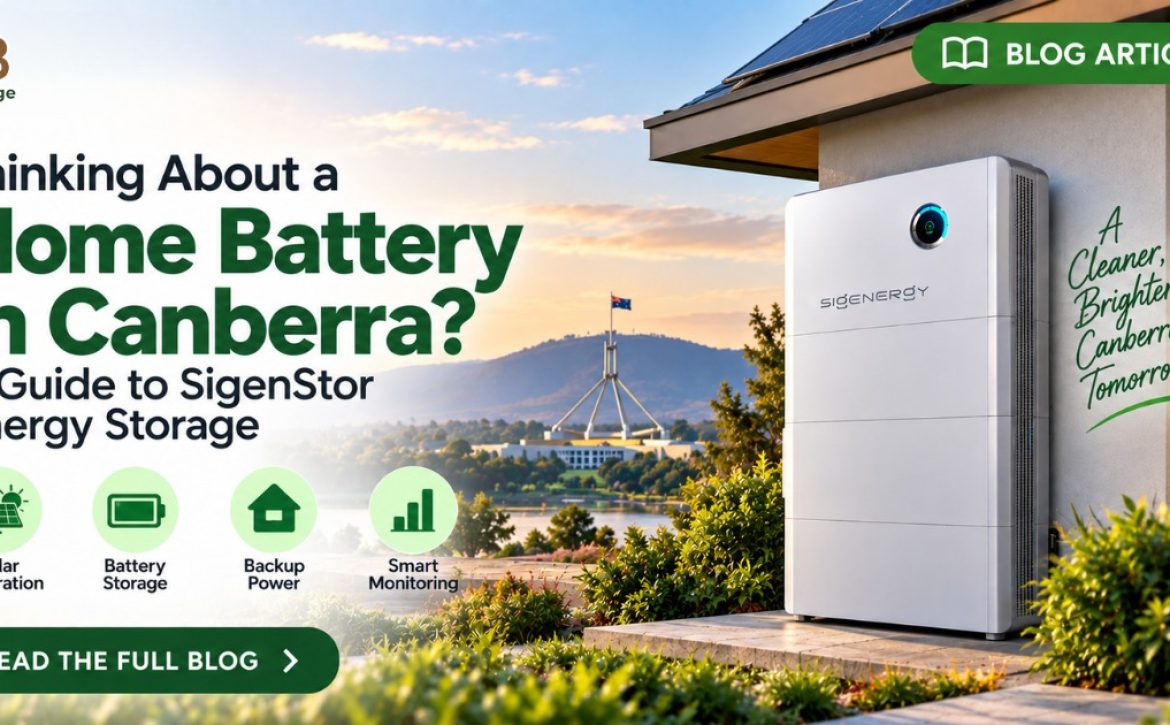
Thinking About a Home Battery in Canberra? A Guide to SigenStor Energy Storage

For many Canberra homeowners, installing solar panels is only the first step towards taking greater control of household energy use. Solar panels can generate electricity during the day, but much of a home’s electricity consumption can occur later in the afternoon and evening, when solar generation is falling or has stopped.

This is where battery storage can play an important role.

A home battery allows excess solar energy generated during the day to be stored and used later, helping households make greater use of the electricity their solar system produces.

One system attracting attention in the home energy storage market is SigenStor by Sigenergy.

SigenStor Battery Canberra is designed as an integrated energy system combining solar conversion, battery storage, energy management and EV charging in one platform. But what does that actually mean for a Canberra homeowner, and is an integrated system suitable for every home?

Let’s take a closer look.

What Is SigenStor?

SigenStor is a modular home energy storage system designed by Sigenergy.

Rather than treating the solar inverter, battery, energy management system and EV charger as completely separate products, SigenStor brings multiple functions together within an integrated platform.

The system can combine:

  • Solar inverter
  • Battery storage
  • Battery power conversion
  • Energy management
  • EV charging
  • Home energy monitoring
  • Backup power functionality

The EV charging component can be included depending on the homeowner’s requirements.

This integrated approach can be useful for homeowners who are thinking beyond simply adding a battery and want to coordinate solar generation, energy storage, household consumption and potentially EV charging.

How Does SigenStor Work With Solar?

A typical solar-only system works by converting sunlight into electricity that can be used by the home.

For example:

Solar panels → Home electricity consumption → Excess solar exported to the grid

The challenge is that solar production and household consumption don’t always occur at the same time.

A household might produce substantial solar energy around midday while nobody is home. Later in the evening, the household may be using electricity for lighting, cooking, heating, cooling, hot water or other appliances when the solar panels are producing little or no electricity.

With battery storage, the energy flow can become:

Solar panels → Home → SigenStor battery → Home

Instead of exporting all excess solar immediately, surplus generation can be stored and subsequently used when required.

SigenStor’s integrated energy management system is designed to coordinate energy generation, storage and consumption.

The system can also provide monitoring and energy management through its connected platform, allowing homeowners to understand how their solar, battery and household energy consumption are interacting.

Why Consider Battery Storage in Canberra?

Battery storage can be useful for households that already have solar but still purchase electricity from the grid.

The main concept is simple.

During the day

Solar panels generate electricity.

The home uses the electricity it needs first.

Excess solar can then be directed towards charging the battery.

During the evening

Solar production decreases.

The battery can supply stored energy to the home.

When solar and battery energy are insufficient

The home can continue drawing electricity from the grid according to the system’s configuration and operating conditions.

The objective isn’t necessarily to disconnect completely from the electricity grid.

Instead, battery storage can provide another source of household energy and give homeowners greater flexibility over when they use the electricity generated by their solar system.

Canberra’s Growing Interest in Home Batteries

Battery storage is becoming an increasingly important part of Canberra’s broader energy landscape.

More homeowners are looking at batteries as a way to make greater use of their solar generation, manage household energy consumption and prepare for increasing electrification.

The growth of electric vehicles, electric hot water systems, reverse-cycle heating and cooling and other electrical appliances can also increase the amount of electricity a household uses.

For homeowners considering multiple energy upgrades, battery storage can therefore become part of a larger home energy strategy.

How Much Battery Storage Does a Canberra Home Need?

There is no single battery size that is suitable for every Canberra home.

A common mistake is to choose a battery based only on the size of the solar system.

Instead, the battery should be considered alongside the household’s actual electricity consumption.

Important factors include:

1. Daily electricity consumption

How much electricity does the household normally use each day?

A home using 15 kWh per day will have different storage requirements from a home using 30 kWh or more.

2. Evening consumption

How much electricity is consumed after solar production falls?

This can include:

  • Lighting
  • Cooking
  • Television and entertainment
  • Heating and cooling
  • Hot water
  • Appliances
  • Home office equipment
  • EV charging
3. Solar system size

A larger solar system may generate more surplus energy available for charging the battery.

However, battery capacity should still be matched to actual energy consumption and expected solar generation.

4. Existing solar system

If you’re adding a battery to an existing solar installation, the existing inverter, system architecture and electrical configuration need to be assessed.

5. Backup requirements

Some homeowners primarily want to reduce grid purchases, while others also want backup power during outages.

These are different requirements and should be discussed during system design.

6. Future energy use

Think about what your household may look like in several years.

Are you planning to:

  • Buy an EV?
  • Install a heat pump?
  • Replace gas appliances with electric alternatives?
  • Add another air conditioner?
  • Increase your household’s electricity consumption?

A modular battery system may provide more flexibility where future expansion is important.

SigenStor’s Modular Battery Design

One of SigenStor’s key characteristics is its modular design.

Depending on the configuration, battery modules can be combined to increase overall storage capacity.

The advantage of modular storage is that homeowners can have greater flexibility when designing their energy system.

For example, a household may initially require a smaller system and later need additional storage because of:

  • EV ownership
  • Increased electricity consumption
  • Electrification of heating or hot water
  • Changes in household occupancy
  • Greater interest in backup power

The appropriate configuration still depends on the specific equipment, installation requirements and applicable Australian standards.

SigenStor and Home Backup Power

Battery storage and backup power are related, but they are not exactly the same thing.

A battery can store energy without necessarily providing backup power to the entire home during a grid outage.

A properly designed backup system needs to account for how the system detects an outage, isolates the home from the grid and supplies the selected loads.

For homeowners considering backup, it is important to ask:

What do you actually want to keep running during an outage?

You might want backup for selected essential loads such as:

  • Refrigeration
  • Lighting
  • Internet
  • Security systems
  • Selected power outlets
  • Essential appliances

Alternatively, you may want a larger backup system capable of supporting substantially more of the home’s electrical demand.

The required battery capacity, inverter capacity, switchboard configuration and backup equipment can vary considerably between properties.

A site assessment is therefore important before promising whole-home backup.

SigenStor and EV Charging

One of SigenStor’s distinguishing features is its integration with EV charging.

For households considering an electric vehicle, this can create an opportunity to connect several energy technologies together.

Instead of having separate systems for solar, battery storage and EV charging, an integrated system can coordinate these technologies around the home’s energy requirements.

The concept can look like this:

Solar → Home → Battery → EV

Depending on the equipment and configuration, the EV can also become part of the wider home energy ecosystem.

This makes SigenStor particularly relevant to homeowners who are considering both battery storage and EV ownership.

However, vehicle compatibility and supported charging functionality should always be confirmed before installation.

Solar + Battery + EV: Creating an Integrated Energy System

Consider a Canberra home with:

  • Rooftop solar
  • SigenStor battery
  • Electric hot water
  • Reverse-cycle heating and cooling
  • EV charging

The energy system could be designed around the following concept:

Solar generation → Household consumption → Battery storage → EV charging → Grid

The energy management system can then coordinate these energy flows according to the system configuration and operating priorities.

This is different from installing several completely independent products that each operate separately.

For households considering multiple energy upgrades, system integration can therefore become an important part of the discussion.

Can SigenStor Be Added to an Existing Solar System?

Potentially, yes — but the answer depends on the existing solar installation.

Before adding battery storage, an installer should assess factors such as:

  • Existing inverter
  • Solar panel capacity
  • Switchboard
  • Phase configuration
  • Metering
  • Available installation space
  • Existing protection equipment
  • Network requirements
  • Desired backup functionality
  • Battery location
  • Future EV charging requirements

A homeowner with an existing solar system should not assume that every battery can simply be connected to the existing installation without additional equipment or changes.

The most appropriate architecture should be determined during the site and electrical assessment.

Canberra Battery Incentives and Financing

For eligible Canberra households, government programs and financing options can be relevant when considering energy upgrades.

The ACT’s Sustainable Household Scheme provides eligible households with access to financing for a range of energy-efficient products and upgrades, including battery storage.

There may also be other battery-related incentives or federal programs available depending on the homeowner’s circumstances and the eligibility requirements at the time of installation.

Because government programs, eligibility criteria and incentive amounts can change, homeowners should always check the current requirements before making a purchasing decision.

Is SigenStor Suitable for Every Canberra Home?

Not necessarily.

A battery system should be selected based on the property’s energy requirements rather than simply choosing a particular brand.

SigenStor may be worth considering for homeowners who are looking for an integrated system that can combine:

  • Solar
  • Battery storage
  • Energy management
  • Backup functionality
  • EV charging
  • Future expansion

However, the right solution will depend on the home’s energy profile.

For example, a household with very low electricity consumption may have different requirements from a large home with electric heating, multiple air-conditioning systems, an EV and high evening consumption.

The important question isn’t simply:

“Which battery is best?”

Instead, consider:

“Which system configuration matches the way my home actually produces and uses energy?”

What Should You Compare Before Buying a Home Battery?

Before choosing a battery system in Canberra, consider more than just the advertised storage capacity.

Battery Capacity

How many usable kWh can the system store?

Power Output

How much power can the battery deliver at one time?

This matters when several appliances are operating simultaneously.

Solar Compatibility

Is the system suitable for your existing or planned solar configuration?

Backup Capability

Does the proposed system support backup, and which circuits will be backed up?

Expandability

Can additional battery modules be added later?

EV Integration

Are you planning to charge an EV at home?

If so, does the system support the charging approach you want?

Monitoring

Can you easily monitor solar production, battery state of charge, household consumption and grid imports?

Installation Requirements

Is there sufficient space, and does the proposed location meet the relevant installation and safety requirements?

Warranty and Support

Understand the battery warranty, performance warranty, installer support and manufacturer’s service arrangements.

Total Installed Cost

Don’t compare batteries purely on cost per kWh.

Installation, electrical work, backup equipment, switchboard modifications, monitoring equipment and other components can affect the total project cost.

SigenStor Battery Storage for New Solar Installations

If you don’t currently have solar, you have an opportunity to design the entire energy system together.

Instead of installing solar first and deciding about battery storage later, you can consider:

Solar + Battery + Backup + EV

as one overall energy strategy.

This can be particularly useful for new homes or households already planning several electrical upgrades.

The solar system can be sized around your electricity consumption, roof characteristics and future energy requirements, while battery storage can be considered alongside your expected evening consumption.

SigenStor Battery Canberra for Existing Solar Homes

For homeowners who already have solar, adding battery storage can be a different process.

Your existing system may already have:

  • Solar panels
  • String inverter
  • Microinverters
  • Hybrid inverter
  • Existing monitoring
  • Existing switchboard configuration

The compatibility and design options will depend on the equipment already installed.

An installer should therefore review your existing system before recommending a battery configuration.

A recent electricity bill, solar-system information and photographs of the switchboard and existing equipment can help provide an initial understanding of the property.

What Does a Battery Assessment in Canberra Involve?

A professional battery assessment should look at more than your roof.

A typical assessment may consider:

  • Electricity Usage

How much energy are you consuming?

  • Solar Generation

How much electricity is your existing or proposed solar system producing?

  • Consumption Profile

When are you using the most electricity?

  • Battery Requirement

How much storage could be useful?

  • Backup Requirement

Which appliances or circuits need to operate during an outage?

  • Electrical Infrastructure

Can the existing switchboard and electrical installation support the proposed system?

  • Future Requirements

Are you planning an EV, heat pump, electric hot water or other major electrical loads?

These factors help determine whether battery storage makes sense and what type of configuration should be considered.

Is a Larger Battery Always Better?

Not necessarily.

A larger battery provides more storage capacity, but that does not automatically mean it will provide a better financial outcome for every household.

The battery should have a realistic opportunity to charge and discharge based on the property’s solar generation and electricity consumption.

For example, if a household has limited surplus solar and relatively low energy consumption, a very large battery may not operate in the same way as it would in a high-consumption home with substantial solar generation.

This is why battery sizing should be based on actual energy data wherever possible.

Why the Right System Design Matters

A home battery is not simply a box that stores electricity.

The complete system can involve:

Solar panels
↓
Solar inverter / energy controller
↓
Battery storage
↓
Home loads
↓
EV charging
↓
Grid

How these components interact affects the overall performance and functionality of the system.

A properly designed installation should therefore consider the household’s current needs as well as potential future changes.

Getting a SigenStor Battery Canberra Assessment

If you’re considering a SigenStor Battery Canberra, the first step should be understanding your home’s energy requirements.

You don’t necessarily need to decide on a battery size before speaking with an installer.

Instead, start with your:

  • Recent electricity bill
  • Existing solar-system details
  • Typical household electricity consumption
  • Preferred battery capacity
  • Backup requirements
  • EV plans
  • Available installation space

From there, a solar and battery assessment can help determine the appropriate system configuration.

Ready to Explore Battery Storage for Your SigenStor Battery Canberra Home?

SigenStor brings solar generation, battery storage, intelligent energy management and EV charging into an integrated energy platform. Its modular design allows different system configurations depending on the property’s requirements, while its EV charging capability can make it relevant for households planning to electrify their transport as well.

But the right battery system ultimately depends on the individual home.

Whether you already have solar or you’re starting from scratch, the best place to begin is with an assessment of your electricity usage, solar generation, backup requirements and future energy plans.

Get a Personalised Solar & Battery Assessment

Thinking about installing a SigenStor Battery Canberra ?

Send us your recent electricity bill and details of your existing solar system, and we’ll help assess the battery capacity, solar configuration and backup options that may be suitable for your home.

Request Your Canberra Solar & Battery Assessment Today

Ready to Explore Battery Storage in Canberra?

Whether you’re installing a new solar system or adding battery storage to an existing one, EcoBridge Solar can help you design a SigenStor solution tailored to your home’s energy usage, backup needs, and future electrification plans.

Contact EcoBridge Solar

Looking for a personalised solar and battery assessment in Canberra?

EcoBridge Solar can help assess your home’s electricity usage, existing solar system, battery sizing, backup options, and EV charging requirements.

Email : info@ecobridgeenergy.com

Website : https://ecobridgeenergy.com/

Service Area

Canberra, ACT and surrounding regions.

Contact EcoBridge Solar today for a personalised solar and battery assessment in Canberra.

Frequently Asked Questions (FAQs)

1. What is SigenStor?

SigenStor is an all-in-one home energy storage system by Sigenergy that combines a solar hybrid inverter, battery storage, smart energy management, optional EV charging, and backup power capabilities into a single integrated platform.

2. Can I add a SigenStor battery to my existing solar system in Canberra?

Yes, in many cases. Compatibility depends on your existing inverter, switchboard, solar system design, metering, and backup requirements. A site assessment is recommended before installation.

3. How do I know what battery size I need?

The ideal battery size depends on your daily electricity consumption, evening energy usage, solar generation, future EV plans, and whether you want backup power—not just the size of your solar system.

4. Does SigenStor provide backup power during a blackout?

It can, if the system is designed with backup functionality. Backup can be configured for essential circuits or, in some homes, a larger portion of the home’s electrical load depending on the installation design.

5. Can SigenStor charge an electric vehicle using solar power?

Yes. SigenStor supports integrated EV charging, allowing compatible EV charging to be coordinated with your home’s solar generation and battery storage.

6. Is SigenStor suitable for single-phase and three-phase homes?

SigenStor is available in configurations suitable for different electrical supply types, but the appropriate setup depends on your home’s electrical infrastructure and installation requirements.

7. Can I expand my SigenStor battery later?

Yes. SigenStor uses a modular battery design, allowing additional battery modules to be added later if your household’s energy requirements increase.

8. Will a battery eliminate my electricity bill?

Not necessarily. A battery can help reduce grid electricity usage by storing excess solar energy, but most homes still remain connected to the electricity grid and may continue importing electricity when needed.

9. Are there battery incentives available in Canberra?

Eligible ACT households may be able to access financing through the ACT Sustainable Household Scheme for battery storage and other energy-efficient home upgrades. Eligibility should be confirmed at the time of application.

10. How long does a home battery installation take?

Most residential battery installations are completed within a day, although the total project timeline depends on system design, approvals, equipment availability, and any required switchboard upgrades.

Read More

Is Your WA Solar System Wasting Energy? How a Battery Can Help You Use More of Your Own Solar

If you already have solar panels installed at your Western Australian home, you’re already taking an important step towards reducing your reliance on grid electricity.

But there’s a common issue many solar homeowners overlook: your solar system may be generating the most electricity when your household needs the least.

During the middle of the day, your panels can produce plenty of solar energy. If you’re at work, the kids are at school, or your household simply isn’t using much electricity, a significant amount of that energy may be exported back to the grid.

A home battery can help change that.

Instead of exporting surplus solar during the day, a battery can store some of that energy and make it available later — particularly during the afternoon and evening when household electricity demand often increases.

At EcoBridge, we help homeowners understand how Solar System Wasting Energy battery storage can work with their existing Solar System Wasting Energy and whether adding a battery could make sense for their household.

Why WA Homeowners Are Considering Solar Batteries

Western Australia has excellent solar conditions, making rooftop solar a popular choice for homeowners.

However, producing solar energy and using solar energy aren’t always the same thing.

Your solar panels typically generate the most electricity during daylight hours, while many households use more energy later in the day.

For example:

  • Your solar panels generate the most electricity around midday.
  • You may be away from home during peak solar production.
  • Household energy use can increase during the afternoon and evening.
  • Without battery storage, surplus solar may be exported to the grid.
  • A battery can store some of that excess energy for later use.

In simple terms, a battery helps close the gap between when your solar generates electricity and when your home actually needs it.

Without a battery

Solar → Home → Excess solar → Grid

With a battery

Solar → Home → Battery → Home later

The objective is simple: use more of the solar energy your system already generates.


Are You Exporting Too Much Solar?

One of the first things to consider when deciding whether a battery could be worthwhile is how much excess solar your household is producing.

Your electricity bill, inverter monitoring platform and solar data may provide useful information about your generation and consumption.

Imagine your solar system produces 30 kWh during the day.

Your home immediately uses 10 kWh.

That leaves approximately 20 kWh of surplus solar.

Without battery storage, that surplus may be exported to the grid.

With a suitably sized battery, some of that energy could potentially be stored and used later when your solar panels are no longer producing electricity.

Of course, your potential savings will depend on several factors, including your electricity tariff, solar system size, household consumption, battery capacity and energy usage patterns.

That’s why a battery assessment based on your actual energy profile is more useful than simply choosing a battery based on its advertised capacity.


A solar battery stores excess electricity generated by your solar panels so it can be used later.

How Does a Solar Battery Work?

During the day, your solar energy can be used directly by appliances in your home.

If your solar system is producing more electricity than your home currently needs, surplus energy can be directed into your battery.

Later, when solar production decreases, stored energy can be used to help power your home.

During the day

Solar panels → Home

Surplus solar → Battery

After sunset

Battery → Home

This process can increase your solar self-consumption — meaning you use a greater proportion of the electricity your solar system generates rather than exporting as much of it to the grid.


Why Your Evening Energy Use Matters

For many Solar System Wasting Energy households, electricity consumption can increase after the sun goes down.

This can include:

  • Air conditioning
  • Cooking
  • Hot water
  • TVs and entertainment
  • Washing machines
  • Clothes dryers
  • Pool pumps
  • Home offices
  • General household appliances
  • EV charging

Your solar panels aren’t generating electricity after sunset, but your household may still be using plenty of it.

A battery gives you the opportunity to shift some of your daytime solar generation into the evening.

Instead of generating solar at midday and exporting the excess, you can potentially store that energy and use it when your household needs it most.


Solar Only vs Solar + Battery

The right setup depends on your home, your electricity usage and your goals.

Solar OnlySolar + Battery
Generates electricity during daylightGenerates and stores electricity
Surplus solar may be exportedSurplus solar can be stored
Greater reliance on grid electricity after solar hoursGreater opportunity to use stored solar
Lower upfront investmentHigher upfront investment
Limited ability to shift solar energyCan shift solar energy into later hours

A battery isn’t automatically the right choice for every household.

The financial benefit depends on your individual energy profile, so it’s important to assess your current solar generation and electricity consumption before investing.


What Size Solar Battery Do You Need?

When it comes to batteries, bigger isn’t necessarily better.

The right battery size depends on factors such as:

  • Your average daily electricity consumption
  • Your existing solar system size
  • How much surplus solar you generate
  • How much electricity you use in the evening
  • Your electricity tariff
  • Household occupancy
  • Your current and future energy needs
  • Whether you own or plan to purchase an EV
  • Whether backup power is important to you

For example, a household using 15–20 kWh of electricity per day may have very different battery requirements from a household using 30–40 kWh.

A professional assessment can help identify a battery capacity that is better matched to your actual energy usage.


Can a Solar Battery Keep Your Home Running During a Blackout?

Some battery systems can provide backup power during a grid outage, but not every battery installation automatically provides whole-home backup.

Depending on the system, backup functionality may require:

  • Additional backup hardware
  • Electrical modifications
  • Essential-load circuits
  • Specific inverter configuration
  • Appropriate battery equipment

If blackout protection is one of your priorities, make sure you discuss backup requirements with your installer before choosing a system.

Ask exactly which appliances and circuits can remain powered during an outage.


Is a Solar Battery Worth It in WA?

There is no single answer that applies to every WA household.

A battery may be worth considering if you:

  • Already have solar installed
  • Regularly export excess solar
  • Use significant electricity in the evening
  • Want to increase your solar self-consumption
  • Have relatively high electricity usage
  • Want greater control over when you use your solar energy
  • Are considering an EV or other high-energy appliances
  • Want battery backup capability

On the other hand, a battery may provide less financial benefit if your solar system is small, your household uses very little electricity, or most of your electricity is already consumed during daylight hours.

The best way to find out is to assess your actual electricity usage and solar generation.


Don’t Compare Batteries on Capacity Alone

Battery capacity is important, but it shouldn’t be the only factor you consider.

Usable capacity

The advertised battery capacity isn’t necessarily the same as the amount of energy available for everyday use. Check the usable capacity when comparing systems.

Power output

Capacity is measured in kWh, while power output is measured in kW.

The kWh figure tells you how much energy the battery can store, while the kW rating helps determine how much power it can supply at a given time.

Inverter compatibility

Your existing solar inverter and system configuration can influence which battery solutions are suitable for your home.

Warranty

Look beyond the headline warranty period. Check the warranty’s conditions, including performance guarantees, cycle or throughput limits and other requirements.

Monitoring

A good monitoring platform can help you understand how your solar and battery system is performing and how your household is using energy.

Backup capability

If backup power is important, confirm exactly what the system can power during an outage.


The Goal Is Simple: Use More of Your Own Solar

A battery isn’t simply about adding another piece of technology to your home.

It’s about changing when you use the electricity your solar panels generate.

Without storage, your energy flow may look like:

Generate → Use → Export

With battery storage, it can potentially become:

Generate → Use → Store → Use later

For households that generate plenty of solar during the day but consume more electricity in the evening, this shift can be particularly useful.


Can You Add a Battery to Your Existing Solar System?

If you already have solar installed, you may not need to replace your entire system to add battery storage.

Depending on your existing solar equipment, inverter, system configuration and energy profile, there may be battery solutions that can work with your current setup.

Before choosing a battery, it’s worth reviewing:

  1. Your latest electricity bill
  2. Your existing solar system size
  3. Your inverter model
  4. Your annual electricity consumption
  5. Your solar generation
  6. Your daytime and evening energy usage
  7. Your current electricity tariff
  8. Your preferred battery capacity
  9. Whether you require backup power

This information can help determine whether battery storage makes sense for your home and what type of system may be suitable.


Ready to Find Out If a Battery Makes Sense for Your WA Home?

If you already have solar but still rely heavily on grid electricity after sunset, your existing solar system may have more potential than you realise.

A correctly sized battery can help store surplus solar during the day and make that energy available when your household needs it later.

Don’t guess which battery you need. Start with your actual energy usage.

Get Your Free Solar & Battery Assessment

EcoBridge can assess your existing solar and energy profile to help you understand:

  • How much solar your system is currently generating
  • How much electricity you’re exporting
  • What battery size may suit your household
  • How much surplus solar you could potentially store
  • Which battery solutions may be suitable for your existing system
  • Whether battery storage makes financial and practical sense for your home
Make more of the solar you already generate.

Get your Free Solar & Battery Assessment today.

EcoBridge

https://ecobridgeenergy.com/
info@ecobridgeenergy.com

Request your assessment today and take the next step towards making more of your solar energy work for your home.

Solar Battery FAQs

1. Is a battery worth adding to my existing solar system?

It can be, particularly if your solar system regularly generates more electricity than your home uses during the day and you consume significant electricity in the evening. The best way to determine whether a battery is worthwhile is to assess your actual solar generation, electricity consumption and tariff.

2. How does a solar battery help reduce grid electricity use?

A battery stores surplus solar energy generated during the day. That stored energy can then be used later when your solar panels aren’t producing enough electricity, such as during the evening. This can increase your solar self-consumption and potentially reduce your reliance on grid electricity.

3. What size battery do I need for my WA home?

There isn’t one battery size that suits every household. Your ideal battery capacity depends on your daily electricity consumption, existing solar system, surplus solar generation, evening usage, tariff and future energy requirements. A professional assessment can help determine an appropriate size.

4. Can I add a battery to my existing solar panels?

In many cases, yes. However, compatibility depends on your existing solar inverter, system configuration and the battery technology being considered. Your existing equipment should be assessed before selecting a battery.

5. Can a solar battery work during a blackout?

Some battery systems can provide backup power during a grid outage, but backup isn’t automatically included with every battery installation. Additional equipment or electrical configuration may be required. If blackout protection is important to you, ask your installer specifically about backup functionality.

6. How much solar energy can a battery store?

That depends on the battery’s capacity. Battery capacity is generally measured in kilowatt-hours (kWh). However, the advertised capacity isn’t necessarily the same as the usable capacity, so it’s important to compare usable capacity when evaluating different systems.

7. Will a battery eliminate my electricity bill?

Not necessarily. A battery can help increase your use of stored solar energy, but most homes will still have periods when they need electricity from the grid. Your electricity bill will depend on your solar generation, energy consumption, tariff, battery operation and other factors.

8. Should I buy the biggest battery I can afford?

Not necessarily. An oversized battery may not provide the best return on investment if you don’t regularly generate enough surplus solar or consume enough electricity later in the day. Battery sizing should be based on your actual energy profile rather than simply choosing the largest available capacity.

9. What should I look for when comparing solar batteries?

Look at more than battery capacity. Important factors include usable capacity, power output, inverter compatibility, warranty conditions, monitoring capabilities, efficiency, system configuration and backup functionality.

10. How can I find out whether a battery is right for my home?

Start by reviewing your latest electricity bill and solar data. Information such as your annual electricity consumption, solar generation, export levels, daytime usage and evening consumption can help determine whether battery storage could be suitable.

Want to know whether battery storage makes sense for your home? Contact EcoBridge for a Solar & Battery Assessment.