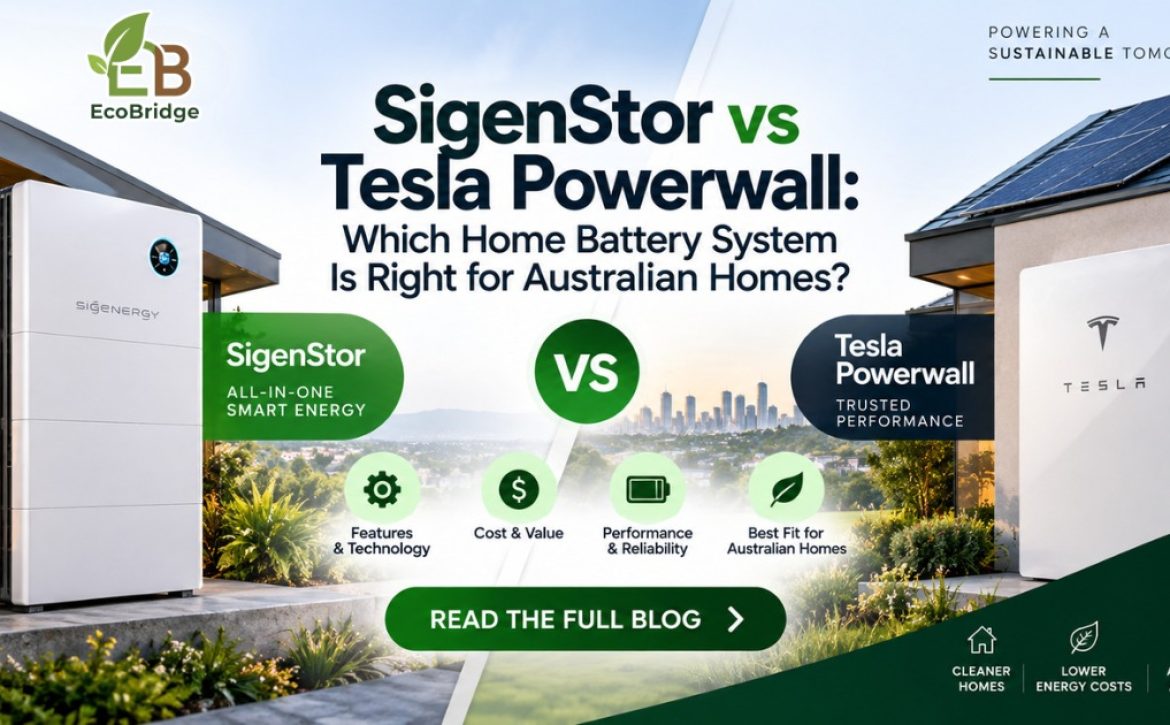
SigenStor vs Tesla Powerwall: Which Home Battery System Is Right for Australian Homes?
Choosing a home battery is no longer simply about adding storage to a solar system. Australian homeowners are increasingly looking at how a battery can reduce grid dependence, improve solar self-consumption, provide backup power and potentially support future technologies such as electric vehicles.
Two energy storage systems that attract significant attention areSigenStor vs Tesla Powerwall.
Both are designed to work with residential solar and energy management systems, but their approaches to battery storage, system configuration, backup, scalability and EV integration are different.
So, which one is right for your Australian home?
The answer depends on your electricity usage, existing solar system, property configuration, backup requirements and future energy plans.
SigenStor vs Tesla Powerwall: Quick Comparison
| Feature | SigenStor | Tesla Powerwall |
| Residential battery storage | Yes | Yes |
| Solar integration | Yes | Yes |
| Energy management system | Yes | Yes |
| Backup power capability | Available with compatible setup | Available |
| Expandable battery storage | Modular and expandable | Expandable with additional units |
| EV charging integration | Integrated within Sigenergy ecosystem | Compatible within Tesla ecosystem |
| Best suited for | Homeowners wanting a flexible, modular energy system. | Homeowners looking for Tesla’s integrated battery ecosystem. |
Exact system capabilities, capacities, backup configurations and installation requirements depend on the selected equipment and property.
What Is SigenStor?
SigenStor is an integrated energy storage platform from Sigenergy designed to combine multiple energy functions within a single ecosystem.
Depending on the configuration, the system can integrate:
- Solar power
- Battery storage
- Hybrid inverter technology
- Energy management
- Backup power
- EV charging
- Home energy monitoring
One of the key ideas behind SigenStor is modularity. Instead of treating the battery as an isolated component, the system is designed as part of a broader home energy platform.
This can be particularly relevant for homeowners who are considering an EV, additional solar generation or increased battery capacity in the future.
What Is Tesla Powerwall?
Tesla Powerwall is a residential energy storage system designed to store electricity generated by solar or supplied from the grid and make that energy available when required.
Powerwall can help homeowners:
- Store excess solar generation
- Use stored energy in the evening
- Reduce reliance on grid electricity
- Maintain power during compatible backup conditions
- Monitor household energy consumption and production
The Tesla ecosystem also provides an integrated software and monitoring experience, allowing homeowners to view energy production, consumption and battery operation.
For homeowners already familiar with Tesla products, the broader Tesla ecosystem can also be an important consideration.
SigenStor vs Tesla Powerwall: What’s the Main Difference?
The biggest difference is not necessarily the battery chemistry or headline storage capacity.
It is the overall system architecture.
SigenStor is designed as a broader modular energy platform that can combine solar, battery storage, inverter functionality, backup and EV charging within the same ecosystem.
Tesla Powerwall takes a highly integrated approach to residential energy storage, with Powerwall forming the central battery component of the Tesla energy ecosystem.
This means the right choice depends heavily on what you want your home energy system to do today — and what you may want it to do in the future.
Battery Capacity Matters — But Usage Matters More
A common mistake homeowners make is choosing a battery based purely on its advertised capacity.
For example, a larger battery isn’t automatically the right battery for every household.
The correct battery size depends on factors such as:
- Daily electricity consumption
- Evening and overnight usage
- Existing solar capacity
- Solar generation profile
- Electricity tariff
- Household occupancy
- Air-conditioning usage
- Pool pumps
- Electric hot water
- EV charging
- Backup requirements
A household using relatively little electricity may not benefit financially from installing excessive battery capacity.
On the other hand, a home with significant evening consumption, multiple air conditioners, an EV or high overnight loads may have a stronger reason to consider a larger storage system.
Battery sizing should therefore start with your electricity usage rather than a battery brand.
SigenStor vs Tesla Powerwall for Solar Self-Consumption
One of the main reasons Australian homeowners install batteries is to use more of their own solar energy.
Solar generation generally occurs during the day, while household electricity consumption can continue well into the evening.
Without a battery
Surplus solar may be exported to the grid.
With battery storage
Excess solar can instead be stored and used later.
For example:
Daytime
Solar → Home → Excess Solar → Battery
Evening
Battery → Home
This can allow homeowners to shift some of their solar generation from the middle of the day into the evening.
Both SigenStor and Powerwall can form part of this type of energy strategy, but the actual financial outcome depends on the home’s generation, consumption, tariff and system design.
Backup Power: An Important Difference to Consider
For many Australian homeowners, battery storage isn’t only about saving money.
It is also about keeping essential appliances operating during a power outage.
However, homeowners should not assume that installing a battery automatically means every appliance in the house will continue operating during a blackout.
Backup functionality depends on the system configuration, electrical installation and the loads being backed up.
Before purchasing a system, ask:
- What circuits will be backed up?
- Will the entire home be backed up?
- Is additional backup equipment required?
- What happens when the battery is depleted?
- Can solar continue operating during an outage?
- What appliances can run simultaneously?
- Is three-phase backup required?
- Are there additional installation costs?
These questions can be more important than simply comparing battery capacity.
SigenStor and EV Charging
For homeowners considering an electric vehicle, the ability to integrate EV charging into their future energy setup can become increasingly important.
SigenStor is designed around a broader energy ecosystem that can incorporate EV charging alongside solar generation, battery storage and home energy management.
This creates the potential for a more integrated energy setup:
Solar → Home → Battery → EV
Rather than treating solar, battery storage and EV charging as completely separate systems, homeowners can consider how the different components work together.
Tesla also has a broader EV and energy ecosystem, making it another option for homeowners who already use or plan to use Tesla products.
The important consideration is not simply whether an EV charger is available, but how the charger interacts with the home’s solar generation, battery and electricity consumption.
Which System Is Better for a New Solar Installation?
There isn’t one answer for every Australian property.
For a new solar and battery installation, the system should be designed around the property’s:
- Roof space
- Solar generation potential
- Household electricity usage
- Single-phase or three-phase supply
- Existing electrical infrastructure
- Backup requirements
- Future EV plans
- Available installation space
SigenStor can be particularly relevant for homeowners looking for a modular energy ecosystem incorporating multiple energy technologies.
Tesla Powerwall can be relevant for homeowners who prefer the Tesla energy ecosystem and its integrated approach to residential storage.
The best starting point is therefore a site-specific assessment rather than choosing a battery based solely on brand recognition.
What About Existing Solar Systems?
If you already have solar installed, you don’t necessarily need to replace your entire system to add battery storage.
However, compatibility needs to be assessed.
An installer should review:
- Existing inverter
- Solar panel capacity
- Switchboard
- Phase configuration
- Metering arrangement
- Battery location
- Existing cabling
- Backup requirements
- Available electrical capacity
Depending on the existing equipment, the battery may be AC-coupled, DC-coupled or installed as part of a different system architecture.
This is one reason why a professional assessment is important before deciding between SigenStor, Powerwall or another battery system.
SigenStor vs Tesla Powerwall: Which One Should You Choose?
Instead of asking which battery is universally better, consider which system aligns with your requirements.
SigenStor may be worth considering if you are looking for:
- A modular energy storage platform
- Integration between solar, battery and EV charging
- A broader home energy ecosystem
- Flexible system configurations
- A system designed with future energy expansion in mind
Tesla Powerwall may be worth considering if you are looking for:
- A highly integrated residential battery solution
- Tesla’s energy management ecosystem
- Residential backup capability
- Integration with other Tesla products
- A streamlined battery-focused solution
These are not absolute rules. The appropriate system depends on the property’s electrical setup, energy consumption, solar configuration and homeowner requirements.
How Much Battery Storage Does an Australian Home Need?
There is no universal battery size that works for every household.
A proper assessment should look at your electricity bill and determine:
- How much electricity you use
Daily and seasonal consumption can vary considerably.
- When you use electricity
A household that consumes most of its energy at night may have different battery requirements from a household that consumes most of its energy during the day.
- How much solar you generate
A battery needs sufficient excess solar generation to charge effectively.
- Your future electricity demand
Adding an EV, pool, air conditioning or electric hot water can significantly change your energy profile.
- Whether you want backup
Backup requirements can influence the required battery capacity and system configuration.
Don’t Choose a Battery Before Looking at Your Electricity Bill
The most useful starting point isn’t a battery brochure.
It’s your electricity usage.
An electricity bill can provide information that helps determine:
- Average consumption
- Usage patterns
- Existing solar exports
- Electricity tariffs
- Current energy costs
From there, a solar and battery system can be designed around your actual requirements.
A system that is correctly sized can potentially provide a better balance between upfront investment, solar utilisation and energy savings than simply installing the largest battery available.
SigenStor or Tesla Powerwall: Get a System Designed for Your Home
SigenStor focuses on a broader, modular energy ecosystem incorporating solar, battery storage, energy management and EV charging.
Tesla Powerwall provides an integrated residential battery solution within the Tesla energy ecosystem.
The right choice depends on your home, electricity consumption, solar system, backup requirements and future plans.
Thinking about installing a battery or upgrading your existing solar system?
Get a complimentary solar and battery assessment to see what system size and configuration may suit your property.
We can review your electricity usage, existing solar, battery requirements and backup needs and help you compare suitable options before you make a decision.
Request Your Complimentary Energy Assessment
Have a recent electricity bill?
Send it through along with your property details and we can assess:
- Recommended solar capacity
- Suitable battery capacity
- Existing solar compatibility
- Battery options
- Backup requirements
- EV charging considerations
- Potential system configuration
Don’t guess your battery size. Design your energy system around how your home actually uses electricity.
Contact EcoBridge Australia
Get in Touch
Email:info@ecobridgeenergy.com
Website: https://ecobridgeenergy.com/
Request your solar & battery assessment today
FAQs — SigenStor vs Tesla Powerwall (Australia)
1. Which is better: SigenStor or Tesla Powerwall?
Neither battery is universally better. SigenStor is designed as a modular home energy platform with battery, inverter, energy management, and EV charging integration, while Tesla Powerwall is a highly integrated residential battery within the Tesla ecosystem.
2. Can SigenStor work with an existing solar system?
Yes. SigenStor can be installed with many existing solar systems, but compatibility depends on your current inverter, switchboard, phase configuration, and overall electrical setup.
3. Can Tesla Powerwall be added to an existing solar installation?
Yes. Tesla Powerwall can be retrofitted to many existing solar systems, although installation requirements vary depending on the existing equipment and system design.
4. Does SigenStor provide backup power during blackouts?
Yes, backup power is available when SigenStor is installed with a compatible backup configuration. The circuits supported during an outage depend on your installation design.
5. Does Tesla Powerwall provide whole-home backup?
It can provide backup power in compatible installations, but whether the entire home or only selected circuits are backed up depends on your electrical configuration and installer design.
6. Which battery is better for electric vehicle charging?
SigenStor includes EV charging as part of its broader energy ecosystem. Tesla Powerwall integrates well with Tesla’s energy products and electric vehicles. The best option depends on your EV plans and overall home energy setup.
7. Can I expand battery storage later?
Yes. Both systems support expansion, although the expansion method and maximum configuration differ depending on the system and installation.
8. What size battery does my Australian home need?
Battery size depends on your daily electricity usage, solar generation, evening energy consumption, electricity tariff, and whether you want backup power or plan to charge an EV.
9. Is SigenStor suitable for three-phase homes?
SigenStor can be configured for different electrical setups, including some three-phase homes, depending on the installation design and compatible equipment.
10. How do I choose between SigenStor and Tesla Powerwall?
The best way is to assess your electricity usage, existing solar system, backup requirements, and future energy goals. A professional site assessment helps determine the most suitable battery size and configuration.