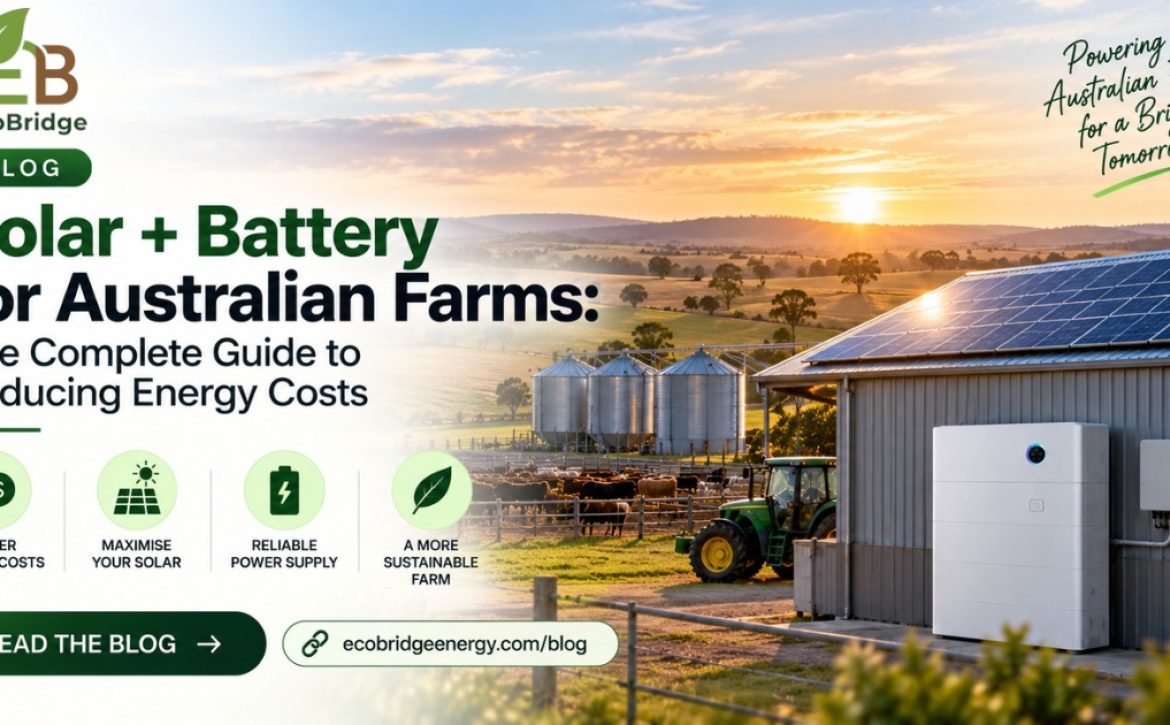
Australian farms face rising electricity costs while relying on energy-intensive equipment every day. From irrigation pumps and dairy systems to cool rooms, workshops, and water infrastructure, farms often consume far more electricity than a typical home.
At EcoBridge Solar, we design solar and battery systems specifically for Australian farms and rural businesses. Rather than offering one-size-fits-all packages, we assess your property’s energy usage, electrical infrastructure, and future needs to recommend a system that works for your operation.
Whether you’re running a dairy farm, vineyard, orchard, grain property, poultry farm, or mixed agricultural business, the right solar and battery setup can help you use more of your own renewable energy and reduce reliance on grid electricity.
Why Solar Makes Sense for Australian Farms
Agricultural properties are well suited to solar because they typically have:
Large shed and workshop roofs ideal for solar panels.
Significant daytime electricity consumption.
High energy costs from pumps, refrigeration, machinery, and processing equipment.
Space for future system expansion or ground-mounted solar.
Common farm equipment powered by solar includes:
Irrigation and bore pumps
Dairy and milking systems
Refrigeration and cool rooms
Grain handling equipment
Water pumping systems
Workshop machinery
Ventilation and extraction systems
Electric fencing
Farm offices
Lighting
Heating and cooling systems
When solar production matches daytime farm activity, more electricity can be used directly on-site instead of being purchased from the grid.
Solar Only vs Solar + Battery
A solar-only system generates electricity during daylight hours. A battery stores surplus solar energy so it can be used later when solar production drops.
Solar Only
Solar powers farm equipment during the day.
Excess electricity is exported to the grid.
Evening and overnight electricity is supplied by the grid.
Solar + Battery
Solar powers daytime loads.
Surplus solar charges the battery.
Stored energy powers the farm during evenings, mornings, or peak tariff periods.
Battery storage can increase on-site solar self-consumption, but the value depends on electricity tariffs, export rates, battery settings, and when the farm uses electricity.
How Much Solar Does a Farm Need?
There is no standard system size for every farm.
The right system depends on your property’s electricity profile, including:
Annual electricity usage.
Time-of-day consumption.
Maximum demand.
Seasonal irrigation or harvesting schedules.
Existing solar capacity.
Three-phase or single-phase supply.
Future electrification plans.
A tailored assessment ensures the system is sized around your farm’s actual energy requirements—not simply the largest system possible.
Choosing the Right Battery Size
Battery capacity is measured in kilowatt-hours (kWh), while power output is measured in kilowatts (kW).
Both matter on farms.
Battery Capacity
Suitable For
10–20 kWh
Smaller rural properties or backup loads.
20–40 kWh
Medium-sized farms with evening energy use.
40–60+ kWh
Larger farms, refrigeration, pumps, and higher overnight loads.
A battery also needs enough power output to start and run motors, pumps, refrigeration equipment, and multiple loads simultaneously.
EcoBridge Solar assesses both storage capacity and power requirements before recommending a battery.
Solar & Battery for Irrigation Pumps
Irrigation is often one of the biggest electricity users on Australian farms.
Solar works particularly well when pumps operate during daylight hours.
When irrigation occurs early morning, evening, or overnight, battery storage may help reduce grid electricity usage.
Important design considerations include:
Pump starting current.
Running load.
Irrigation schedules.
Seasonal pumping requirements.
Three-phase compatibility.
Three-Phase Solar Systems for Farms
Many agricultural properties operate on three-phase power because of large motors and equipment.
Three-phase systems require careful design around:
Three-phase inverters.
Battery compatibility.
Load balancing across phases.
Switchboard capacity.
Export limits from the local network.
Existing electrical infrastructure.
A site inspection ensures the system integrates correctly with the property’s electrical supply.
Backup Power for Farms
Not all solar systems provide electricity during a blackout.
If backup power is important, the system must be specifically designed for it.
Backup circuits can supply essential equipment such as:
Refrigeration and cool rooms.
Water pumps.
Communications equipment.
Security systems.
Essential lighting.
Farm office equipment.
Selected agricultural machinery.
EcoBridge Solar can design systems with backup capability based on your operational priorities.
Off-Grid & Hybrid Farm Solar Systems
Some rural properties have limited or unreliable grid access.
An off-grid or hybrid solar system may include:
Solar panels.
Battery storage.
Backup generator integration.
Smart energy management.
Critical load prioritisation.
These systems are designed for reliability throughout the year, including periods of lower solar generation.
Solar for Farm Sheds & Agricultural Buildings
Farm sheds often provide ideal installation locations.
Before installation, EcoBridge Solar assesses:
Roof condition.
Roof orientation and pitch.
Structural suitability.
Shading.
Available roof area.
Cable routing.
Switchboard location.
Inverter installation area.
Where roof installation isn’t suitable, ground-mounted systems may also be an option.
Why Choose EcoBridge Solar?
EcoBridge Solar specialises in solar and battery solutions for homes, farms, and commercial properties across Australia.
What Makes EcoBridge Different?
Tailored farm solar design based on your electricity usage.
CEC-compliant installations using quality equipment.
Battery storage expertise for rural and agricultural applications.
Three-phase solar system design for pumps and machinery.
Hybrid and backup power solutions for critical farm loads.
Transparent quotes with system performance estimates.
Ongoing monitoring and support after installation.
Scalable systems that can grow with your farm.
We work with farmers to design systems that match seasonal energy demands, future expansion plans, and available infrastructure.
How EcoBridge Designs Your Farm Solar System
Our assessment process focuses on your property’s actual electricity usage.
Step 1 — Review Your Electricity Usage
We analyse:
Recent electricity bills.
Tariff structure.
Peak demand.
Daily and seasonal usage patterns.
Step 2 — Assess Your Property
We review:
Roof or ground space.
Switchboard.
Three-phase supply.
Existing solar.
Major electrical equipment.
Step 3 — Recommend System Options
We compare different configurations, including:
Solar only.
Larger solar + smaller battery.
Solar + larger battery.
Solar + battery + backup power.
This helps you understand which option best matches your farm’s operating requirements.
Ready to Reduce Your Farm’s Energy Costs?
Every Australian farm has different energy needs.
EcoBridge Solar provides tailored solar and battery assessments based on your property’s electricity usage, equipment, and future plans.
If you have a recent electricity bill, we can assess:
Recommended solar system size.
Suitable battery capacity.
Potential backup options.
Three-phase compatibility.
Estimated solar generation and self-consumption.
Contact EcoBridge Solar today for a customised Farm Solar & Battery Assessment.
Many Australian farms have high daytime electricity consumption, making solar an effective way to offset electricity purchased from the grid. The benefits depend on your energy usage, tariffs, and system design.
2. What size solar system does a farm need?
There is no standard size. The right system depends on annual electricity consumption, peak demand, irrigation schedules, available roof space, and future energy needs.
3. Should I add a battery to my farm solar system?
A battery may be beneficial if your farm produces excess solar energy during the day and uses significant electricity during evenings, mornings, or peak tariff periods.
4. What battery size is best for a farm?
Battery sizes vary depending on the property’s energy profile. Smaller farms may require around 10–20 kWh, while larger agricultural operations may benefit from 30–60 kWh or more.
5. Can a battery run irrigation pumps?
Yes, provided the battery and inverter are correctly sized for the pump’s starting and running power requirements.
6. Do farm solar systems work with three-phase power?
Yes. EcoBridge Solar designs three-phase solar and battery systems for farms operating pumps, motors, refrigeration, and other three-phase equipment.
7. Will solar panels power my farm during a blackout?
Standard grid-connected solar systems typically shut down during a blackout. Backup power requires compatible battery storage and backup system design.
8. Can EcoBridge Solar install off-grid systems?
Yes. EcoBridge Solar designs off-grid and hybrid solar systems for rural properties where grid access is unavailable or unreliable.
9. Can I install solar on a farm shed?
In many cases, yes. Farm sheds often provide excellent roof space for solar panels, subject to structural and site assessment.
10. Can I expand my solar system later?
Many systems can be designed with future expansion in mind, allowing additional solar panels or battery storage as your farm’s energy requirements grow.
11. How long does a farm solar installation take?
Installation time depends on system size, site conditions, electrical infrastructure, and network approvals. EcoBridge Solar provides an installation timeline during the quoting process.
12. What information do I need for a solar assessment?
The best starting point is a recent electricity bill, along with details about your property’s major electrical equipment, irrigation schedules, existing solar system (if any), and future energy plans.
Looking for Commercial Solar & Battery Solutions, business solar panels, commercial battery storage, or a solar PPA in Australia? Compare your options and find the right energy solution for your business.
Electricity is one of the largest ongoing operating costs for many Australian businesses. Whether you operate a warehouse in Sydney, a manufacturing facility in Melbourne, a retail business in Brisbane, a farm in regional Western Australia or a commercial property in Adelaide, rising and unpredictable electricity costs can have a direct impact on your bottom line.
Commercial solar panels and battery storage can help businesses generate more of their own electricity, increase energy independence and reduce exposure to grid electricity prices.
But choosing a commercial solar system is not simply about putting as many solar panels as possible on a roof.
The right solution depends on your electricity consumption, operating hours, tariff structure, roof space, connection requirements, battery requirements, property ownership, available incentives and financing structure.
That is where EcoBridge can help.
EcoBridge is an independent energy solutions and comparison platform that helps Australian businesses understand their Commercial Solar & Battery Solutions and energy options and connect with suitable accredited providers.
We do not operate as a solar installation company. Instead, we help businesses compare suitable solutions and make a more informed decision before committing to a project.
Commercial solar refers to solar photovoltaic (PV) systems designed for businesses, commercial buildings and other non-residential properties.
Depending on the property’s electricity consumption and available roof or ground space, a commercial solar system can range from a relatively small installation to hundreds of kilowatts or more.
Typical commercial solar customers include:
Warehouses
Factories
Manufacturing businesses
Retail stores
Shopping centres
Offices
Medical centres
Hotels and accommodation businesses
Restaurants and cafés
Schools and childcare centres
Farms and agricultural businesses
Workshops
Automotive businesses
Cold storage facilities
Distribution centres
Strata and commercial property owners
Large commercial buildings
The economics of commercial solar are generally strongest when a business can use a significant portion of the electricity generated during the day.
Queensland Government guidance, for example, notes that the main value of solar for a small-to-medium business is generally maximising the use of solar generation rather than simply exporting excess electricity to the grid.
Why Are Australian Businesses Installing Solar?
The main reason businesses consider commercial solar is simple: to reduce the amount of electricity they need to purchase from the grid.
A correctly designed system can help a business:
Reduce daytime electricity purchases
Businesses that operate during daylight hours can use solar electricity directly as it is generated. This can be particularly useful for businesses with:
Refrigeration
Air conditioning
Manufacturing equipment
Pumps
Compressors
Machinery
IT equipment
Commercial kitchens
EV charging
Processing equipment
Reduce exposure to electricity price increases
Generating electricity on-site can provide a degree of protection against future changes in electricity prices.
Increase energy independence
Solar allows businesses to generate part of their electricity requirements on-site rather than relying entirely on the electricity grid.
Improve sustainability
Businesses can increase the proportion of their electricity supplied by renewable generation and potentially reduce their operational emissions.
Improve long-term operating costs
Unlike electricity purchased from the grid, solar generation has no fuel cost once the system is operating.
The financial result depends on the system cost, electricity tariff, solar production, self-consumption, financing structure and other factors.
Commercial Solar & Battery Solutions
Solar panels generate electricity when sunlight is available. But many businesses continue using substantial amounts of electricity after solar production begins to fall.
This is where commercial battery storage can become valuable. A battery can store electricity and make it available later. For example:
Daytime
Evening / peak period
Solar → Business loads Solar → Battery charging Excess → Grid
Battery → Business loads
This can increase solar self-consumption and reduce the amount of electricity purchased from the grid during certain periods.
Commercial batteries can also be considered for applications such as:
Peak demand management
Time-of-use energy shifting
Solar self-consumption
Backup power
Load management
Energy arbitrage
Demand response
Greater energy resilience
However, battery storage should not automatically be added to every commercial solar project. The battery needs to be sized around the business’s actual electricity usage, tariff structure and operating profile.
How Big Should a Commercial Solar System Be?
There is no universal “best” commercial solar system size. A 30 kW system may be suitable for one business while another property may require 100 kW, 250 kW, 500 kW or more.
The correct size depends on factors including:
Annual electricity consumption
Daytime electricity usage
Peak demand
Business operating hours
Roof size
Roof orientation
Roof condition
Available electrical capacity
Existing solar
Electricity tariff
Export limitations
Network requirements
Battery storage
Future electricity demand
This is why a professional commercial solar assessment should begin with the business’s electricity data rather than simply choosing a system based on roof size.
Commercial Solar Battery Sizing
Battery size is measured in kilowatt-hours (kWh). For example:
20 kWh battery
50 kWh battery
100 kWh battery
200 kWh battery
500 kWh battery
1 MWh battery
But battery capacity alone does not tell you whether the system is suitable.
Usable capacity
Power output
Charge rate
Discharge rate
Inverter capacity
Warranty
Operating temperature
Cycle life
Backup capability
Monitoring system
Network requirements
Installation requirements
A commercial battery should therefore be designed around the business’s actual load profile.
Commercial Solar & Battery Solutions for Businesses
Commercial battery storage is becoming increasingly relevant for Australian businesses. The Clean Energy Regulator’s 2026 data shows that non-residential battery installations are already occurring across multiple capacity ranges, demonstrating growing interest in battery storage beyond residential properties.
For businesses, batteries can have a different financial purpose compared with residential systems. A commercial battery may be used to:
Reduce peak demand — Some businesses experience periods where electricity demand suddenly increases. A battery can potentially discharge during selected high-demand periods, depending on the tariff and system design.
Store excess solar — Instead of exporting excess solar during the middle of the day, a battery can store some of that energy for later use.
Shift electricity consumption — Energy can be stored when electricity is cheaper or when solar production is high and used later.
Improve energy resilience — Depending on the equipment and system configuration, batteries can provide backup power to selected loads during an outage.
Support future energy requirements — Businesses installing EV chargers, additional machinery, refrigeration or other electrical equipment may consider batteries as part of a broader energy strategy.
Commercial Solar Rebates and Incentives in Australia
One of the most important things businesses need to understand is that solar incentives are not the same across Australia.
Eligibility can depend on:
System size
Technology
Location
Business type
Installation date
Existing system
Electricity connection
Applicable government program
Accredited installer
Program rules
The Clean Energy Regulator currently states that eligible solar PV systems up to 100 kW can participate in the Small-scale Renewable Energy Scheme, while larger systems fall into different renewable-energy certificate arrangements.
Battery eligibility and incentive structures can also differ from solar. This is why businesses should verify the current incentive position before signing a contract.
State-by-State Commercial Solar & Battery Guide
New South Wales
New South Wales has a growing market for commercial solar and battery storage. Businesses in NSW should consider:
Electricity consumption
Network connection requirements
Solar export limitations
Battery sizing
Demand charges
Available incentives
Future electricity demand
Finance options
Importantly, NSW is introducing new business battery activities under the Peak Demand Reduction Scheme. The proposed BESS4 activity is designed for small and medium businesses installing batteries between 20 kWh and 200 kWh, while BESS5 targets larger commercial and industrial sites with batteries between 200 kWh and 10 MWh. The activities are scheduled to commence on 1 September 2026.
Businesses should confirm eligibility and current incentive settings before making investment decisions.
Popular searches: Commercial solar Sydney · Commercial solar installers Sydney · Business solar Sydney · Commercial battery Sydney · Business battery storage Sydney · Solar battery Sydney · Warehouse solar Sydney · Industrial solar Sydney · Commercial solar Newcastle · Commercial solar Wollongong · Commercial solar regional NSW
Victoria
Victoria has a mature commercial solar market, with businesses increasingly considering solar generation, battery storage and alternative financing models. For Victorian businesses, an assessment should consider:
Electricity consumption
Existing solar
Network connection
Solar system size
Battery requirements
Electricity tariff
Property ownership
Finance structure
Available incentives
Solar Victoria confirms that eligible solar PV systems can receive Small-scale Technology Certificate benefits, with the STC value incorporated into the quoted system price by the installer.
Popular searches: Commercial solar Melbourne · Commercial solar installers Melbourne · Business solar Melbourne · Commercial battery Melbourne · Warehouse solar Melbourne · Industrial solar Melbourne · Commercial solar Geelong · Commercial solar regional Victoria
Queensland
Queensland has strong solar resources and a large market for business solar. It also highlights the importance of considering demand tariffs, grid connection requirements and premises ownership.
Queensland businesses should consider:
Daytime energy consumption
Demand charges
Solar export
Network connection
Existing electricity infrastructure
Battery storage
Roof capacity
Business operating hours
For larger solar and battery systems, Queensland has additional technical requirements. For example, new or replacement rooftop solar PV and battery systems of 10 kVA or greater are subject to generation signalling requirements.
Popular searches: Commercial solar Brisbane · Commercial solar installers Brisbane · Business solar Brisbane · Commercial battery Brisbane · Solar battery Brisbane · Warehouse solar Brisbane · Commercial solar Gold Coast · Commercial solar Sunshine Coast · Commercial solar regional Queensland
Western Australia
Western Australia has its own electricity market and technical requirements, so commercial solar systems in WA should be assessed separately from systems in the eastern states.
From 1 May 2026, new requirements apply to many new and upgraded rooftop solar and battery systems in the South West Interconnected System (SWIS). These requirements include provisions around inverter capacity, remote disconnection/reconnection or export limitation, and compliance with AS/NZS 4777.2.
This makes professional system design and network compliance particularly important.
Popular searches: Commercial solar Perth · Commercial solar installers Perth · Business solar Perth · Commercial battery Perth · Warehouse solar Perth · Industrial solar Perth · Commercial solar regional WA
South Australia
South Australia has a strong solar market and significant interest in battery storage. For commercial customers, the right solution depends on electricity consumption, solar generation, battery requirements and available programs.
South Australian Government information confirms that solar and battery storage can help businesses generate and store their own electricity.
Businesses should also carefully review current grants and program availability because government programs can have application periods, eligibility criteria and funding limits. For example, the South Australian Powering Business Grant included a solar and battery stream for eligible businesses, with grant calculations linked to system capacity and eligible project expenditure.
Popular searches: Commercial solar Adelaide · Commercial solar installers Adelaide · Business solar Adelaide · Commercial battery Adelaide · Warehouse solar Adelaide · Industrial solar Adelaide · Commercial solar regional SA
Solar PPA for Australian Businesses
Buying a solar system outright is not the only way to access solar. A Power Purchase Agreement (PPA) can be an alternative for eligible businesses.
Under a typical PPA structure, a third party finances and owns the solar system while the business purchases the electricity generated by the system under an agreed contractual arrangement. This can potentially reduce the upfront capital requirement.
A PPA may be worth considering for businesses that:
Want to avoid a large upfront solar investment
Have suitable electricity consumption
Have a long-term lease or property arrangement
Want predictable energy costs
Prefer an operating-expense model
Want to preserve capital for core business activities
However, PPA contracts can be complex. Businesses should review:
Contract duration
Electricity price
Escalation clauses
Minimum purchase requirements
Maintenance responsibilities
Roof access
Insurance
Property ownership
Early termination
Buyout options
End-of-term arrangements
Not every business will qualify for a PPA. EcoBridge can help businesses understand whether a PPA or other financing structure may be worth exploring.
Operating Lease for Commercial Solar
An operating lease can be another option for businesses that do not want to purchase the solar system outright. Depending on the provider and contract structure, the business may make regular payments for the use of the system while avoiding the full upfront capital expenditure.
This can be particularly relevant to businesses that:
Lease their premises
Want to preserve cash flow
Prefer predictable payments
Want to avoid a large capital purchase
Have a long-term operating horizon
The accounting, tax and legal treatment of an operating lease depends on the specific structure and the business’s circumstances, so businesses should obtain appropriate professional advice.
Commercial Solar Finance Options
Businesses may have several ways to fund a solar and battery project. Common structures include:
Outright purchase — The business pays for the system upfront.
Commercial finance — The business finances the system through a lender.
Operating lease — The business pays for use of the equipment rather than purchasing it outright.
Power Purchase Agreement — A third party finances and owns the system, with the business purchasing electricity under the PPA.
Hybrid structures — Some projects combine different forms of financing or energy procurement.
The cheapest option is not necessarily the best option. A business should compare: upfront cost + finance cost + energy savings + contract terms + ownership + residual value + maintenance obligations.
Solar by Industry
Solar for Warehouses
Warehouses can be particularly suitable for commercial solar because they often have large roof areas, high daytime electricity usage, refrigeration or HVAC loads, lighting loads, long operating hours and large electrical infrastructure.
A warehouse solar assessment should consider roof structure, available roof space, electricity usage, export restrictions and future expansion. Adding battery storage can also help businesses use more of their solar energy outside peak solar production periods.
Solar for Factories & Manufacturing Businesses
Manufacturing businesses can have substantial electricity consumption from machinery, motors, compressors, pumps, production lines, HVAC, refrigeration and automation equipment.
Solar can offset some of this daytime electricity consumption. Battery storage may also be considered where the business has significant peak demand or wants to shift energy consumption. For manufacturing businesses, the electricity bill and interval consumption data are particularly important.
Solar for Retail Businesses
Retail businesses can benefit from solar when they have substantial daytime electricity consumption, such as lighting, air conditioning, refrigeration, POS systems, display equipment, food preparation and EV charging.
Shopping centres and larger retail properties may also require more detailed network and electrical assessments.
Solar for Farms & Agricultural Businesses
Agricultural businesses can have significant electricity requirements from irrigation, pumps, refrigeration, grain handling, processing, water systems, workshops and livestock facilities.
Solar can be particularly useful where electricity consumption occurs during daylight hours. Battery storage may be considered when energy demand extends into evening periods or where resilience is important.
How Much Does Commercial Solar Cost?
There is no single price for commercial solar in Australia. The cost can vary significantly depending on:
System size
Panel selection
Inverter capacity
Battery size
Roof type
Installation height
Electrical upgrades
Switchboard requirements
Cable length
Network connection
Structural requirements
Site access
Crane or lifting requirements
Export limitations
Backup requirements
For this reason, businesses should avoid choosing a commercial solar provider purely on the lowest advertised price. A cheap quote may not include all the requirements necessary for a compliant installation.
How Much Can a Business Save With Solar?
The savings from commercial solar depend on the amount of electricity generated and how much of that electricity the business uses.
Simplified example: If a business generates 100,000 kWh of solar electricity annually and uses a large portion of that electricity on-site, the value of the solar can be substantial.
But the actual financial return depends on:
Electricity purchase price
Solar generation
Self-consumption
Export value
Demand charges
System cost
Finance costs
Maintenance
System degradation
Future electricity prices
This is why a proper commercial solar proposal should use the business’s actual electricity bill and, where possible, interval consumption data.
What Electricity Bill Do I Need for a Commercial Solar Quote?
For an accurate assessment, businesses should ideally provide:
Recent electricity bill
A current bill can help identify: retailer, usage, tariff, supply charges, demand charges, meter information, NMI and electricity consumption. Several months of bills can provide a better picture of seasonal electricity consumption.
Interval data
Where available, interval data can provide an even better understanding of the business’s load profile.
Site information
Businesses may also need to provide: property address, roof photos, switchboard photos, meter photos, proposed battery location and existing solar information.
Why Use EcoBridge?
Choosing a commercial energy solution can be complicated. There are hundreds of products, installers, financing structures and energy programs available across Australia.
EcoBridge helps simplify the process. We help businesses:Compare commercial solar optionsUnderstand different system sizes, equipment configurations and project structures.Explore battery storageAssess whether battery storage may make sense based on electricity usage and business requirements.Compare finance optionsExplore outright purchase, commercial finance, operating lease and PPA options where available.Understand incentivesIdentify relevant government programs and incentives that may apply to the business and project.Connect with suitable providersWhere appropriate, EcoBridge can connect businesses with suitable accredited solar and energy providers for assessment, design and installation.Make a more informed decisionOur goal is not simply to recommend the biggest solar system. The objective is to help businesses understand their options and choose an energy solution that fits their electricity consumption, property and financial objectives.
EcoBridge assists businesses researching commercial energy solutions across:
New South Wales
Commercial solar Sydney
Commercial solar Newcastle
Commercial solar Wollongong
Commercial solar Central Coast
Commercial solar Western Sydney
Commercial solar regional NSW
Commercial battery NSW
Business solar NSW
Victoria
Commercial solar Melbourne
Commercial solar Geelong
Commercial solar Ballarat
Commercial solar Bendigo
Commercial solar regional Victoria
Commercial battery Victoria
Business solar Victoria
Queensland
Commercial solar Brisbane
Commercial solar Gold Coast
Commercial solar Sunshine Coast
Commercial solar Townsville
Commercial solar Cairns
Commercial solar Toowoomba
Commercial solar regional Queensland
Commercial battery Queensland
Western Australia
Commercial solar Perth
Commercial solar Fremantle
Commercial solar Mandurah
Commercial solar Bunbury
Commercial solar regional WA
Commercial battery Perth
Business solar WA
South Australia
Commercial solar Adelaide
Commercial solar regional SA
Commercial battery Adelaide
Business solar South Australia
Solar battery SA
Is Commercial Solar Right for Your Business?
The answer depends on your numbers. If your business has:
High electricity bills
Large daytime energy consumption
Available roof space
Suitable electrical infrastructure
Long operating hours
High peak demand
Existing solar that needs expansion
An interest in battery storage
A preference for PPA or finance rather than upfront purchase
… then it may be worth getting a commercial solar assessment.
Get a Commercial Solar & Battery Assessment
You don’t need to know exactly how many panels or how much battery storage you need before contacting us. Start with your electricity bill.
EcoBridge can help assess your requirements and identify suitable options for your business. We can help you explore:
Commercial Solar | Commercial Batteries | Solar + Battery | PPA | Operating Lease | Commercial Energy Solutions
Request an Assessment
Submit your business details and a recent electricity bill to get started. We’ll review your requirements and, where appropriate, connect you with a suitable energy provider for the next stage.Business name Business address Contact name Phone Email Average electricity bill Solar required Yes No Unsure Battery required Yes No Unsure Finance/PPA required Yes No Unsure Request a Commercial Solar & Battery Assessment →
Frequently Asked Questions
What is commercial solar?
Commercial solar is a solar PV system designed to generate electricity for a business or commercial property. System size can range from smaller business installations to large commercial and industrial projects.
Is commercial solar worth it in Australia?
It can be, particularly for businesses with significant daytime electricity consumption. The financial outcome depends on system cost, electricity tariffs, solar generation, self-consumption, financing and other factors.
Can a business install solar and a battery?
Yes. Commercial solar and battery storage can be designed as an integrated system, subject to site, electrical, network and product requirements.
What size commercial battery do I need?
There is no standard size. Battery capacity should be determined using electricity consumption, peak demand, solar generation, operating hours, tariffs and the business’s objectives.
Can a business get a solar rebate?
Some commercial solar and battery projects may qualify for incentives, certificates or state-based programs depending on system size, location, technology and eligibility. Incentive rules change, so eligibility should be checked before signing a contract.
Is there a commercial solar rebate in NSW?
NSW has several energy programs and incentive mechanisms, and new business battery activities are scheduled to commence in September 2026. Eligibility depends on the project and business.
Is there a commercial solar rebate in Victoria?
Eligible solar PV systems may receive STC benefits, while other programs and eligibility criteria can apply depending on the project.
Does Queensland have commercial solar incentives?
Queensland businesses should assess the current federal and state programs applicable to their system. Queensland Government guidance also highlights the importance of network connection, demand tariffs and self-consumption when assessing business solar.
Can WA businesses install commercial solar batteries?
Yes, but businesses in WA need to consider the applicable network and technical requirements. New requirements for many rooftop solar and battery systems in the SWIS commenced on 1 May 2026.
Can South Australian businesses get help with solar and batteries?
South Australia has supported business energy programs, although individual grants and funding rounds have specific eligibility and availability requirements. Businesses should check the current program before relying on a grant in their financial calculations.
What is a commercial solar PPA?
A Power Purchase Agreement is a contractual arrangement where a third party may finance and own a solar system while the business purchases electricity generated by the system under agreed terms.
What is an operating lease for solar?
An operating lease can allow a business to use solar equipment in exchange for regular payments rather than purchasing the system outright. The exact structure depends on the provider and contract.
Can I get a commercial solar quote without knowing the system size?
Yes. Providing your electricity bill and property address is usually a better starting point than trying to determine the system size yourself.