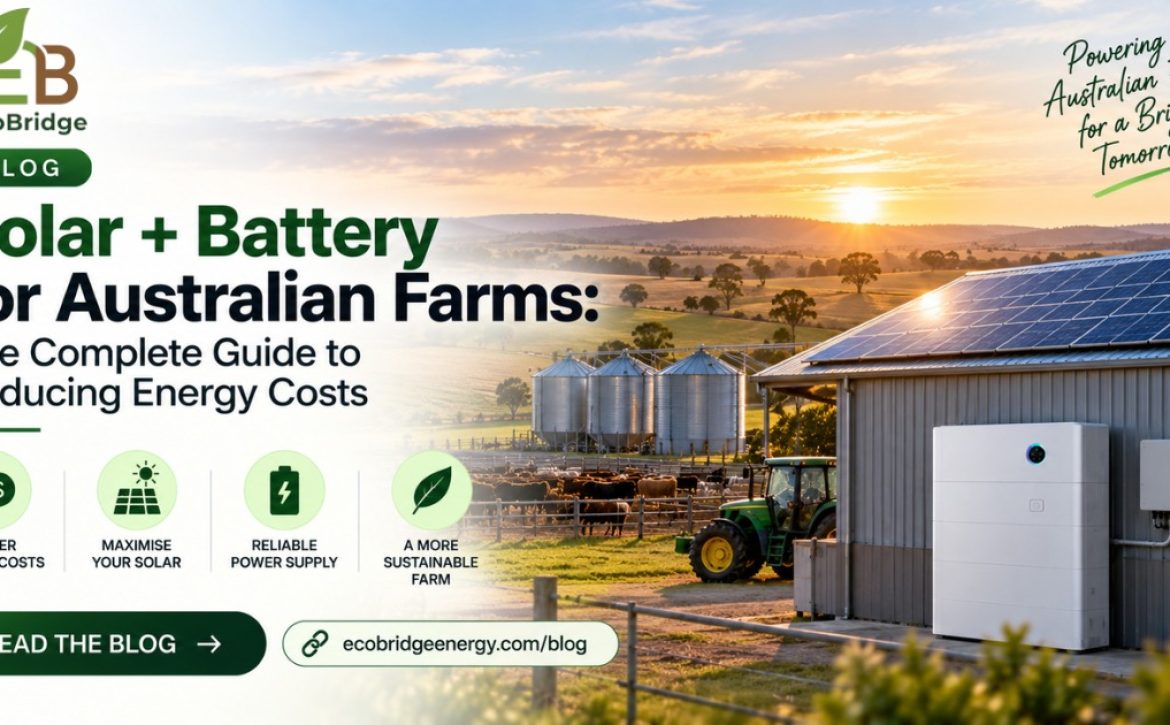
Solar + Battery for Australian Farms: The Complete Guide by EcoBridge Solar
Australian farms face rising electricity costs while relying on energy-intensive equipment every day. From irrigation pumps and dairy systems to cool rooms, workshops, and water infrastructure, farms often consume far more electricity than a typical home.
At EcoBridge Solar, we design solar and battery systems specifically for Australian farms and rural businesses. Rather than offering one-size-fits-all packages, we assess your property’s energy usage, electrical infrastructure, and future needs to recommend a system that works for your operation.
Whether you’re running a dairy farm, vineyard, orchard, grain property, poultry farm, or mixed agricultural business, the right solar and battery setup can help you use more of your own renewable energy and reduce reliance on grid electricity.
Why Solar Makes Sense for Australian Farms
Agricultural properties are well suited to solar because they typically have:
- Large shed and workshop roofs ideal for solar panels.
- Significant daytime electricity consumption.
- High energy costs from pumps, refrigeration, machinery, and processing equipment.
- Space for future system expansion or ground-mounted solar.
Common farm equipment powered by solar includes:
- Irrigation and bore pumps
- Dairy and milking systems
- Refrigeration and cool rooms
- Grain handling equipment
- Water pumping systems
- Workshop machinery
- Ventilation and extraction systems
- Electric fencing
- Farm offices
- Lighting
- Heating and cooling systems
When solar production matches daytime farm activity, more electricity can be used directly on-site instead of being purchased from the grid.
Solar Only vs Solar + Battery
A solar-only system generates electricity during daylight hours. A battery stores surplus solar energy so it can be used later when solar production drops.
Solar Only
- Solar powers farm equipment during the day.
- Excess electricity is exported to the grid.
- Evening and overnight electricity is supplied by the grid.
Solar + Battery
- Solar powers daytime loads.
- Surplus solar charges the battery.
- Stored energy powers the farm during evenings, mornings, or peak tariff periods.
Battery storage can increase on-site solar self-consumption, but the value depends on electricity tariffs, export rates, battery settings, and when the farm uses electricity.
How Much Solar Does a Farm Need?
There is no standard system size for every farm.
The right system depends on your property’s electricity profile, including:
- Annual electricity usage.
- Time-of-day consumption.
- Maximum demand.
- Seasonal irrigation or harvesting schedules.
- Existing solar capacity.
- Three-phase or single-phase supply.
- Future electrification plans.
A tailored assessment ensures the system is sized around your farm’s actual energy requirements—not simply the largest system possible.
Choosing the Right Battery Size
Battery capacity is measured in kilowatt-hours (kWh), while power output is measured in kilowatts (kW).
Both matter on farms.
| Battery Capacity | Suitable For |
|---|---|
| 10–20 kWh | Smaller rural properties or backup loads. |
| 20–40 kWh | Medium-sized farms with evening energy use. |
| 40–60+ kWh | Larger farms, refrigeration, pumps, and higher overnight loads. |
A battery also needs enough power output to start and run motors, pumps, refrigeration equipment, and multiple loads simultaneously.
EcoBridge Solar assesses both storage capacity and power requirements before recommending a battery.
Solar & Battery for Irrigation Pumps
Irrigation is often one of the biggest electricity users on Australian farms.
Solar works particularly well when pumps operate during daylight hours.
When irrigation occurs early morning, evening, or overnight, battery storage may help reduce grid electricity usage.
Important design considerations include:
- Pump starting current.
- Running load.
- Irrigation schedules.
- Seasonal pumping requirements.
- Three-phase compatibility.
Three-Phase Solar Systems for Farms
Many agricultural properties operate on three-phase power because of large motors and equipment.
Three-phase systems require careful design around:
- Three-phase inverters.
- Battery compatibility.
- Load balancing across phases.
- Switchboard capacity.
- Export limits from the local network.
- Existing electrical infrastructure.
A site inspection ensures the system integrates correctly with the property’s electrical supply.
Backup Power for Farms
Not all solar systems provide electricity during a blackout.
If backup power is important, the system must be specifically designed for it.
Backup circuits can supply essential equipment such as:
- Refrigeration and cool rooms.
- Water pumps.
- Communications equipment.
- Security systems.
- Essential lighting.
- Farm office equipment.
- Selected agricultural machinery.
EcoBridge Solar can design systems with backup capability based on your operational priorities.
Off-Grid & Hybrid Farm Solar Systems
Some rural properties have limited or unreliable grid access.
An off-grid or hybrid solar system may include:
- Solar panels.
- Battery storage.
- Backup generator integration.
- Smart energy management.
- Critical load prioritisation.
These systems are designed for reliability throughout the year, including periods of lower solar generation.
Solar for Farm Sheds & Agricultural Buildings
Farm sheds often provide ideal installation locations.
Before installation, EcoBridge Solar assesses:
- Roof condition.
- Roof orientation and pitch.
- Structural suitability.
- Shading.
- Available roof area.
- Cable routing.
- Switchboard location.
- Inverter installation area.
Where roof installation isn’t suitable, ground-mounted systems may also be an option.
Why Choose EcoBridge Solar?
EcoBridge Solar specialises in solar and battery solutions for homes, farms, and commercial properties across Australia.
What Makes EcoBridge Different?
- Tailored farm solar design based on your electricity usage.
- CEC-compliant installations using quality equipment.
- Battery storage expertise for rural and agricultural applications.
- Three-phase solar system design for pumps and machinery.
- Hybrid and backup power solutions for critical farm loads.
- Transparent quotes with system performance estimates.
- Ongoing monitoring and support after installation.
- Scalable systems that can grow with your farm.
We work with farmers to design systems that match seasonal energy demands, future expansion plans, and available infrastructure.
How EcoBridge Designs Your Farm Solar System
Our assessment process focuses on your property’s actual electricity usage.
Step 1 — Review Your Electricity Usage
We analyse:
- Recent electricity bills.
- Tariff structure.
- Peak demand.
- Daily and seasonal usage patterns.
Step 2 — Assess Your Property
We review:
- Roof or ground space.
- Switchboard.
- Three-phase supply.
- Existing solar.
- Major electrical equipment.
Step 3 — Recommend System Options
We compare different configurations, including:
- Solar only.
- Larger solar + smaller battery.
- Solar + larger battery.
- Solar + battery + backup power.
This helps you understand which option best matches your farm’s operating requirements.
Ready to Reduce Your Farm’s Energy Costs?
Every Australian farm has different energy needs.
EcoBridge Solar provides tailored solar and battery assessments based on your property’s electricity usage, equipment, and future plans.
If you have a recent electricity bill, we can assess:
- Recommended solar system size.
- Suitable battery capacity.
- Potential backup options.
- Three-phase compatibility.
- Estimated solar generation and self-consumption.
Contact EcoBridge Solar today for a customised Farm Solar & Battery Assessment.
Contact EcoBridge Solar
- 📧 Email: info@ecobridgeenergy.com
- 🌐 Website: https://ecobridgeenergy.com/
What we’ll assess:
- Recommended solar system size.
- Suitable battery capacity.
- Three-phase compatibility.
- Backup power options.
- Estimated solar generation and self-consumption.
- System expansion options for future farm growth.
Frequently Asked Questions (FAQs)
1. Is solar worth it for Australian farms?
Many Australian farms have high daytime electricity consumption, making solar an effective way to offset electricity purchased from the grid. The benefits depend on your energy usage, tariffs, and system design.
2. What size solar system does a farm need?
There is no standard size. The right system depends on annual electricity consumption, peak demand, irrigation schedules, available roof space, and future energy needs.
3. Should I add a battery to my farm solar system?
A battery may be beneficial if your farm produces excess solar energy during the day and uses significant electricity during evenings, mornings, or peak tariff periods.
4. What battery size is best for a farm?
Battery sizes vary depending on the property’s energy profile. Smaller farms may require around 10–20 kWh, while larger agricultural operations may benefit from 30–60 kWh or more.
5. Can a battery run irrigation pumps?
Yes, provided the battery and inverter are correctly sized for the pump’s starting and running power requirements.
6. Do farm solar systems work with three-phase power?
Yes. EcoBridge Solar designs three-phase solar and battery systems for farms operating pumps, motors, refrigeration, and other three-phase equipment.
7. Will solar panels power my farm during a blackout?
Standard grid-connected solar systems typically shut down during a blackout. Backup power requires compatible battery storage and backup system design.
8. Can EcoBridge Solar install off-grid systems?
Yes. EcoBridge Solar designs off-grid and hybrid solar systems for rural properties where grid access is unavailable or unreliable.
9. Can I install solar on a farm shed?
In many cases, yes. Farm sheds often provide excellent roof space for solar panels, subject to structural and site assessment.
10. Can I expand my solar system later?
Many systems can be designed with future expansion in mind, allowing additional solar panels or battery storage as your farm’s energy requirements grow.
11. How long does a farm solar installation take?
Installation time depends on system size, site conditions, electrical infrastructure, and network approvals. EcoBridge Solar provides an installation timeline during the quoting process.
12. What information do I need for a solar assessment?
The best starting point is a recent electricity bill, along with details about your property’s major electrical equipment, irrigation schedules, existing solar system (if any), and future energy plans.