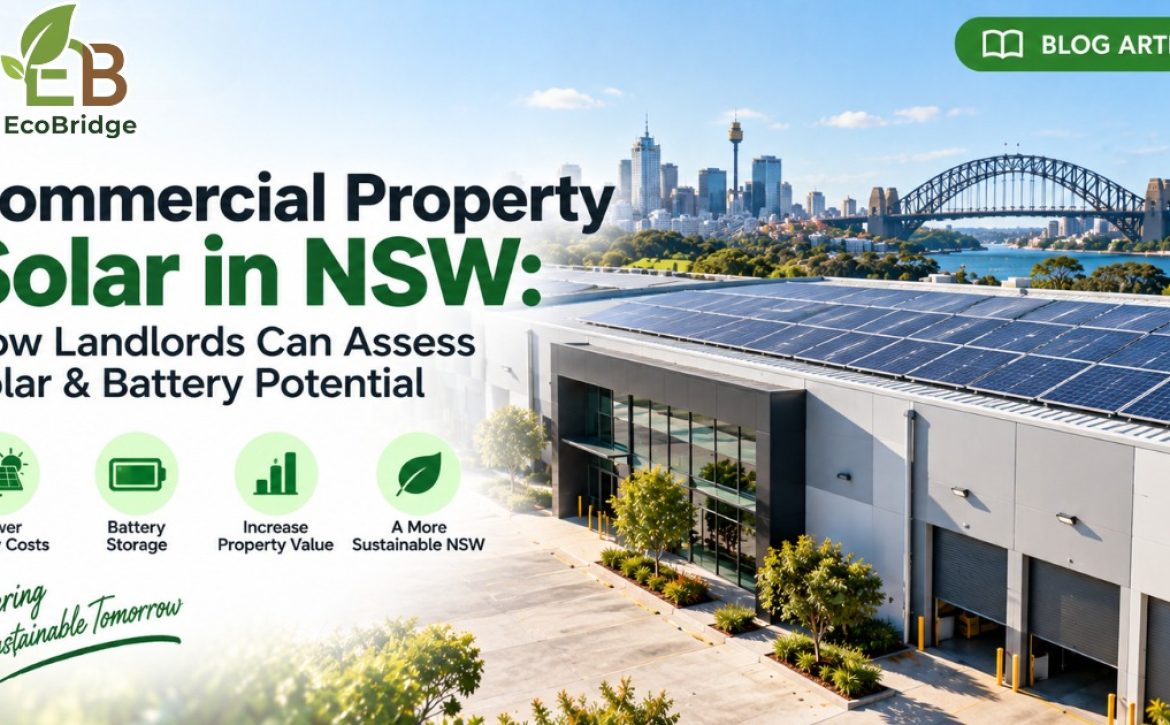
Commercial Property Solar in NSW: How Landlords Can Assess Solar & Battery Potential
As electricity prices continue to rise across New South Wales, commercial property owners are increasingly looking at solar panels and battery storage as a long-term investment. For landlords, installing solar on commercial buildings is no longer just a sustainability initiative—it can improve property value, attract quality tenants, reduce operating costs in common areas, and create new revenue opportunities.
However, not every commercial property is suitable for the same solar and battery solution. Before investing, landlords should assess the building’s energy usage, roof suitability, electrical infrastructure, and financial returns.
This guide explains how NSW commercial landlords can evaluate the solar and battery potential of their properties and make informed energy decisions.
Why Commercial Landlords in NSW Are Investing in Solar
Commercial solar adoption is growing across NSW because many commercial properties use significant electricity during daylight hours—the same time solar panels generate the most energy. Solar can help reduce reliance on grid electricity while improving the property’s environmental credentials. Commercial landlords are increasingly exploring solar and battery solutions to reduce electricity costs, improve energy resilience, and increase control over energy consumption.
Benefits of Solar for Commercial Property Owners
- Lower electricity costs for shared building services.
- Increased property value and tenant appeal.
- Reduced exposure to rising electricity prices.
- Better sustainability and ESG performance.
- Potential eligibility for available commercial solar incentives.
- Opportunity to integrate battery storage for greater energy flexibility.
Whether you own an office building, warehouse, retail centre, industrial facility, or mixed-use commercial property, a properly designed solar system can support long-term operating savings.
Step 1: Assess Your Commercial Roof Space
The roof is one of the most valuable assets for a commercial solar installation.


What to Check
| Roof Assessment Factor | Why It Matters |
|---|---|
| Available roof area | Determines how many solar panels can be installed. |
| Roof orientation | North-facing roofs generally maximise solar generation in NSW, although east and west roofs can also perform well depending on energy demand. |
| Roof pitch | Influences solar panel efficiency and mounting design. |
| Shading | Trees, neighbouring buildings, HVAC equipment, and signage can reduce energy production. |
| Roof condition | An older roof may require repairs before solar installation. |
| Roof material | Metal, Colorbond, concrete tile, and membrane roofs each require different mounting systems. |
Roof Suitability Checklist
- Large unobstructed roof sections.
- Minimal daytime shading.
- Structurally suitable roof.
- Enough clearance around equipment and access pathways.
- Remaining roof lifespan aligns with solar panel lifespan.
Step 2: Understand the Building’s Electricity Usage
The best commercial solar system starts with electricity data—not roof size alone. A professional assessment should consider the property’s actual consumption profile, operating hours, tariffs, and future electricity needs.
Collect Recent Electricity Bills
A recent electricity bill helps identify:
- Total electricity consumption.
- Peak demand charges.
- Time-of-use tariffs.
- Daily usage patterns.
- Meter type.
- Network charges.
Questions Landlords Should Ask
- Who pays the electricity bill?
- Is electricity separately metered for tenants?
- Are common areas landlord-funded?
- Are there multiple tenancies?
- Are operating hours mostly during the day?
Understanding these answers helps determine how much solar energy can be consumed on-site versus exported.
Step 3: Evaluate Tenant Energy Consumption
Different tenants consume electricity differently.
| Commercial Tenant Type | Typical Daytime Solar Usage |
|---|---|
| Office buildings | High weekday daytime consumption. |
| Retail stores | Strong daytime usage during trading hours. |
| Warehouses | Often consistent daytime operational loads. |
| Industrial facilities | Can have large daytime equipment loads. |
| Medical centres | Long daytime operating hours. |
| Shopping centres | Shared common area loads plus tenant usage. |
The closer solar production matches daytime electricity demand, the greater the potential financial benefit.
Step 4: Check Electrical Infrastructure


Commercial solar may require assessment of existing electrical infrastructure.
Key Items to Review
- Main switchboard capacity.
- Metering configuration.
- Distribution boards.
- Existing solar system compatibility.
- Grid connection requirements.
- Available inverter location.
- Cable pathways.
- Fire and safety compliance.
Older buildings may need electrical upgrades before installing a larger solar system.
Step 5: Determine the Right Solar System Size
There is no universal best commercial solar size.
System capacity depends on:
- Annual electricity consumption.
- Daytime load.
- Roof size.
- Budget.
- Export limits.
- Future expansion plans.
- Battery integration.
Typical Commercial Solar Sizes
| Property Type | Indicative Solar Range |
|---|---|
| Small office | 20–30 kW |
| Retail building | 30–60 kW |
| Warehouse | 50–150 kW |
| Industrial facility | 100–500+ kW |
| Shopping centre | 100 kW to multi-megawatt |
A professional assessment should size the system around energy consumption rather than installing the maximum number of panels.
Step 6: Assess Whether Battery Storage Makes Sense
Solar panels generate electricity during the day.
A commercial battery stores excess solar energy for later use.


Battery Storage Can Help With
- Evening electricity use.
- Peak demand reduction.
- Time-of-use tariff optimisation.
- Backup power for selected circuits.
- Greater solar self-consumption.
- Energy resilience during outages.
Factors
| Factor | Importance |
|---|---|
| Daytime solar surplus | Determines charging potential. |
| Evening electricity demand | Determines battery usage. |
| Peak demand charges | May improve battery value. |
| Battery capacity (kWh) | Should match property load profile. |
| Power output (kW) | Determines how much load battery can support. |
| Backup requirements | Optional feature depending on business needs. |
Battery storage should be designed around the property’s actual electricity profile rather than selecting the largest battery available.
Step 7: Review NSW Solar Incentives and Financing Options
Commercial landlords should understand available financial pathways before investing.
Possible Options Include
- Small-scale Technology Certificates (STCs) for eligible systems.
- Large-scale Generation Certificates (LGCs) for qualifying projects.
- Commercial battery incentive programs where applicable.
- Power Purchase Agreements (PPAs).
- Equipment finance.
- Operating leases.
- Outright purchase.
The most suitable option depends on property ownership, electricity usage, and investment objectives. EcoBridge helps businesses compare commercial solar, battery, and PPA options across Australia.+1
Step 8: Calculate Potential ROI
Commercial solar is a long-term investment.
Factors That Affect ROI
- Electricity prices.
- Solar system size.
- Battery inclusion.
- Daytime self-consumption.
- Export tariffs.
- Installation complexity.
- Maintenance costs.
- Financing structure.
Typical Financial Assessment Includes
| Assessment Item | Purpose |
|---|---|
| Annual electricity savings | Estimate reduced grid consumption. |
| Solar generation forecast | Estimate yearly production. |
| Battery savings analysis | Evaluate load shifting benefits. |
| Payback estimate | Understand investment timeframe. |
| Cash flow projection | Review long-term savings potential. |
Step 9: Consider Future Energy Needs
Solar systems should be designed with future expansion in mind.
Future-Proof Your Commercial Property
Think about future additions such as:
- EV charging stations.
- Heat pumps.
- Additional tenancy.
- Building extensions.
- Battery expansion.
- Increased operating hours.
Planning ahead can reduce future upgrade costs.
Common Commercial Properties Suitable for Solar in NSW
Commercial solar is suitable across many industries.
| Property Type | Solar Potential |
|---|---|
| Office buildings | Excellent |
| Warehouses | Excellent |
| Factories | Excellent |
| Retail centres | High |
| Medical centres | High |
| Schools | High |
| Hotels | High |
| Agricultural properties | High |
| Mixed-use commercial buildings | High |
Each property requires an individual assessment of energy usage, roof space, and electrical infrastructure.
A Commercial Solar Assessment Checklist for NSW Landlords
Before requesting quotes, gather:
- Last 12 months of electricity bills.
- Property address.
- Roof photos.
- Switchboard photo.
- Meter box photo.
- Roof dimensions (if available).
- Information about tenants and operating hours.
- Details of any existing solar system.
- Interest in battery storage or finance options.
Providing this information helps create a more accurate commercial solar assessment.
Why Choose EcoBridge Australia?
EcoBridge provides guidance on commercial solar systems, battery storage, PPAs, financing pathways, and energy solutions tailored to Australian commercial properties.
EcoBridge Can Help You Assess
- Commercial roof suitability.
- Solar system sizing.
- Battery storage potential.
- Electricity bill analysis.
- PPA and finance options.
- NSW commercial solar opportunities.
- Expansion of existing commercial solar systems.
Whether you’re managing a single commercial property or a multi-site portfolio across NSW, EcoBridge can help you evaluate suitable renewable energy options.
Contact EcoBridge Australia
Get a Free Commercial Solar & Battery Assessment
EcoBridge Australia helps businesses and commercial property owners explore smarter solar and battery solutions across New South Wales and Australia.
Website : https://ecobridgeenergy.com/
Email : info@ecobridgeenergy.com
Service Areas
New South Wales (NSW), Victoria (VIC), Queensland (QLD), South Australia (SA), Tasmania (TAS), and Western Australia (WA).
Frequently Asked Questions (FAQs)
1. Can landlords install solar on a commercial property with tenants?
Yes. Commercial landlords can install solar on tenanted properties, but the structure depends on lease arrangements, metering configuration, and who pays for electricity. Shared-area solar, tenant-funded arrangements, or PPAs may all be possible depending on the property setup.
2. How do I know if my commercial property is suitable for solar?
A commercial solar assessment typically reviews roof space, orientation, shading, structural condition, electricity bills, switchboard capacity, and tenant energy usage to determine suitability.
3. Is battery storage necessary for a commercial solar system?
Not always. Battery storage is most valuable when a property has excess daytime solar generation, evening electricity usage, peak demand charges, or a need for backup power and energy resilience.
4. How much roof space does a commercial solar system need?
The required roof space depends on the system size and panel efficiency. Larger commercial systems require more usable roof area, but the final design depends on energy consumption and site layout rather than roof size alone.
5. Can an existing commercial solar system be expanded?
In many cases, yes. Existing systems can often be expanded if the roof, inverter capacity, switchboard, and network connection allow it. A technical assessment is recommended before adding new panels or batteries.
6. What information should I provide for a commercial solar assessment?
Providing recent electricity bills, roof photos, switchboard and meter box photos, property address, operating hours, and details of existing solar systems helps create a more accurate assessment.
7. What is a Power Purchase Agreement (PPA) for commercial solar?
A PPA is a financing arrangement where a provider installs and maintains the solar system while the business purchases the electricity it generates, often without paying the upfront system cost.
8. How long do commercial solar panels and batteries last?
Commercial solar panels commonly come with long performance warranties, while battery lifespan depends on technology, usage cycles, warranty terms, and operating conditions.
9. Can solar help increase the value of a commercial property?
Many commercial property owners consider solar an investment that can improve building efficiency, reduce operating costs, and support sustainability goals, which may enhance the property’s appeal to prospective tenants and buyers.
10. How can EcoBridge help commercial landlords in NSW?
EcoBridge helps landlords assess solar and battery potential, review electricity usage, compare system options, explore finance or PPA pathways, and identify suitable commercial energy solutions for NSW properties.