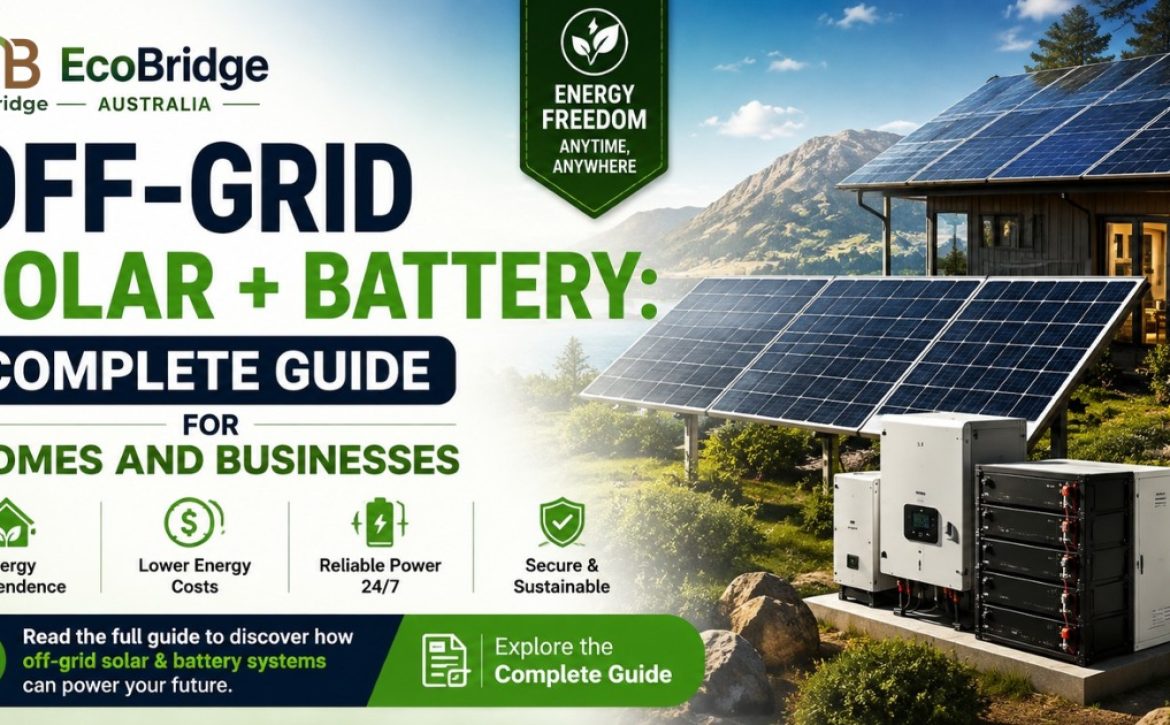
Off-Grid Solar + Battery: Complete Guide for Homes and Businesses
For homes, farms and businesses in remote areas, reliable electricity can be a challenge. A traditional Off-Grid Solar + Battery connection may be expensive, unavailable or unreliable, while rising electricity costs are encouraging more property owners to consider generating and storing their own energy.
An off-grid solar and battery system can provide an alternative by generating electricity from solar panels and storing excess energy in batteries for use when the sun isn’t producing enough power.
But going off-grid requires much more than simply installing solar panels and a battery.
The system needs to be designed around your electricity consumption, peak loads, available sunlight, battery capacity and backup requirements.
This guide explains how off-grid solar battery systems work, what equipment is required, how to size a system and what to consider before making the investment.
What Is an Off-Grid Solar + Battery System?
An off-grid solar system is an energy system that operates independently from the electricity grid.
Instead of relying on the grid for electricity, the property generates its own power using solar panels and stores energy in batteries.
A typical system consists of:
- Solar panels
- Hybrid or off-grid inverter
- Battery storage
- Energy management equipment
- Switchboard and protection equipment
- Monitoring system
- Backup generator where required
The system is designed to generate enough electricity during periods of sunlight and store sufficient energy to cover periods when solar production is low or unavailable.
Unlike a standard grid-connected solar system, an off-grid system cannot simply rely on the grid when solar production is insufficient.
That makes battery storage and system sizing particularly important.
How Does Off-Grid Solar + Battery Work?
The basic process is straightforward.
During the day
Solar panels generate electricity.
That electricity is first used to power the property’s appliances, equipment or business operations.
Any excess generation can be directed toward charging the battery.
When solar production decreases
As the sun sets or solar generation drops due to weather conditions, the battery can supply electricity to the property.
During the night
The battery can provide power for lighting, refrigeration, security systems, communications, appliances and other electrical loads.
During extended periods of poor weather
If solar generation remains low for an extended period, the battery can eventually become depleted.
This is why an off-grid system needs to be designed with sufficient generation and storage capacity.
For some properties, a backup generator may also be included as an additional layer of energy security.
What Equipment Does an Off-Grid Solar System Need?
An effective Off-Grid Solar + Battery is made up of several interconnected components.
- Solar Panels
Solar panels are responsible for generating electricity from sunlight.
The number of panels required depends on:
- Daily electricity consumption
- Location
- Available sunlight
- Roof or ground-mount space
- Seasonal energy requirements
- System losses
- Battery charging requirements
A larger solar array can provide more energy during the day and help recharge the battery after overnight use.
However, simply adding more panels isn’t enough. The rest of the system needs to be designed to work with the array.
- Battery Storage
The battery stores excess solar energy for later use.
Battery capacity is generally measured in kilowatt-hours (kWh).
For example, a 20 kWh battery has a nominal storage capacity of approximately 20 kWh, although the amount of energy that can actually be used depends on the battery’s usable capacity and operating settings.
Battery sizing depends heavily on how much electricity the property uses after sunset and how much backup duration is required.
- Off-Grid or Hybrid Inverter
The inverter is one of the most important components of the system.
It converts electricity between the forms required by the solar panels, batteries and property’s electrical loads.
The inverter also manages energy flows between:
Solar → Loads → Battery
and
Battery → Loads
The inverter needs to be appropriately sized for both continuous electricity demand and the property’s peak loads.
- Monitoring and Energy Management
Modern systems can include monitoring platforms that provide information about:
- Solar generation
- Battery state of charge
- Electricity consumption
- Battery charging and discharging
- System performance
- Energy usage patterns
Monitoring can help property owners identify unusually high consumption and understand how effectively the system is operating.
Why Battery Sizing Is So Important
In a grid-connected solar system, the electricity grid can act as a source of backup energy.
In an off-grid system, there is no such safety net.
If the battery is empty and solar generation is insufficient, the property may not have enough electricity.
That’s why battery sizing should consider the property’s energy consumption and required autonomy, rather than simply choosing a battery based on its capacity.
For example, a property might use:
- 10 kWh during the evening
- 5 kWh overnight
- 5 kWh during early morning
That creates a very different battery requirement from a property using 40 or 50 kWh overnight.
How Many Solar Panels Do You Need for an Off-Grid System?
There is no universal number.
The required solar capacity depends on several factors.
Daily energy consumption
The first step is understanding how many kWh the property consumes each day.
Location
Solar generation varies depending on geographic location and seasonal conditions.
Seasonal demand
A property may consume more electricity during winter because of heating, while summer demand may increase because of cooling.
Battery charging
The solar system needs to generate enough electricity not only to power the property during the day but also to recharge the battery.
Weather conditions
An off-grid system needs to account for periods when solar generation is below average.
This is particularly important for properties that cannot tolerate interruptions.
Off-Grid Solar for Homes
Off-grid solar can be suitable for homes where connecting to the electricity grid is difficult or expensive.
This can include:
- Rural properties
- Remote homes
- Holiday properties
- Rural lifestyle properties
- Cabins
- Remote accommodation
- Properties far from existing grid infrastructure
A properly designed system can provide electricity for everyday household requirements such as:
- Refrigeration
- Lighting
- Cooking
- Water pumps
- Air conditioning
- Heating
- Internet equipment
- Security systems
- Household appliances
However, high-energy appliances can significantly affect system requirements.
For example, electric hot water, large air-conditioning systems, pool pumps and electric vehicle charging can substantially increase electricity consumption.
Off-Grid Solar for Businesses
Businesses operating in remote locations can also benefit from off-grid energy systems.
Potential applications include:
- Farms
- Workshops
- Warehouses
- Remote offices
- Agricultural facilities
- Rural businesses
- Remote accommodation
- Construction sites
- Telecom facilities
- Industrial operations
For commercial applications, system design becomes even more important because businesses can have large and unpredictable electricity loads.
Machinery, refrigeration, pumps, compressors and other equipment can create significant peak demand.
An off-grid commercial system therefore needs to be designed around both energy consumption and peak power requirements.
Can an Off-Grid Solar System Run a Business 24/7?
Potentially, yes — but it depends on the system design.
Running a business completely off-grid requires enough generation and storage to cover:
- Normal daytime consumption
- Overnight consumption
- Peak loads
- Battery charging
- Seasonal variations
- Periods of low solar generation
For energy-intensive businesses, this may require a substantial solar array and large battery system.
A backup generator may also be considered where uninterrupted operation is critical.
The objective isn’t simply to install enough equipment for an average day.
The system needs to account for the worst realistic operating conditions.
What Happens During Cloudy or Rainy Weather?
This is one of the most important considerations when designing an off-grid system.
Solar panels continue to generate electricity during cloudy conditions, but production can be significantly lower than during strong sunlight.
If several low-generation days occur consecutively, battery storage may gradually become depleted.
A well-designed system can address this through a combination of:
- Additional solar capacity
- Larger battery storage
- Energy management
- Load management
- Backup generation
The right approach depends on the property’s location, consumption and reliability requirements.
Off-Grid Solar vs Grid-Connected Solar
The two systems serve different purposes.
- Feature Off-Grid Solar Grid-Connected Solar
- Electricity grid required No Yes
- Solar panels Yes Yes
- Battery Usually essential Optional
- Grid backup No Yes
- Energy independence High Moderate
- System complexity Higher Lower
- Battery sizing importance Very high Moderate
- Backup generator May be useful Usually unnecessary
- Suitable for remote properties Yes Depends on grid availability
Grid-connected solar can be simpler because the grid provides electricity when solar generation is insufficient.
Off-grid solar provides greater independence but requires more careful planning.
Off-Grid Solar vs Solar + Battery With Grid Connection
It’s also important to distinguish between a completely off-grid system and a grid-connected solar + battery system.
A grid-connected solar + battery system can use the electricity grid as an additional source of power.
An off-grid system cannot.
This means an off-grid system generally needs more attention to:
- Battery capacity
- Solar generation
- Backup power
- Peak loads
- Seasonal energy production
- Energy management
If grid connection is already available, a grid-connected solar + battery system may be a more practical option for some properties.
How Much Does an Off-Grid Solar + Battery System Cost?
There is no fixed price because system requirements can vary considerably.
The total project cost can depend on:
- Solar capacity
- Battery capacity
- Inverter size
- Battery technology
- Mounting structure
- Electrical work
- Switchboard requirements
- Installation conditions
- Backup generator requirements
- Monitoring equipment
- Site accessibility
- Distance from existing electrical infrastructure
A small rural home and a large remote commercial facility could have completely different system requirements.
Instead of choosing a system based on price alone, it’s important to compare the system’s expected energy production, usable battery capacity, reliability and long-term operating requirements.
Is Off-Grid Solar Worth It?
Off-grid solar can be particularly valuable when connecting to the electricity grid is expensive, difficult or impractical.
It can also provide greater energy independence and reduce reliance on external electricity infrastructure.
However, going off-grid isn’t automatically the cheapest option.
A proper comparison should consider:
- Cost of grid connection
- Cost of solar installation
- Battery investment
- Ongoing energy requirements
- Backup requirements
- Equipment replacement
- Maintenance
- Future electricity demand
For some properties, extending the grid may be more economical.
For others, an appropriately designed solar + battery system can be an attractive long-term solution.
Key Benefits of Off-Grid Solar + Battery
Energy Independence
Generate and store your own electricity instead of relying entirely on the grid.
Suitable for Remote Locations
Off-grid systems can provide electricity where grid connection isn’t readily available.
Better Use of Solar Energy
Excess daytime generation can be stored for later use.
Potentially Lower Grid Dependence
Where grid electricity is available but expensive or unreliable, solar and storage can reduce reliance on it.
Energy Resilience
A properly designed system can provide electricity during grid interruptions — although a completely off-grid system is independent of grid outages by design.
Scalable Energy Solution
Depending on the equipment and design, systems can potentially be expanded as energy requirements increase.
Important Things to Consider Before Going Off-Grid
Before investing in an off-grid solar system, consider the following:
- Understand your electricity consumption
Look at your current electricity usage and identify your biggest energy-consuming appliances or equipment.
- Identify peak loads
A battery may have sufficient energy capacity but still need an inverter capable of handling high instantaneous loads.
- Consider seasonal requirements
Winter and summer electricity consumption can be very different.
- Plan for poor solar conditions
Your system should be designed around realistic periods of low solar generation.
- Consider future electricity demand
Electric vehicles, additional air conditioning, machinery, refrigeration and business expansion can significantly increase electricity consumption.
- Think about backup power
For critical operations, a backup generator may provide an additional layer of protection.
Final Thoughts
An off-grid solar + battery system can provide reliable, independent electricity for homes, farms, remote properties and businesses.
But successful off-grid energy isn’t simply about installing as many solar panels or batteries as possible.
The system needs to be designed around the property’s:
- Electricity consumption
- Operating hours
- Peak loads
- Solar potential
- Battery requirements
- Seasonal conditions
- Backup requirements
- Future energy needs
For some properties, solar-only isn’t enough. For others, a large battery may not provide an attractive return. The right solution depends on the numbers.
Thinking About Going Off-Grid?
If you’re considering an off-grid solar and battery system for your home, farm, business or remote property, start with an assessment of your current electricity usage and future energy requirements.
A properly designed system can help determine the appropriate combination of solar generation, battery storage, inverter capacity and backup power for your property.
Request an off-grid solar assessment to explore the right system for your energy needs.
Contact EcoBridge Australia
Ready to make the switch to clean, reliable energy? Get in touch with EcoBridge Australia for expert advice on solar panels, battery storage, heat pumps, EV chargers, and renewable energy solutions for homes and businesses.
EcoBridge Australia
Email: info@ecobridgeenergy.com
Website:https://ecobridgeenergy.com/
EcoBridge provides renewable energy solutions across Australia, including New South Wales, Queensland, South Australia, Tasmania, Victoria, and Western Australia.
Get a Free Quote:
Contact the EcoBridge team to discuss your energy requirements and receive a tailored solar or battery solution for your property.
Get Started
To assess your requirements, you may be asked for:
- Property address
- Recent electricity bill, if available
- Average electricity consumption
- Property type
- Major electrical equipment
- Expected operating hours
- Future energy requirements
- Contact details
Frequently Asked Questions:
1. What is an off-grid solar system?
An off-grid solar system generates electricity from solar panels and stores excess energy in batteries for use when the sun isn’t shining. Unlike a grid-connected system, it can operate independently of the utility grid.
2. How does an off-grid solar and battery system work?
Solar panels produce electricity during daylight hours. A solar inverter converts the electricity into usable AC power, while a charge controller or hybrid inverter manages battery charging. Stored energy can then power your home or business at night or during periods of low sunlight.
3. Can an off-grid solar system power an entire home?
Yes. A properly designed system can power an entire home, including appliances, lighting, cooling, pumps, electronics, and other loads. The system must be sized according to your daily energy consumption and peak power requirements.
4. How many solar panels do I need for an off-grid home?
The number depends on your electricity consumption, location, available sunlight, panel capacity, and system losses. A professional system design should account for your average daily usage as well as seasonal changes in solar production.
5. How much battery storage does an off-grid system need?
Battery capacity depends on how much electricity you use and how many hours or days of backup you require. Homes with critical loads or frequent cloudy weather may need additional storage to maintain reliable power.
6. How long can an off-grid solar battery provide power?
It depends on the battery capacity and your electricity consumption. For example, a larger battery can provide several hours or potentially a full day or more of backup, depending on the connected loads.
7. Can solar batteries provide power at night?
Yes. Batteries store excess solar energy generated during the day and discharge it when solar production is unavailable, including at night.
8. What happens during several cloudy or rainy days?
Solar production can fall during extended periods of poor weather. An off-grid system therefore needs sufficient battery storage and, in some cases, a backup generator or other power source to maintain reliability during prolonged low-sun conditions.
9. Do off-grid solar systems need a generator?
Not always. A sufficiently sized solar-and-battery system can operate without a generator. However, a generator can provide an additional layer of backup for businesses, remote properties, or locations that experience extended periods of low solar generation.
10. What type of battery is best for off-grid solar?
Lithium-ion batteries, particularly lithium iron phosphate (LiFePO₄) batteries, are widely used because of their long cycle life, high usable capacity, efficiency, and relatively low maintenance. The best option depends on the system design, budget, climate, and energy requirements.