Read More

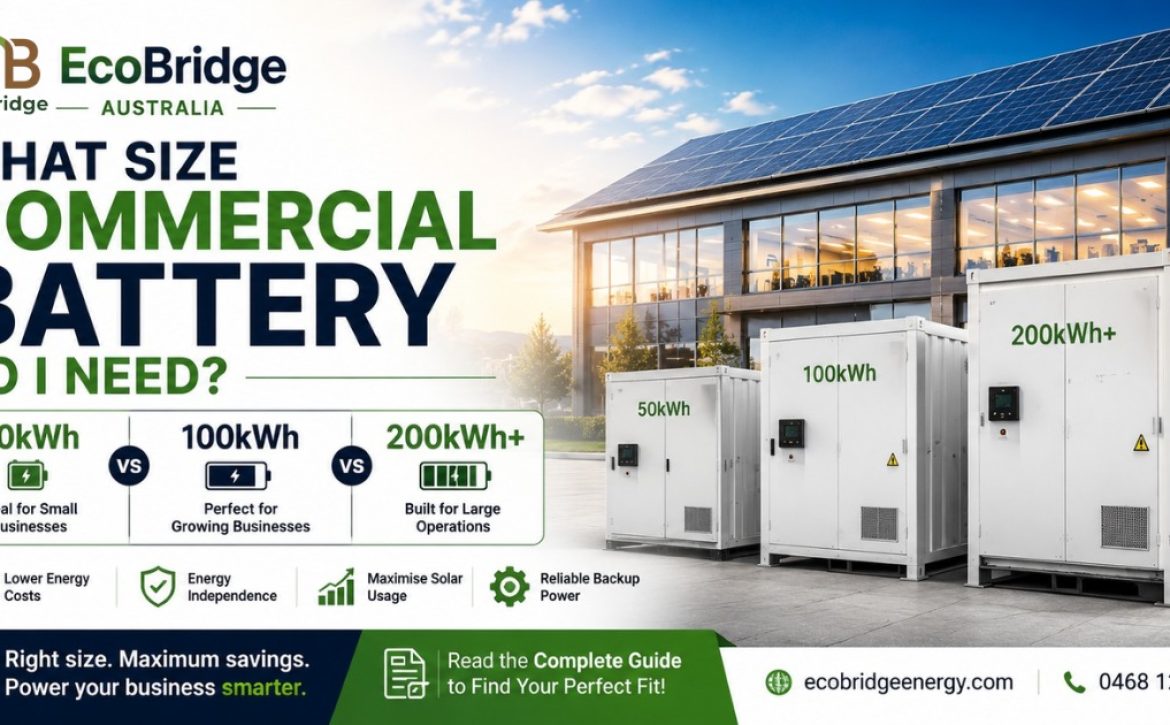
What Size Commercial Battery Do I Need? 50kWh vs 100kWh vs 200kWh+

Choosing a commercial battery is not simply a matter of picking the biggest system that fits your budget.

For Australian businesses, the right battery size depends on how much electricity you use, when you use it, how much solar you generate, your peak demand, available space and how you want the battery to operate.

A 50kWh battery may be more than enough for one business, while a larger warehouse, factory or hospitality business may benefit from 100kWh, 200kWh or considerably more.

So how do you know which option makes sense for your business?

In this guide, we compare 50kWh, 100kWh and 200kWh+ commercial battery systems, what each can potentially be used for, and the factors you should consider before investing.

Why Are Businesses Installing Commercial Batteries?

Solar panels can significantly reduce the amount of electricity a business purchases from the grid during daylight hours.

But there is a problem for many businesses:

Your electricity usage doesn’t always match your solar production.

A business may generate plenty of solar around midday but still consume electricity:

  • Early in the morning
  • Late in the afternoon
  • In the evening
  • Overnight
  • During periods of high production or demand

A battery allows excess solar generation to be stored and used later, helping businesses increase the amount of generated energy they can consume themselves.

For some businesses, battery storage can also form part of a broader strategy to manage periods of high electricity demand.

The Australian Government’s energy guidance notes that commercial batteries can help businesses store solar energy for later use and potentially reduce electricity purchases and peak demand, depending on the business and tariff structure.

50kWh vs 100kWh vs 200kWh+: What’s the Difference?

There isn’t one battery size that is right for every business.

Think of battery capacity as the amount of energy the battery can store.

For example:

  • 50kWh = up to 50kWh of stored energy
  • 100kWh = up to 100kWh
  • 200kWh = up to 200kWh

Actual usable capacity, charge/discharge limits and system performance depend on the battery technology, inverter, configuration and operating conditions.

Here’s a simplified comparison:

Battery size Often worth considering for Typical objective
50kWh Small businesses, offices, retail, smaller commercial sites Solar self-consumption
100kWh Medium commercial sites, larger retail, hospitality Greater solar utilisation + peak management
200kWh+ Large facilities, warehouses, factories, high-energy businesses Large-scale energy management

These are general categories rather than strict rules. A business shouldn’t select a battery purely based on its size.

Is a 50kWh Commercial Battery Enough?

A 50kWh battery can be a practical starting point for businesses that have moderate electricity consumption and a suitable solar system.

It can be particularly relevant for businesses that want to:

Store excess solar

Instead of exporting surplus solar generation during the day, the battery can store some of that energy for later use.

Increase solar self-consumption

If your business has electricity demand outside the strongest solar-generation hours, stored energy can potentially be used later.

Reduce grid reliance

Using stored energy when appropriate can reduce the amount of electricity purchased from the grid.

Keep the system relatively compact

A smaller battery generally requires less physical space than a larger commercial installation, although installation requirements vary considerably between products and sites.

Who might consider 50kWh?

Examples could include:

  • Small offices
  • Retail stores
  • Cafés and restaurants
  • Professional practices
  • Small warehouses
  • Workshops
  • Smaller commercial buildings

But the important question isn’t simply:

“Do I need 50kWh?”

It’s:

“How much energy does my business actually need to store?”

When Does a 100kWh Battery Make Sense?

A 100kWh battery provides roughly twice the nominal storage capacity of a 50kWh system.

For businesses with higher daytime solar generation and greater electricity consumption, this can provide more flexibility.

A 100kWh system may be worth investigating when a business has:

  • A larger commercial solar system
  • Significant daytime electricity consumption
  • Meaningful electricity usage after sunset
  • Higher daily energy consumption
  • Greater surplus solar generation
  • A need for more substantial energy storage

For example, imagine a business produces substantial excess solar energy during the middle of the day but continues operating well into the evening.

A larger battery may allow more of that solar energy to be shifted from the middle of the day into later operating periods.

However, bigger doesn’t automatically mean better.

If your business regularly has insufficient excess solar to charge a 100kWh battery, installing additional storage may not provide the expected financial benefit.

What About 200kWh+ Commercial Batteries?

Once you move into the 200kWh+ range, you’re generally looking at substantially larger commercial energy-storage applications.

These systems may be relevant for businesses such as:

  • Manufacturing facilities
  • Large warehouses
  • Distribution centres
  • Shopping centres
  • Large hospitality operations
  • Agricultural businesses
  • Cold storage facilities
  • High-energy commercial sites
  • Businesses operating for extended hours

A larger battery can provide considerably more stored energy, but the economics become increasingly dependent on the site’s actual electricity profile.

For these projects, battery sizing should generally be based on detailed energy data rather than a simple rule of thumb.

The Biggest Mistake: Choosing a Battery Based on Solar Size Alone

One of the most common mistakes businesses can make is thinking:

“I have a 100kW solar system, so I need a 100kWh battery.”

That’s not necessarily correct.

Solar capacity and battery capacity are two different things.

A 100kW solar system describes the potential power output of the solar array under appropriate conditions.

A 100kWh battery describes its nominal energy storage capacity.

Your battery should be assessed alongside:

  • Solar generation
  • Electricity consumption
  • Load profile
  • Peak demand
  • Operating hours
  • Electricity tariff
  • Export arrangements
  • Battery power rating
  • Available installation space
  • Future energy requirements

Your Electricity Bill Can Tell You a Lot

One of the easiest ways to start assessing battery requirements is to look at your business electricity bills.

But the total bill isn’t enough.

A proper assessment should ideally examine interval electricity data where available.

This can show:

  • When are you using electricity?
  • How much electricity are you using?
  • When does your demand peak?
  • How much solar are you currently exporting?
  • What happens outside your solar-generation hours?

These answers are much more useful than simply looking at your monthly electricity spend.

Battery Size vs Battery Power: Don’t Confuse the Two

This is particularly important for commercial systems.

kWh = energy capacity

kW = power

A 100kWh battery doesn’t automatically mean it can deliver 100kW of power.

For example, depending on the system configuration, a battery could have:

100kWh capacity + 50kW power

or another power-to-energy ratio.

Why does this matter?

Imagine a business has a large short-duration power requirement.

Having plenty of stored energy isn’t necessarily enough if the battery and inverter cannot provide the required power at that moment.

That’s why commercial battery design should consider both energy capacity and power requirements.

How Long Can a Commercial Battery Run My Business?

This is one of the most common questions businesses ask.

The answer depends on your actual load.

A simplified example:

If a business was consuming an average of 25kW, then a 100kWh battery could theoretically provide around:

100 ÷ 25 = 4 hours

However, this is only a simplified calculation.

Real-world operation depends on factors such as:

  • Usable battery capacity
  • Battery state of charge
  • Inverter efficiency
  • Maximum discharge rate
  • Simultaneous loads
  • Operating conditions
  • System controls

Therefore, you shouldn’t assume that a 100kWh battery will automatically provide four hours of backup or operation.

Should I Choose 50kWh, 100kWh or 200kWh+?

Here’s a simple way to think about it.

Consider 50kWh if:

Your business has moderate energy consumption and you’re primarily looking to increase solar self-consumption and shift some excess solar into later periods.

Consider 100kWh if:

You have a larger solar installation, higher electricity consumption and enough surplus solar or suitable operating economics to justify additional storage.

Consider 200kWh+ if:

Your business has substantial energy consumption, large solar generation, significant peak demand or extended operating hours that can make larger-scale storage worthwhile.

But don’t make the final decision from a generic table.

Your electricity data should determine the system.

What Does a Commercial Battery System Cost?

There isn’t a single price for a 50kWh, 100kWh or 200kWh commercial battery.

The installed cost can depend on:

  • Battery brand and technology
  • Inverter capacity
  • Number of battery modules
  • Switchboard upgrades
  • Electrical infrastructure
  • Installation complexity
  • Site access
  • Monitoring and control systems
  • Backup requirements
  • Civil works
  • Compliance requirements
  • Network requirements

That’s why comparing batteries purely on $/kWh can be misleading.

A cheaper battery may not provide the same power output, warranty, integration capabilities or installation requirements as another system.

Is a Bigger Commercial Battery Always Better?

No.

The objective isn’t to install the largest battery possible.

The objective is to install a battery that makes sense for the business.

For example, if a 200kWh battery frequently sits partially charged because there isn’t enough excess solar or suitable evening consumption, the additional capacity may not provide the expected return.

On the other hand, if a business consistently has substantial excess solar and significant electricity consumption later in the day, a smaller battery could leave valuable solar energy unused.

The right system is about matching storage to your energy profile.

What Information Do You Need to Size a Commercial Battery?

Before recommending a commercial battery, an installer or energy specialist will typically want information such as:

  1. Electricity bills

Ideally, several recent bills.

  1. Interval data

Where available, this can provide much better insight into your consumption pattern.

  1. Solar system details

Existing or proposed solar capacity, inverter specifications and expected generation.

  1. Business operating hours

A business operating 24/7 has a very different energy profile from one operating 8am–5pm.

  1. Site details

Roof area, switchboard configuration and available battery installation space can all matter.

  1. Your objective

Are you primarily looking to:

  • Reduce electricity costs?
  • Increase solar self-consumption?
  • Manage peak demand?
  • Reduce grid reliance?
  • Add energy resilience?
  • Prepare for future electrification?

The answer can influence the ideal system configuration.

What About Battery Backup?

If you’re considering a battery because you want protection during a grid outage, make sure you specifically discuss backup capability.

Not every commercial battery installation automatically provides whole-business backup.

The required system may depend on:

  • Essential loads
  • Switchboard configuration
  • Inverter capability
  • Battery power output
  • Automatic transfer equipment
  • Generator integration
  • Site electrical design

A business might therefore choose to back up only critical equipment rather than the entire facility.

The Right Commercial Battery Is About Your Business, Not a Number

A 50kWh battery isn’t necessarily better than a 100kWh battery.

And a 200kWh system isn’t automatically the best investment.

The right solution depends on the relationship between:

Solar generation → Business consumption → Battery storage → Grid usage

The goal is to design a system that works with your actual operating profile.

For some businesses, that could mean 50kWh.

For others, 100kWh may be more appropriate.

And for high-energy commercial facilities, a 200kWh+ system may be worth investigating.

Want to Know What Size Battery Your Business Actually Needs?

Rather than guessing between 50kWh, 100kWh and 200kWh+, get your business’s energy usage assessed against its solar generation and operating profile.

A commercial solar and battery assessment can help determine:

  • Recommended battery capacity
  • Required inverter power
  • Solar system size
  • Potential energy savings
  • Battery utilisation
  • Potential payback
  • Suitable financing options

Submit your business details and electricity information for a commercial solar + battery assessment.

[Get a Commercial Energy Assessment →]

Every site is different. Battery sizing, savings and payback should be confirmed using the business’s actual electricity consumption, solar generation, tariff and site conditions.

EcoBridge Australia – Contact Details

EcoBridge Australia

FAQs: What Size Commercial Battery Do I Need? (50kWh vs 100kWh vs 200kWh+)

1. How do I know what size commercial battery my business needs?

The right battery size depends on your daily energy consumption, peak power demand, backup duration requirements, and whether you’re using solar. Review your electricity bills and identify how much energy (kWh) your business uses during the hours you want battery support.

2. Who is a 50kWh commercial battery best for?

A 50kWh battery is ideal for small businesses such as retail stores, cafés, offices, clinics, salons, and small workshops. It can provide backup power for essential loads or reduce electricity costs during peak tariff hours.

3. Is a 100kWh battery enough for a medium-sized business?

Yes. A 100kWh battery is a common choice for medium-sized businesses, including restaurants, supermarkets, warehouses, schools, and manufacturing units with moderate energy needs. It offers longer backup time and greater savings through peak shaving.

4. When should I consider a 200kWh or larger battery system?

Choose a 200kWh+ battery if you operate a large commercial facility, factory, data center, hotel, hospital, or logistics hub with high energy consumption. These systems support larger loads, longer backup times, and integration with larger solar installations.

5. What’s the difference between kWh and kW?
  • kWh (kilowatt-hour): Measures how much energy the battery stores.
  • kW (kilowatt): Measures how much power the battery can deliver at one time.

A battery may store 100kWh but have a power output of 50kW or 100kW, depending on its design.

6. How long will a commercial battery provide backup power?

Backup time depends on the connected load. For example:

Battery SizeApproximate Backup
50kWh~5 hours for a 10kW load
100kWh~5 hours for a 20kW load
200kWh~5 hours for a 40kW load

Actual backup duration varies based on battery efficiency and depth of discharge.

7. Can I use a commercial battery without solar panels?

Yes. Commercial batteries can charge from the electrical grid and provide backup during outages or reduce demand charges. However, pairing a battery with solar usually increases long-term savings.

8. Can I expand my battery system later?

Many commercial battery systems are modular, allowing you to add additional battery units as your energy needs grow. Check compatibility with your inverter and battery management system before expanding.

9. How much can a commercial battery reduce electricity bills?

Savings depend on your tariff structure and usage pattern. Businesses can reduce costs through peak shaving, time-of-use energy shifting, solar energy storage, and avoiding high demand charges.

10. What factors affect the battery size I should choose?

Consider:

  • Daily energy usage (kWh).
  • Peak demand (kW).
  • Required backup duration.
  • Critical equipment that must stay powered.
  • Solar system size (if applicable).
  • Future business expansion plans
Read More

Commercial Solar and Battery Systems for WA Businesses: The Complete Guide to Reducing Energy Costs in Western Australia

Electricity prices continue to rise across Western Australia, putting pressure on businesses of all sizes. Whether you operate a warehouse in Perth, a manufacturing facility in Kwinana, a retail store in Fremantle, or a regional agricultural business, energy costs are becoming one of the largest operating expenses.

Commercial solar and battery storage systems offer a practical, long-term solution. By generating your own electricity during the day and storing excess energy for use during peak periods or outages, businesses can dramatically reduce power bills while improving energy reliability.


At EcoBridge Australia, we help Western Australian businesses design and install commercial solar and battery solutions that maximize savings and deliver long-term returns.

Why WA Businesses Are Investing in Commercial Solar

Western Australia enjoys some of the highest solar radiation levels in the world, making it one of the best locations for commercial solar installations.

Businesses benefit from:

  • Lower electricity costs
  • Protection from rising energy prices
  • Reduced carbon emissions
  • Improved energy independence
  • Better business sustainability
  • Increased property value
  • Positive environmental branding

For many businesses, commercial solar pays for itself within several years while continuing to generate savings for more than 25 years.


Why Add Battery Storage?

Solar panels generate electricity during daylight hours. However, many businesses consume significant energy early in the morning, evenings, or during cloudy periods.

Battery storage solves this problem by storing excess solar energy generated during the day.

Benefits include:

Lower Peak Demand Charges

Commercial electricity bills often include demand charges. Batteries help reduce these expensive peak demand periods.

Backup Power During Outages

Battery systems provide backup power, helping businesses continue operating during unexpected blackouts.

Increased Solar Self-Consumption

Instead of exporting excess electricity back to the grid at low feed-in tariffs, businesses can use stored energy when electricity prices are highest.

Energy Independence

Less dependence on the electricity grid means greater protection against future price increases.


Which Businesses Benefit Most?

Commercial solar and battery storage systems are ideal for:

  • Manufacturing facilities
  • Warehouses
  • Retail centres
  • Shopping complexes
  • Hotels
  • Restaurants
  • Farms
  • Schools
  • Hospitals
  • Office buildings
  • Automotive workshops
  • Cold storage facilities
  • Logistics companies
  • Mining support businesses

Any business with daytime electricity usage can significantly reduce operating costs with solar.


Typical Commercial Solar System Sizes

The right system depends on your business’s electricity usage.

Business TypeRecommended Solar Size
Small Office20–30 kW
Retail Store30–50 kW
Medium Warehouse50–100 kW
Factory100–250 kW
Industrial Facility250 kW+

Battery capacity is selected based on your load profile and backup requirements.


How Much Can WA Businesses Save?

Savings depend on:

  • Electricity consumption
  • System size
  • Battery capacity
  • Peak demand charges
  • Energy usage patterns

Many businesses reduce electricity costs by 40% to 80%, depending on how much solar energy they consume on-site.

For businesses with high daytime electricity usage, commercial solar can generate substantial annual savings while providing excellent return on investment.


Components of a Commercial Solar and Battery System

A complete commercial energy solution includes:

Solar Panels

High-efficiency commercial solar panels convert sunlight into electricity.

Commercial Inverters

Inverters convert DC electricity into AC electricity suitable for business operations.

Battery Storage

Commercial batteries store unused solar power for later use.

Energy Monitoring

Smart monitoring systems provide real-time insights into:

  • Solar production
  • Battery performance
  • Grid usage
  • Energy savings

Business owners can monitor their systems remotely through mobile apps or online dashboards.


Government Incentives for WA Businesses

Australian businesses may be eligible for government incentives that reduce the upfront cost of commercial solar installations.

These may include:

  • Small-scale Technology Certificates (STCs) for eligible systems
  • Large-scale Generation Certificates (LGCs) for larger installations
  • Accelerated depreciation benefits (subject to current tax regulations)
  • State-based commercial energy initiatives where applicable

Our team helps businesses identify available incentives and maximize potential savings.


Commercial Battery Options

Modern battery systems offer excellent performance and scalability.

Popular commercial battery technologies include:

  • Sungrow
  • Sigenergy
  • Alpha ESS
  • BYD
  • Tesla Powerwall (small commercial)
  • Huawei

The best battery depends on:

  • Energy consumption
  • Backup requirements
  • Available installation space
  • Budget

EcoBridge Australia helps businesses choose the most suitable solution.


Commercial solar and battery storage systems Installation Process

1. Energy Assessment

We analyse your electricity bills and energy usage.

2. Site Inspection

Our experts assess roof space, switchboards, shading, and structural suitability.

3. System Design

A customised solar and battery solution is designed for your business.

4. Quote

You’ll receive a transparent proposal outlining projected savings, costs, and ROI.

5. Installation

CEC-accredited installers complete the installation safely and efficiently.

6. Commissioning

Why Choose EcoBridge Australia?

At EcoBridge Australia, we specialise in delivering reliable renewable energy solutions tailored to Australian businesses.

Your system is tested, connected, and monitored to ensure optimal performance.

Our advantages include:

  • CEC-accredited installers
  • Premium solar panels and battery systems
  • Custom commercial designs
  • Honest advice
  • Ongoing local support
  • High-quality workmanship
  • Competitive pricing
  • Long-term warranties

Our goal is to help Western Australian businesses reduce operating costs while transitioning to clean, renewable energy.


Future-Proof Your Business

Electricity prices are unlikely to decrease in the coming years.

Businesses that invest in commercial solar and battery systems today gain:

  • Lower operating costs
  • Greater energy security
  • Improved sustainability
  • Stronger competitive advantage
  • Long-term financial savings

The earlier you switch, the sooner your business starts saving.


Get a Free Commercial Solar Quote

If you’re ready to reduce electricity costs and improve your business’s energy efficiency, EcoBridge Australia can help.

Our commercial solar specialists provide:

  • Free site assessments
  • Tailored system designs
  • Transparent pricing
  • Professional installation
  • Ongoing technical support

Contact us today to discover how much your Western Australian business could save with commercial solar and battery storage.


Contact EcoBridge Australia

You can get in touch with EcoBridge Australia for a free commercial solar consultation:

  • Website:https://ecobridgeenergy.com/
  • Email: info@ecobridgeenergy.com

Frequently Asked Questions (FAQs)

1. Is commercial solar worth it for businesses in Western Australia?

Yes. Western Australia receives abundant sunshine, making commercial solar one of the most cost-effective ways for businesses to reduce electricity bills and improve energy independence.


2. How much can my business save with commercial solar?

Savings vary depending on your energy usage and system size, but many WA businesses reduce electricity costs by 40%–80%.


3. Why should I install a battery with my commercial solar system?

Battery storage allows you to store excess solar energy for use during peak electricity pricing, at night, or during power outages, increasing your energy savings and reliability.


4. How long do commercial solar panels last?

Most high-quality commercial solar panels are designed to last 25 years or more, with minimal maintenance.


5. What size solar system does my business need?

The ideal system size depends on your electricity consumption, available roof space, and future energy requirements. EcoBridge Australia provides customised system designs based on your business needs.


6. Are government rebates available for commercial solar?

Eligible businesses may qualify for Australian renewable energy incentives such as STCs or LGCs, depending on the system size and applicable regulations.


7. Will solar work during a power outage?

Standard grid-connected solar systems shut down during outages for safety reasons. However, a battery system with backup capability can continue supplying power to selected business circuits.


8. How long does installation take?

Most commercial solar installations are completed within a few days to several weeks, depending on the project size, site conditions, and approvals.


9. What maintenance does a commercial solar system require?

Commercial systems require periodic inspections, cleaning when necessary, and performance monitoring to ensure optimal efficiency.


10. Why choose EcoBridge Australia for commercial solar in WA?

EcoBridge Australia offers tailored commercial solar and battery solutions, CEC-accredited installations, premium equipment, transparent advice, and ongoing support to help businesses maximize long-term energy savings.

Read More

Federal Battery Rebate vs NSW Battery Incentives: Which One Saves You More?

If you’re considering installing a home battery, you’ve probably come across the Federal Battery Rebate and NSW Battery Incentives. With new government support available, many homeowners across New South Wales are wondering which program offers the greatest financial benefit.

Understanding the difference between the Federal Battery Rebate and NSW Battery Incentives is essential before investing in battery storage. While both programs are designed to make home batteries more affordable, they provide different types of financial support and have different eligibility requirements.

This guide explains how each program works, compares their benefits, and helps you determine which option could deliver the best value for your home.

What Is the Federal Battery Rebate?

The Federal Battery Rebate is an Australian Government initiative designed to reduce the upfront cost of installing eligible home battery systems. The program encourages more Australian households to store excess solar energy, reduce reliance on the electricity grid, and lower long-term electricity costs.

For most homeowners, the Federal Battery Rebate provides an immediate reduction in the installation cost, making battery storage more accessible and affordable.

What Are NSW Battery Incentives?

NSW Battery Incentives are state government programs that encourage homeowners to install battery storage systems and participate in Virtual Power Plants (VPPs). Depending on eligibility and available programs, homeowners may receive additional financial benefits beyond the Federal Battery Rebate.

These incentives are designed to improve grid stability while helping households maximise the value of their solar energy systems.

Federal Battery Rebate vs NSW Battery Incentives: Key Differences

FeatureFederal Battery RebateNSW Battery Incentives
Managed byAustralian GovernmentNSW Government
Primary PurposeReduce upfront battery installation costsEncourage battery adoption and Virtual Power Plant participation
Main BenefitUpfront financial rebateAdditional incentives and ongoing VPP benefits
EligibilityEligible battery systems meeting government requirementsNSW homeowners who meet program eligibility
Best ForLower installation costsLong-term energy savings and additional incentives

Although these programs differ, they often complement each other rather than compete.

Can You Combine the Federal Battery Rebate and NSW Incentives?

One of the most common questions homeowners ask is whether both programs can be claimed together.

In many cases, eligible NSW homeowners may be able to access both the Federal Battery Rebate and available NSW Battery Incentives, subject to current government rules and eligibility requirements. Combining both programs can significantly reduce the overall cost of installing a home battery system while increasing long-term savings.

Which Option Saves More?

The answer depends on several factors, including:

  • Battery size
  • Your property’s eligibility
  • Household electricity usage
  • Solar system capacity
  • Participation in eligible Virtual Power Plant programs

The Federal Battery Rebate generally provides the largest immediate saving by reducing installation costs, while NSW Battery Incentives can deliver additional long-term value through ongoing incentives and energy savings.

For many households, combining both programs provides the greatest financial benefit.

Why Install a Home Battery Now?

Government rebates and incentive programs can change over time. Installing a battery while support programs are available can help you:

  • Reduce your electricity bills
  • Store excess solar energy for later use
  • Increase your home’s energy independence
  • Protect against rising electricity prices
  • Improve backup power during outages
  • Maximise available government rebates and incentives

Taking advantage of available support today could significantly reduce your investment while improving your home’s energy efficiency.

Why Choose EcoBridge Australia?

At EcoBridge Australia, we make it easy to understand the available battery rebates and incentives and help you maximise your savings.

Our experienced team can help you:

  • Assess your eligibility for government rebates and incentives
  • Recommend the most suitable battery system for your home
  • Explain available Federal and NSW support programs
  • Provide professional installation by qualified technicians
  • Help you maximise your long-term energy savings

Whether you’re installing a new battery or upgrading your existing solar system, EcoBridge Australia is committed to providing reliable, cost-effective renewable energy solutions tailored to your needs.

Contact EcoBridge Australia

Ready to start saving with a home battery?

EcoBridge Australia

📧 Email:info@ecobridgeenergy.com

🌐 Website: https://ecobridgeenergy.com/

Contact our friendly team today for a free consultation and discover how much you could save with the right battery solution.

Conclusion

Choosing between the Federal Battery Rebate and NSW Battery Incentives doesn’t necessarily mean selecting one over the other. Depending on your eligibility, you may be able to access both programs and significantly reduce the cost of installing a home battery system.

EcoBridge Australia can help you understand your options, assess your eligibility, and recommend the best battery solution for your home. Get in touch with our team today and take the next step towards lower energy bills and greater energy independence.

Frequently Asked Questions

1. What is the difference between the Federal Battery Rebate and NSW Battery Incentives?

The Federal Battery Rebate provides an upfront discount on eligible battery installations, while NSW Battery Incentives offer additional financial benefits, including incentives for participating in Virtual Power Plant programs.

2. Can I claim both the Federal Battery Rebate and NSW Battery Incentives?

In many cases, yes. Eligible NSW homeowners may be able to access both programs, subject to current government eligibility requirements.

3. Which option offers greater savings?

The Federal Battery Rebate usually delivers immediate savings on installation costs, while NSW Battery Incentives can provide additional long-term value. Combining both programs often results in the highest overall savings.

4. Who is eligible?

Eligibility depends on the battery system installed, your location, and the specific requirements of each government program. EcoBridge Australia can help determine your eligibility.

5. Is installing a home battery worth it?

For many Australian homeowners, installing a battery is a worthwhile investment. It can reduce electricity bills, increase solar self-consumption, provide backup power during outages, and improve long-term energy independence while taking advantage of available government incentives.