Category: home battery rebates

Read More

Sungrow SBH Home Battery in Australia: Capacity Options, Features, Benefits and Is It Right for Your Home?

Store More Solar Energy with the Sungrow SBH Battery

Are you looking for a reliable home battery that allows you to store excess solar energy and use it whenever your household needs it?

With electricity prices continuing to affect Australian households, more homeowners are considering solar battery storage to reduce their reliance on the electricity grid and make better use of their solar power.

The Sungrow SBH Home Battery is a high-voltage residential energy storage solution designed for households seeking flexible storage capacities, advanced energy management and reliable solar energy storage.

Whether you already have rooftop solar or are planning a new solar and battery installation, the Sungrow SBH range offers several capacity options to consider.

At EcoBridge Australia, we help homeowners explore suitable solar battery solutions based on their electricity consumption, property requirements and future energy goals.

What Is the Sungrow SBH Home Battery?

The Sungrow SBH is a modular, high-voltage lithium battery storage system designed to operate with compatible Sungrow hybrid inverters.

Its modular design allows homeowners to select different storage capacities using stackable 5kWh battery modules.

The system stores excess electricity generated by your solar panels during daylight hours, allowing you to use that energy in the evening, overnight or when solar production is limited.

When correctly configured with compatible equipment, the system may also provide backup electricity during grid outages.

This makes the Sungrow SBH an option worth exploring for Australian households looking to improve solar self-consumption and increase their energy independence.

Sungrow SBH Battery Capacity Options

One of the major advantages of the Sungrow SBH range is its range of storage capacities.

Commonly offered Australian configurations include:

  • 20kWh – SBH200: Suitable for households looking for substantial home battery storage.
  • 25kWh – SBH250: An additional storage option for homes with higher evening electricity consumption.
  • 30kWh – SBH300: Designed for households requiring greater energy storage.
  • 35kWh – SBH350: An option for larger households with significant electricity requirements.
  • 40kWh – SBH400: The largest standard single-stack configuration in this range, designed for homes with substantial storage needs.

The SBH platform may also support parallel configurations, subject to manufacturer specifications and compatible system design.

Choosing the correct battery capacity is important. A larger battery does not necessarily mean greater savings. Your ideal system should reflect your electricity consumption, solar generation, available energy exports and budget.

Key Features and Benefits of the Sungrow SBH Battery

1. Flexible Modular Battery Design

The Sungrow SBH features a modular design using 5kWh battery modules.

This allows different storage capacities to be configured according to individual household requirements.

It also provides flexibility when planning a solar and battery system for current and future energy needs.

2. Advanced High-Voltage Technology

The SBH uses high-voltage battery technology and is designed to work with compatible Sungrow hybrid inverters.

This integrated approach supports efficient energy management and communication between the battery and inverter.

3. Lithium Iron Phosphate (LFP) Technology

The battery uses lithium iron phosphate chemistry, commonly known as LFP.

LFP technology is widely used in residential energy storage because of its thermal stability, durability and suitability for regular charging and discharging.

4. Substantial Energy Storage Capacity

With commonly offered configurations ranging from 20kWh to 40kWh, the Sungrow SBH can be considered for households with higher electricity requirements.

It may be particularly worth assessing for properties with:

  • Ducted air conditioning.
  • Swimming pools and pumps.
  • Multiple household appliances.
  • Electric vehicle charging requirements.
  • Higher evening and overnight electricity consumption.

The actual operating time depends on battery charge, appliance consumption, inverter output and system configuration.

5. Indoor and Outdoor Installation Flexibility

The Sungrow SBH features an IP55 protection rating and is designed for suitable indoor or outdoor installation locations.

However, the final installation location must meet manufacturer requirements, applicable Australian standards, environmental conditions and required clearances.

6. Smart Energy Monitoring with iSolarCloud

With a compatible Sungrow system, homeowners can use the iSolarCloud monitoring platform to view important energy information.

Depending on the system configuration, monitoring can provide information about:

  • Solar electricity generation.
  • Battery charging and discharging.
  • Household electricity consumption.
  • Grid electricity imports and exports.
  • Overall system performance.

This helps homeowners better understand how their solar and battery system operates.

7. Backup Power Compatibility

The Sungrow SBH can form part of a backup power solution when paired with compatible inverter equipment and an appropriately designed backup arrangement.

This can help supply selected household circuits during a grid outage.

However, whole-home backup is not automatically included with every installation. Backup capacity, supported circuits and additional electrical equipment must be assessed before installation.

Is the Sungrow SBH Battery Suitable for Your Home?

The Sungrow SBH may be worth considering if you:

  • Already have solar panels and want to store more excess solar electricity.
  • Use substantial amounts of electricity after sunset.
  • Own a larger home with higher energy consumption.
  • Want a high-capacity battery storage solution.
  • Are planning a new solar and battery installation.
  • Prefer an integrated battery and inverter solution from Sungrow.

However, it may not be the most economical option for every household.

If your electricity consumption is relatively low or your solar system produces limited excess electricity, a smaller battery may provide better value.

The best approach is to assess your household’s energy requirements before deciding on battery capacity.

How Do You Choose the Right Sungrow SBH Battery Capacity?

Before selecting a battery, consider these three important factors.

1. Household Electricity Consumption

Review your recent electricity bills and smart meter data to understand your average daily electricity consumption.

This will help identify how much stored energy your household may need.

2. Solar Generation and Excess Electricity

If you already have solar panels, check how much excess electricity your system exports during the day.

A battery can store some of this surplus electricity for use later.

3. Evening and Overnight Energy Requirements

Consider how much electricity your household uses after sunset.

Air conditioning, refrigeration, lighting, pool pumps and other appliances can all influence your battery requirements.

A professional assessment should also consider inverter compatibility, available installation space, electrical infrastructure, backup requirements and your budget.

Why Choose EcoBridge Australia for Your Solar Battery Requirements?

At EcoBridge Australia, we believe that choosing the right solar battery starts with understanding your property’s energy needs.

We help Australian homeowners explore suitable solar panels, battery storage and renewable energy solutions.

Our approach focuses on:

  • Personalised solar and battery assessments.
  • Suitable battery capacity recommendations.
  • Guidance on solar and inverter compatibility.
  • Residential and commercial energy solutions.
  • Assistance with exploring available battery incentives.
  • Connecting customers with suitable installation professionals.
  • Solutions designed around long-term energy requirements.

Our goal is to make your transition towards smarter energy storage simple and straightforward.

Get a Personalised Sungrow SBH Battery Assessment

Every home has different electricity requirements, which is why selecting the right battery capacity is important.

If you are considering the Sungrow SBH Home Battery, EcoBridge Australia can help you explore suitable storage options and understand the requirements for your property.

Get in touch with our team to discuss:

  • Sungrow SBH battery capacities from 20kWh to 40kWh.
  • Compatibility with your existing solar installation.
  • New solar and battery system options.
  • Potential backup power configurations.
  • Available incentives and eligibility requirements.
  • Installation considerations and personalised quotations.

Contact EcoBridge Australia today to explore your solar battery options and take the next step towards smarter home energy management.

Contact EcoBridge Australia

EcoBridge Australia – Solar Panels, Battery Storage and Renewable Energy Solutions

Website: https://ecobridgeenergy.com/

Email: info@ecobridgeenergy.com

Request your free solar and battery assessment today!


Frequently Asked Questions About the Sungrow SBH Home Battery

1. What is the Sungrow SBH home battery?

The Sungrow SBH is a modular, high-voltage residential battery designed to store excess solar electricity for later household use. It works with compatible Sungrow hybrid inverters.

2. What Sungrow SBH battery sizes are available in Australia?

Commonly offered configurations include 20kWh, 25kWh, 30kWh, 35kWh and 40kWh. Availability should be confirmed with your installer.

3. Can I install a Sungrow SBH battery with my existing solar panels?

Potentially, yes. However, compatibility depends on your existing inverter, electrical configuration and system design. A compatible hybrid inverter or system upgrade may be required.

4. Is the Sungrow SBH a lithium battery?

Yes. The Sungrow SBH uses lithium iron phosphate (LFP) battery chemistry, which is widely used in residential energy storage applications.

5. Can the Sungrow SBH battery power my home during a blackout?

It can support backup power when installed with compatible inverter equipment and a correctly configured backup system. The available backup capacity and supported household circuits depend on the installation.

6. How long can a Sungrow SBH battery power a house?

Operating time depends on the battery’s available charge, household electricity consumption, inverter output and appliances being used.

For example, a home using less electricity during an outage may operate for longer than a property running several high-power appliances.

7. Is the Sungrow SBH suitable for larger Australian homes?

It may be suitable for larger properties with substantial electricity requirements, particularly where evening and overnight energy consumption is high.

A professional assessment can help determine the appropriate capacity.

8. Can I expand the Sungrow SBH battery capacity in the future?

The SBH platform supports modular configurations and certain parallel arrangements. However, future expansion depends on manufacturer compatibility, installation requirements and the existing system configuration.

9. Can the Sungrow SBH battery be installed outdoors?

The SBH has an IP55 protection rating and is designed for suitable indoor and outdoor locations. The installation must follow the manufacturer’s environmental, clearance and mounting requirements.

10. How can I monitor my Sungrow SBH battery?

Compatible Sungrow systems can be monitored through the iSolarCloud platform, allowing homeowners to view relevant information about solar generation, battery operation and electricity usage.

11. Is a 40kWh Sungrow SBH battery better than a 20kWh battery?

Not necessarily. A 40kWh battery offers greater storage capacity, but it may not provide better financial returns for every household.

Your electricity consumption, solar exports, battery utilisation and installation costs should all be considered.

12. Does the Sungrow SBH qualify for Australian battery rebates?

Eligibility depends on the applicable government incentive scheme, approved product requirements, installation date and installer accreditation.

Homeowners should confirm current eligibility and the applicable discount before purchasing.

13. How much does a Sungrow SBH battery cost in Australia?

The total cost depends on battery capacity, inverter compatibility, installation complexity, additional electrical work and any applicable incentives.

Contact EcoBridge Australia for a personalised assessment and quotation.

14. Does the Sungrow SBH require regular maintenance?

The battery is designed for automated operation and generally requires limited routine maintenance. Monitoring system performance and arranging inspections when recommended by the manufacturer or installer can help maintain reliable operation.

15. How do I choose the right Sungrow SBH battery for my property?

Start by reviewing your electricity bills, solar generation, existing inverter details and evening energy requirements.

EcoBridge Australia can help you explore suitable battery capacities and identify the system configuration that best matches your property.

Ready to explore Sungrow SBH battery storage for your home? Contact EcoBridge Australia today for personalised solar and battery guidance.

Read More

Is a 20–40 kWh Home Battery Right for Your Home? A Complete Guide to Energy Storage, Energy Independence and Long-Term Savings

As electricity prices continue to influence household budgets, more homeowners are looking for smarter ways to manage their energy consumption. Solar panels are already helping households generate clean electricity, but what happens when the sun goes down?

This is where a home battery storage system can make a significant difference.

A 20–40 kWh home battery system can provide substantial energy storage, helping households store excess solar power during the day and use it during the evening, at night, or when solar generation is limited.

But is a battery of this size right for your home?

At EcoBridge Energy, we believe the right energy solution starts with understanding your household’s electricity needs, lifestyle, and future energy goals.

In this guide, we explore the benefits of 20 kWh and 40 kWh home battery systems, how they work, who should consider them, and what to think about before investing.

1. What Is a 20–40 kWh Home Battery?

A home battery is an energy storage system that stores electricity for later use.

When your rooftop solar panels generate more electricity than your home needs, the excess energy can be stored in your battery instead of being exported to the electricity grid.

You can then use this stored electricity when:

  • Your solar panels are not generating power.
  • Your household uses more electricity in the evening.
  • Electricity prices are higher during peak periods.
  • You want backup power during a grid outage, if your system supports backup operation.

The kWh (kilowatt-hour) rating represents the amount of energy a battery can store.

20 kWh Home Battery

A 20 kWh battery can be a suitable option for households with moderate to high energy consumption, particularly those with solar panels and regular evening electricity usage.

40 kWh Home Battery

A 40 kWh battery offers greater storage capacity and may suit larger homes, households with higher electricity consumption, electric vehicles, or people looking for greater energy independence.

Actual usable energy depends on the battery’s specifications, reserve settings, and operating conditions.

2. Why Consider a Bigger Home Battery?

Choosing a larger battery can provide several advantages when its capacity matches your household’s energy requirements.

Bigger Energy Storage

A larger battery allows you to store more of the surplus electricity generated by your solar panels.

Instead of relying heavily on grid electricity after sunset, you can use more of the solar energy generated earlier in the day.

More Energy Self-Sufficiency

With sufficient solar generation and battery storage, your household may reduce its reliance on electricity retailers.

A well-designed system can help you power essential household appliances using stored solar energy.

Long-Term Savings Potential

A home battery can help reduce electricity bills by increasing self-consumption of solar energy and reducing grid imports.

Your actual savings depend on electricity tariffs, feed-in rates, battery efficiency, usage patterns, installation costs, and the amount of solar energy available.

3. Is a 20 kWh Battery Enough for Your Home?

A 20 kWh battery may be a good choice if:

  • You have a medium-sized household.
  • Your daily electricity consumption is moderate to high.
  • You already have a rooftop solar system.
  • You mainly want to cover evening and overnight electricity usage.
  • You want to reduce your dependence on grid electricity.

For example, a household using electricity for lighting, refrigeration, televisions, washing machines, and other everyday appliances may benefit from a properly sized 20 kWh storage system.

However, the actual performance depends on how much energy your appliances consume and the battery’s usable capacity and power output.

4. When Should You Choose a 40 kWh Battery?

A 40 kWh battery may be worth considering if your household has higher energy requirements.

It could be suitable for:

  • Large family homes with several occupants.
  • Homes with electric vehicle charging requirements.
  • Properties with multiple air conditioners.
  • Households using electric hot water systems.
  • Homes with high evening and overnight electricity consumption.
  • Properties seeking more substantial backup energy storage.

A larger battery can store more electricity, but it also needs sufficient solar generation or another suitable charging source.

The best solution is not necessarily the biggest battery. It is the system that matches your actual energy requirements.

5. 20 kWh vs 40 kWh: Which One Should You Choose?

Feature20 kWh Battery40 kWh Battery
Storage capacity20 kWh nominal40 kWh nominal
Energy storageSubstantialHigher
Suitable householdMedium to largeLarge or high-demand
Evening usageGood potential coverageGreater potential coverage
EV requirementsDepends on usageMore storage flexibility
Initial investmentGenerally lowerGenerally higher
Space requirementsUsually lessUsually more

Note: These are general comparisons, not guaranteed performance figures. Actual usable capacity, output, backup capability and savings depend on the selected battery and system design.

6. How Does a Home Battery Work with Solar Panels?

A solar battery works alongside your rooftop solar panels to make better use of the electricity your home generates.

During the day: Solar panels generate electricity to power your home. Any surplus electricity can charge the battery.

During the evening: When solar production decreases, your home can use electricity stored in the battery.

During night: Your battery can continue supplying electricity until its usable energy is depleted or the system switches to another power source.

During a power outage: A compatible battery system with correctly configured backup functionality can supply selected circuits or, where designed, more of the home.

Not every solar battery automatically provides backup power. Always confirm this feature before installation.

7. Important Things to Consider Before Installing a 20–40 kWh Battery

Before choosing your home battery, consider the following factors.

Your daily electricity consumption

Review your electricity bills to understand how much energy your household uses each day and when you use it.

Your existing solar system

Your solar panel capacity should be suitable for charging the proposed battery. An undersized solar system may not generate enough surplus electricity to make full use of a large battery.

Usable battery capacity

Check both nominal and usable capacity. A battery advertised as 20 kWh may provide less than 20 kWh of usable energy.

Battery power output

Storage capacity and power output are different. A battery may store a substantial amount of electricity but still have limits on how many appliances it can operate simultaneously.

Warranty and safety

Check the manufacturer’s warranty, expected battery life, safety certifications, installation requirements and after-sales support.

Future energy requirements

If you plan to purchase an electric vehicle, install additional appliances or expand your home, consider these changes when selecting your battery.

The Australian Government’s YourHome guide also recommends matching battery capacity to household consumption, solar generation, backup requirements and future energy needs. YourHome+2

8. Why Choose EcoBridge Energy?

At EcoBridge Energy, the goal is to help homeowners make informed decisions about solar energy and battery storage.

Choosing an energy storage system should be about more than selecting a capacity number. It should be about finding a practical solution that works with your household, electricity consumption and long-term plans.

With a suitable home battery solution, you can work towards:

  • Better utilisation of solar energy.
  • Reduced reliance on grid electricity.
  • Greater control over household energy consumption.
  • More flexibility in managing electricity costs.
  • Improved energy resilience with suitable backup configurations.

Whether you are considering a 20 kWh or 40 kWh home battery, the right system design is essential.

9. Is It Time to Upgrade Your Home Energy Storage?

If you already have solar panels but still purchase considerable electricity from the grid in the evening, adding battery storage may be worth exploring.

A 20–40 kWh battery could offer additional flexibility for households with higher energy requirements.

However, before investing, compare your daily electricity usage, solar generation, battery specifications, installation costs and expected financial benefits.

Make a smarter move towards energy independence with EcoBridge Energy.

Contact our team to discuss your home energy storage requirements and explore a suitable battery solution.

10. Contact EcoBridge Energy

EcoBridge Energy

Your partner in smarter energy solutions

Email:info@ecobridgeenergy.com

Website: https://ecobridgeenergy.com/

Frequently Asked Questions (FAQs)

1. What is a 20–40 kWh home battery?

A 20–40 kWh home battery is an energy storage system that stores electricity generated by solar panels or another compatible source for later household use.

2. Is a 20 kWh battery enough to power a house?

A 20 kWh battery may provide sufficient stored energy for many household needs, depending on daily electricity consumption, usable capacity, and appliance requirements.

3. Who should consider a 40 kWh home battery?

A 40 kWh battery may suit larger households, homes with electric vehicles, properties with high electricity consumption, and homeowners seeking greater energy storage capacity.

4. Can a home battery store excess solar energy?

Yes. A compatible battery system can store surplus electricity generated by rooftop solar panels during the day for use during evenings and periods of low solar generation.

5. Can a 20–40 kWh battery reduce electricity bills?

Yes, it can potentially reduce electricity bills by storing excess solar energy and reducing the amount of electricity purchased from the grid. Actual savings depend on energy consumption, electricity tariffs, solar generation and system costs.

6. Can a home battery provide electricity during a blackout?

Yes, if the battery system includes suitable backup functionality and has been correctly installed and configured. Some systems support essential circuits, while others may support a larger portion of the property.

7. How long can a 40 kWh battery power my home?

It depends on your household’s electricity consumption and the battery’s usable capacity.

For illustration, if 36 kWh is usable:

  • At 3 kWh per hour, it could theoretically supply 12 hours.
  • At 2 kWh per hour, it could theoretically supply 18 hours.
  • At 1 kWh per hour, it could theoretically supply 36 hours.

Actual runtime will vary because of conversion losses, operating conditions and power limitations.

8. Can I install a battery if I already have solar panels?

Yes. Many home battery systems can be added to existing solar installations. Compatibility with your solar inverter, electrical configuration and switchboard should be checked before installation.

9. Is a bigger home battery always better?

No. A bigger battery is not automatically more economical. The ideal capacity depends on household electricity usage, available surplus solar energy, budget and future energy requirements.

10. What is the difference between kW and kWh?

kWh measures how much energy a battery stores, while kW measures how much power it can deliver at a given time.

For example, a 20 kWh battery with a 5 kW output can theoretically deliver 5 kW of power for four hours, assuming the full 20 kWh is usable and ignoring losses.

11. How do I know which battery size is right for my home?

Review your electricity bills, daily consumption, solar generation, evening energy requirements and backup needs. A qualified installer can assess these factors and recommend a suitable system.

Read More

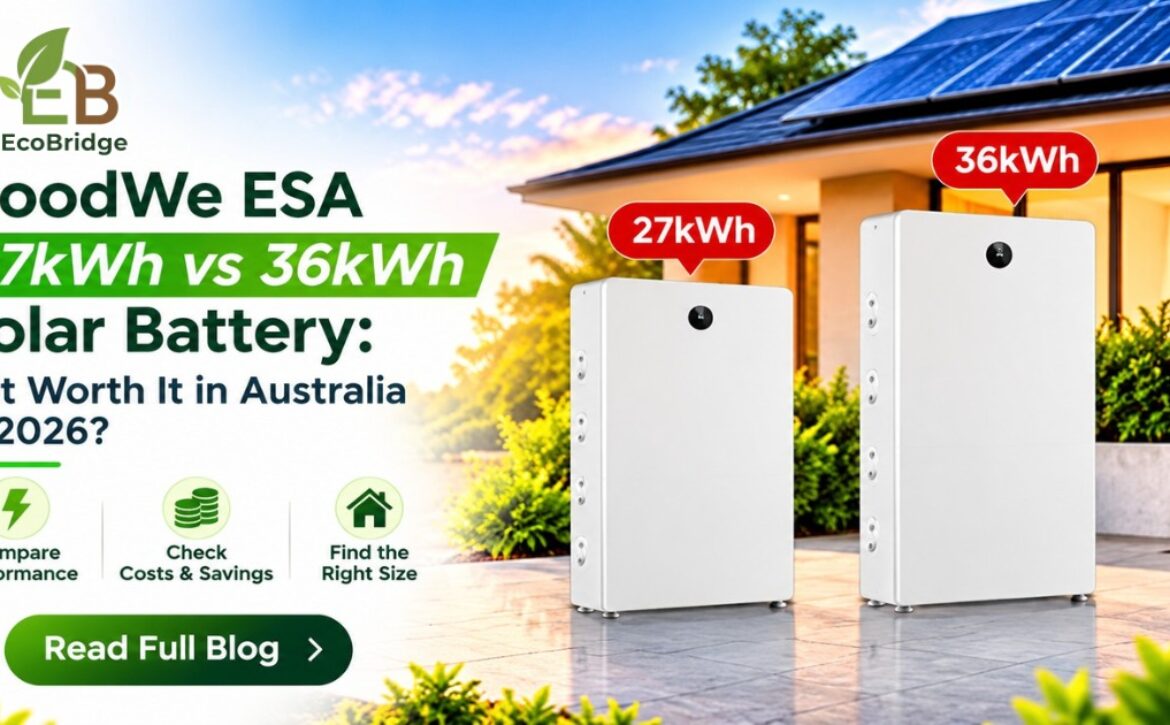
GoodWe ESA 27kWh vs 36kWh: Choosing the Right Solar Battery for Your Home

As electricity prices continue to influence household budgets across Australia, more homeowners are looking for smarter ways to generate, store and use their own electricity.

Solar panels can generate clean electricity during the day, but what happens when the sun goes down? This is where home battery storage becomes valuable.

Social

The GoodWe ESA battery system, with its modular 9kWh configuration, offers two larger storage options worth considering: 27kWh and 36kWh.

But which one is right for your home?

Should you invest in the 27kWh battery and keep your initial costs lower, or choose the 36kWh configuration for additional storage capacity?

At EcoBridge Australia, we believe the right battery should be selected according to your household’s energy consumption, solar generation, budget and future electricity requirements.

In this guide, we compare the GoodWe ESA 27kWh and 36kWh configurations to help you understand their differences and make a more informed decision.

What Is the GoodWe ESA 9kWh Battery?

The GoodWe ESA is an integrated energy storage solution designed to help homeowners manage their solar electricity more effectively.

Its modular battery configuration allows additional storage capacity to be included depending on the household’s energy requirements and compatible system design.

Based on the specified 9kWh module configuration:

  • 3 battery modules provide 27kWh nominal storage.
  • 4 battery modules provide 36kWh nominal storage.

Each 9kWh module is specified to provide approximately 8.85kWh of usable energy.

This modular approach gives homeowners the flexibility to consider different storage capacities rather than choosing a single fixed battery size.

However, compatibility with the inverter, electrical supply and approved system configuration should always be confirmed before installation.

GoodWe ESA 27kWh vs 36kWh: Specifications Compared

Understanding the differences between the two configurations is the first step towards choosing the right battery.

SpecificationGoodWe ESA 27kWhGoodWe ESA 36kWh
Battery modules3 × 9kWh4 × 9kWh
Nominal capacity27kWh36kWh
Approx. usable capacity26.55kWh35.40kWh
Battery chemistryLFPLFP
Additional storageStandard configuration9kWh more
Relative investmentGenerally lowerGenerally higher
Suitable householdHigh consumptionVery high consumption

Specifications are based on the stated 9kWh module configuration. Confirm the current manufacturer datasheet, approved inverter combinations and Australian product availability before purchasing.

The biggest difference is the additional 9kWh of nominal storage available with the 36kWh configuration.

However, a bigger battery does not automatically mean bigger savings. Your household must have sufficient solar generation to charge it and enough electricity demand to use the stored energy.

Why Choose the GoodWe ESA 27kWh Battery?

The GoodWe ESA 27kWh configuration may be suitable for households with substantial electricity consumption, particularly during the evening and overnight.

During daylight hours, your solar panels generate electricity. Any surplus energy can potentially be stored in the battery instead of being exported to the electricity grid.

When solar production decreases, the stored energy can help power compatible household appliances.

Key Benefits of a 27kWh Battery

A 27kWh configuration may be worth considering if you:

  • Have a large rooftop solar installation.
  • Regularly use air conditioning during the evening.
  • Have a household with several occupants.
  • Want to increase your solar self-consumption.
  • Have relatively high overnight electricity consumption.
  • Want substantial battery storage without adding a fourth module.

For example, imagine your household needs approximately 20–25kWh of battery-supplied electricity overnight.

A 27kWh nominal battery, offering approximately 26.55kWh of specified usable capacity, could be a suitable option, depending on operating conditions and conversion losses.

The main advantage is that you can access substantial energy storage without necessarily paying for the additional capacity of a 36kWh system.

Is the GoodWe ESA 36kWh Battery Worth the Upgrade?

The GoodWe ESA 36kWh configuration provides an additional 9kWh of nominal storage compared with the 27kWh option.

This additional capacity may benefit households with particularly high electricity consumption.

For example, homes with multiple air conditioners, electric hot water systems, swimming pool pumps and electric vehicle charging requirements may need more stored energy.

Key Benefits of a 36kWh Battery

A 36kWh configuration may be worth considering if you:

  • Have consistently high evening electricity consumption.
  • Operate multiple air conditioning units.
  • Have an electric vehicle and home charging requirements.
  • Run a swimming pool pump or other high-energy appliances.
  • Have a large solar installation with regular excess generation.
  • Want additional storage capacity for future household requirements.

Consider a household that regularly consumes around 30kWh of battery-supplied energy overnight.

A 27kWh nominal battery offers approximately 26.55kWh of specified usable capacity, which may not cover the entire requirement.

A 36kWh nominal battery provides approximately 35.40kWh of specified usable capacity, potentially making it a better match.

However, the additional battery capacity is only financially worthwhile if you can regularly charge and use it.

How Much Usable Energy Do You Get From a GoodWe ESA Battery?

When comparing batteries, it is important to understand the difference between nominal capacity and usable capacity.

Nominal capacity describes the total rated energy storage, while usable capacity indicates the amount specified as available for normal operation.

Based on the specified GoodWe 9kWh module configuration:

Battery ConfigurationNominal CapacityApprox. Usable Capacity
3 modules27kWh26.55kWh
4 modules36kWh35.40kWh

Actual energy delivered to household appliances may vary depending on battery efficiency, operating conditions, inverter limitations and system settings.

Another important consideration is battery power output.

Battery capacity determines how much energy can be stored, while inverter output determines how much electricity can be supplied at a particular time.

Therefore, selecting a suitable system involves considering both your total energy consumption and your peak electricity demand.

How Much Can You Save With a GoodWe ESA Solar Battery?

One of the biggest reasons homeowners invest in battery storage is to reduce their reliance on electricity purchased from the grid.

A solar battery stores surplus electricity generated during the day and makes it available when household demand increases.

However, actual savings depend on several factors:

  • Your electricity import tariff.
  • Your solar feed-in tariff.
  • Daily solar generation.
  • Evening and overnight electricity consumption.
  • Battery charging and discharging efficiency.
  • Inverter power limitations.
  • Total installed system cost.
  • Applicable government incentives.
Example 1: Household Using 20kWh Overnight

Suppose your home regularly requires 20kWh of electricity after sunset.

A 27kWh nominal battery offers approximately 26.55kWh of specified usable capacity.

If sufficient solar energy is available to charge the battery, this configuration may cover much of your overnight electricity requirement.

A 36kWh battery could provide additional flexibility, but some of its extra storage might remain unused.

Example 2: Household Using 30kWh Overnight

Now consider a home that regularly requires 30kWh of electricity overnight.

A 27kWh nominal battery may not provide sufficient usable energy to cover the entire requirement.

A 36kWh nominal battery offers approximately 35.40kWh of specified usable capacity, making it potentially more suitable.

These examples are illustrative. Actual savings and battery performance depend on solar generation, electricity consumption, weather, operating efficiency and system configuration.

The important takeaway: Choose a battery based on the amount of electricity your household can realistically store and use, rather than simply selecting the largest available capacity.

GoodWe ESA Battery Price in Australia: What Affects Installation Costs?

The installed cost of a solar battery depends on more than its advertised capacity.

A 36kWh configuration will generally cost more than a 27kWh configuration because it includes an additional battery module.

Other factors that influence installation costs include:

  1. Battery modules and equipment selection.
  2. Compatible inverter requirements.
  3. Single-phase or three-phase electrical supply.
  4. Installation complexity.
  5. Switchboard upgrades.
  6. Backup power equipment.
  7. Additional electrical work.
  8. Monitoring and energy management requirements.
  9. Manufacturer warranty and installation support.

When comparing quotes, always request an itemised breakdown.

This helps you understand exactly what is included and avoid comparing systems based only on their advertised battery capacity.

At EcoBridge Australia, we encourage homeowners to consider the complete installation package, including equipment compatibility, installation requirements and ongoing support.

Can a GoodWe ESA Battery Reduce Your Electricity Bills?

Yes, a correctly designed solar and battery system can help reduce the amount of electricity you purchase from the grid.

During the day, solar panels generate electricity to operate household appliances and charge the battery.

In the evening, stored electricity can help meet household demand when solar production is unavailable.

This can be particularly useful for households that consume more electricity after sunset.

However, a battery does not automatically eliminate electricity bills.

You may still need grid electricity when:

  • The battery has been depleted.
  • Solar generation is insufficient.
  • Household demand exceeds available battery output.
  • Extended cloudy weather limits charging opportunities.

The best results come from matching battery capacity with solar generation and household electricity usage.

Can the GoodWe ESA Battery Provide Backup Power During Blackouts?

Backup power is an important consideration for homeowners looking to improve household energy security.

A compatible and correctly configured battery system may provide electricity to supported household circuits during a grid outage.

However, backup functionality depends on the inverter model, system design and required backup equipment.

Battery capacity alone does not determine which appliances can operate during an outage.

For example, running several air conditioners, an oven, a pool pump and other high-powered appliances simultaneously may exceed the available inverter output.

Before installation, ask your installer about:

  • Whole-home versus selected-circuit backup.
  • Continuous and surge power capacity.
  • Essential appliance requirements.
  • Single-phase or three-phase compatibility.
  • Expected backup duration.

If backup power is important to your household, your system should be designed around the appliances you need to operate during an outage.

Is GoodWe ESA Suitable for Single-Phase and Three-Phase Homes?

Your property’s electrical supply plays an important role in determining which battery configuration is suitable.

Single-phase and three-phase properties can have different inverter and installation requirements.

This becomes particularly important for homes with:

  • Multiple air conditioning systems.
  • Electric vehicle chargers.
  • Electric hot water systems.
  • Large solar installations.
  • High-powered household appliances.

Before choosing a battery, your installer should assess your electrical supply, existing solar equipment, inverter compatibility and backup requirements.

A professional assessment helps ensure the proposed system is suitable for your property.

GoodWe ESA 27kWh vs 36kWh: Which Battery Should You Choose?

The right option depends on your household’s electricity consumption, available solar generation and budget.

Choose the 27kWh Configuration If:
  • Your household has high but predictable electricity consumption.
  • Your solar system can regularly charge the battery.
  • Your overnight electricity requirements are within its usable capacity.
  • You want substantial storage with a lower initial investment than the four-module configuration.
Choose the 36kWh Configuration If:
  • Your household consistently consumes more electricity overnight.
  • You have substantial surplus solar generation.
  • You operate several high-energy appliances.
  • You expect increased electricity demand in the future.
  • The additional storage can replace electricity you would otherwise purchase from the grid.

Neither configuration is automatically better.

The most suitable battery is the one that balances storage capacity, energy consumption, installation costs and long-term financial value.

Why Choose EcoBridge Australia for Your Solar and Battery Requirements?

Choosing the right solar battery is an important investment. You need more than just a product recommendation.

At EcoBridge Australia, our focus is on helping homeowners and businesses understand their renewable energy options and select solutions that match their property and energy requirements.

We focus on:

  • Tailored solar and battery solutions.
  • Quality renewable energy products.
  • Professional system design.
  • Residential and commercial energy solutions.
  • Installation support.
  • Smart energy management.
  • Customer-focused guidance.
  • Long-term energy efficiency.

Whether you are considering a new solar installation or upgrading an existing system with battery storage, our team can help you explore suitable options.

We also encourage homeowners to compare different battery technologies and configurations before making a final investment.

How to Get a Solar Battery Quote From EcoBridge

Before recommending a battery, it is important to understand your existing electricity usage and solar generation.

To help assess your requirements, prepare the following information:

  • Your property postcode.
  • Existing solar system capacity.
  • Current inverter model, if available.
  • A recent electricity bill.
  • Preferred battery capacity.
  • Single-phase or three-phase supply, if known.
  • Backup power requirements.
  • Photos of your switchboard and proposed battery installation area.

Providing these details helps the team understand your property and identify suitable solar and battery options.

Get Your Solar Battery Assessment With EcoBridge Australia

Choosing between a 27kWh and 36kWh solar battery should not be based on storage capacity alone.

Your solar generation, household electricity consumption, inverter requirements, installation costs and future energy plans all play an important role.

A 27kWh configuration may be suitable for households with substantial but moderate overnight energy requirements, while a 36kWh configuration may provide additional flexibility for homes with consistently higher consumption.

At EcoBridge Australia, we aim to make the transition to smarter energy solutions easier through tailored recommendations and customer-focused support.

Ready to explore solar battery storage for your home?

Contact EcoBridge Australia today to discuss your energy requirements and request a personalised solar and battery assessment.

EcoBridge Australia – Smarter Energy. A More Sustainable Future.

Contact EcoBridge Australia

Looking for a suitable solar battery solution for your property? Speak with EcoBridge Australia.

Website:https://ecobridgeenergy.com/

Email:info@ecobridgeenergy.com


Frequently Asked Questions (FAQs)

1. What is the difference between GoodWe ESA 27kWh vs 36kWh?

The 27kWh configuration uses three 9kWh battery modules, while the 36kWh configuration uses four modules. The larger system provides an additional 9kWh of nominal storage.

2. How much usable capacity does a GoodWe ESA 27kWh battery provide?

Based on the specified 9kWh module configuration, the 27kWh system provides approximately 26.55kWh of usable energy. Actual energy delivered may vary depending on operating conditions and system efficiency.

3. How much usable capacity does a GoodWe ESA 36kWh battery provide?

The 36kWh configuration provides approximately 35.40kWh of specified usable energy, based on four 9kWh modules.

4. Is a 36kWh solar battery better than a 27kWh battery?

Not necessarily. A 36kWh battery offers more storage, but it is only worthwhile if your household regularly uses the additional energy and your solar system can charge it.

5. Can a GoodWe ESA battery reduce electricity bills?

Yes. A correctly sized battery can store excess solar electricity for use during the evening and overnight, potentially reducing the amount of electricity purchased from the grid.

6. Can the GoodWe ESA battery provide backup power during a blackout?

Backup functionality may be available with a compatible system configuration and the required backup equipment. The appliances supported during an outage depend on inverter capacity and installation design.

7. Can I install a GoodWe ESA battery with my existing solar panels?

Potentially, yes. Compatibility depends on your existing inverter, solar installation and the approved battery configuration. A professional assessment is recommended before installation.

8. Is a 27kWh battery enough for a large Australian home?

It may be suitable for some large households, depending on their electricity consumption, solar generation and overnight energy requirements. Homes with particularly high consumption may benefit from a larger configuration.

9. How long can a 36kWh solar battery power a house?

Backup duration depends on how much electricity your home consumes. Higher appliance usage will drain the battery faster, while lower consumption can extend its operating time.

10. Is a larger solar battery always more economical?

No. A larger battery generally costs more. If the additional storage is rarely charged or used, it may not provide enough additional savings to justify the investment.

11. Does the GoodWe ESA battery work with single-phase and three-phase power?

The suitable configuration depends on the compatible inverter and electrical requirements of your property. Your installer should confirm the approved system combination before installation.

12. How do I choose the right solar battery size?

Consider your daily electricity consumption, evening energy requirements, solar generation, electricity tariffs, budget and future energy plans. EcoBridge Australia can help you assess suitable solar and battery solutions.

13. How can I get a solar battery quote from EcoBridge Australia?

Visit the EcoBridge website or contact the team by email or phone. Providing your electricity bill, postcode and existing solar system details can help with the initial assessment.