Battery storage is often seen as something that only makes sense alongside solar panels. But that’s changing. Across the UK, more homeowners are asking whether they can install a home battery without solar panels and still reduce their electricity bills.
The short answer is yes — a standalone battery system can work without solar, and for some households it can be a smart investment. With time-of-use electricity tariffs, smart meters, and growing concerns about rising energy costs and power outages, battery-only systems are becoming increasingly popular.
In this guide, EcoBridge explains how standalone battery storage works, when it makes financial sense, and what to consider before installing one.
What Is a Standalone Home Battery?
A standalone Battery Storage Without Solar Panels system is connected to your home’s electrical supply and the National Grid, but not to solar panels.
Instead of storing excess solar energy, the battery charges using electricity from the grid during cheaper off-peak hours. It then powers your home during expensive peak-rate periods, helping you avoid buying electricity when prices are highest.
In simple terms, you’re storing low-cost electricity and using it later when electricity costs more.
How Battery Storage Saves Money Without Solar
The biggest advantage of a battery-only system is energy arbitrage — buying electricity at a low price and using it when prices increase.
Many UK energy suppliers now offer smart tariffs where electricity prices vary throughout the day.
Example of a Typical Time-of-Use Tariff
Time Period
Typical Electricity Price
Overnight (off-peak)
7–10p per kWh
Daytime
15–25p per kWh
Evening Peak
30–40p per kWh
For example, if your battery charges overnight at 8p per kWh and supplies electricity during a 35p per kWh evening peak, you could save around 27p per unit of electricity used, before accounting for battery efficiency losses.
A 10kWh battery that cycles daily could potentially reduce electricity costs by several hundred pounds per year, depending on your tariff and household usage.
How a Battery-Only System Works
Modern battery systems operate automatically using smart scheduling.
Here’s a typical daily cycle:
Charge overnight during low-cost electricity hours.
Store electricity until it’s needed.
Discharge during peak hours when electricity is most expensive.
Repeat automatically every day based on your tariff settings.
Many batteries integrate with smart meters and supplier tariffs, allowing charging and discharging schedules to be optimised without manual input.
Unlike a solar battery system, however, all electricity still comes from the grid — you’re simply changing when you buy it.
Can a Battery Provide Backup Power During a Power Cut?
Yes — but only if the system is designed for backup power.
A compatible inverter and backup configuration can keep essential circuits running during a power outage, including:
Lighting
Wi-Fi router
Fridge and freezer
Heating controls
Phone charging
Selected sockets
This can provide several hours of backup power depending on battery size and household demand.
It’s important to note that not all battery systems include backup functionality. This feature requires compatible hardware and should be planned during installation.
When Does Battery Storage Without Solar Make Sense?
A standalone battery can be an excellent option in several situations.
Battery-Only May Be Right for You If:
Your roof isn’t suitable for solar panels.
You use most of your electricity during evenings.
You have access to a smart off-peak tariff.
You want protection against rising electricity prices.
You want backup power during outages.
You’re planning to install solar panels in the future and want a compatible battery now.
Households with electric heating, electric vehicles, or high evening electricity use often benefit the most.
When Solar and Battery Is Still the Better Option
For many UK homeowners, combining Battery Storage Without Solar Panels delivers greater long-term value because it can:
Reduce electricity imported from the grid.
Store surplus solar generation for later use.
Earn income through export tariffs.
Improve your home’s EPC rating.
Increase energy independence.
Add appeal to your property for future buyers.
A battery-only system reduces costs through tariff optimisation, while a solar-plus-battery system also generates your oBattery Storage Without Solar Panelswn electricity.
Things to Consider Before Installing a Battery
Tariff Dependency
Savings depend on the difference between off-peak and peak electricity prices. Smaller price differences reduce potential savings.
Battery Efficiency
Most home batteries have a round-trip efficiency of around 85–95%, meaning a small amount of energy is lost during charging and discharging.
Battery Lifespan
Quality lithium batteries are typically designed for 6,000–10,000 charge cycles, which can equate to well over 10 years of daily use.
Future Energy Plans
If you’re considering solar panels later, choosing a battery that is compatible with future solar integration can reduce installation costs down the line.
Is Battery Storage Without Solar Worth It?
The answer depends on your household.
A battery-only system is most worthwhile if:
You have a smart tariff with cheap overnight electricity.
You consume a significant amount of electricity during expensive evening periods.
You value energy resilience during power cuts.
You want lower electricity bills without installing solar immediately.
Every home uses electricity differently, so the best way to evaluate savings is by analysing your actual consumption rather than relying on estimates.
Why Choose EcoBridge?
At EcoBridge, we help homeowners across the UK find the most cost-effective battery storage solution for their property and lifestyle.
Tailored savings calculations using your electricity usage.
Battery-only and solar battery system design.
Smart tariff optimisation.
Professional installation by qualified engineers.
Ongoing support and advice for future solar integration.
Our approach is simple: we recommend solutions based on real household energy data, helping you understand the costs, savings, and long-term benefits before you invest.
Frequently Asked Questions (FAQs)
1. Can I install a home battery without solar panels?
Yes. A standalone battery can be installed without solar panels and charged directly from the National Grid using off-peak electricity tariffs.
2. How does a battery save money without solar?
It charges when electricity is cheapest, usually overnight, and supplies your home during expensive peak-rate hours, reducing the cost of electricity you buy from the grid.
3. Do I need a smart meter for a battery-only system?
A smart meter isn’t always mandatory, but it’s highly recommended because most time-of-use tariffs require one to access cheaper off-peak electricity rates.
4. Which UK tariffs work best with battery storage?
Time-of-use tariffs offered by suppliers such as Octopus Energy, OVO Energy, E.ON Next, and other providers with off-peak pricing are generally the most suitable.
5. Can a battery power my home during a power cut?
Yes, if the battery system includes backup functionality and is installed with a compatible inverter and backup circuit. Not every battery provides this feature as standard.
6. How long does a home battery last?
Most modern lithium battery systems last between 10 and 15 years and are rated for approximately 6,000 to 10,000 charging cycles.
7. Can I add solar panels to my battery later?
Yes. Many battery systems are designed to be compatible with future solar PV installations, making it possible to expand your energy system later.
8. Is battery storage without solar worth it in the UK?
It can be, especially for households with high evening electricity usage, access to low overnight tariffs, and a desire for backup power or protection against rising energy prices.
9. What size battery do I need without solar?
The right battery size depends on your daily electricity consumption and how much energy you want to shift from off-peak to peak hours. Many homes choose systems between 5kWh and 15kWh.
10. How can EcoBridge help me choose the right battery?
EcoBridge analyses your electricity usage, tariff, budget, and future energy plans to recommend the battery system that offers the best value and realistic long-term savings.
Thinking about installing solar but unsure whether you should stay connected to the electricity grid or become completely energy independent?
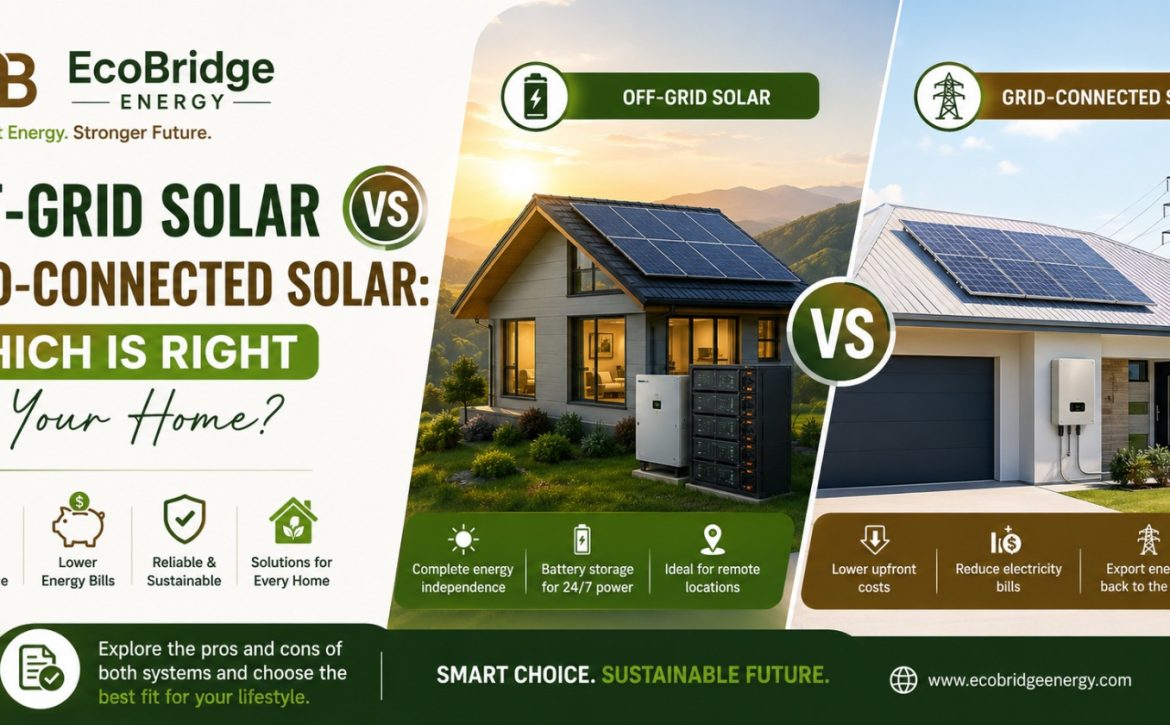
Choosing between Off-Grid Solar vs Grid-Connected Solar depends on your location, energy consumption, budget, battery requirements and how much independence you want from the electricity grid.
For some homeowners, a grid-connected solar system with battery storage can provide excellent savings while keeping the grid available as a backup. For remote properties, farms and homes where grid access is limited or expensive, an off-grid solar system may be a better solution.
What Is Off-Grid Solar?
An off-grid solar system operates independently from the electricity grid.
A typical system includes:
Solar panels
Battery storage
An off-grid or hybrid inverter
Battery management equipment
Backup generation where required
The solar panels generate electricity during the day, while batteries store excess energy for use at night or during periods of low solar production.
Because there is no grid available as a backup, the system needs to be carefully designed around your household’s electricity consumption.
What Is Grid-Connected Solar?
A grid-connected solar system remains connected to the electricity network.
Solar panels generate electricity during the day, and your home can use that energy directly. Excess electricity can be exported to the grid, depending on your electricity plan and local requirements.
Adding a battery can allow you to store surplus solar energy and use it later when your panels aren’t producing enough electricity.
This can provide a balance between energy savings, battery storage and grid reliability.
Off-Grid Solar vs Grid-Connected Solar:
Feature Off-Grid Solar Grid-Connected Solar
Electricity grid Not required Required
Battery Essential Optional
Energy independence Very high Moderate to high
Backup during grid outage Built into system Depends on system design
System complexity Higher Generally simpler
Upfront investment Usually higher Usually lower
Suitable for remote properties Excellent Depends on grid availability
Generator backup Sometimes recommended Usually unnecessary
Which System Costs More?
An off-grid system generally requires more equipment because it needs enough solar generation and battery capacity to meet your electricity requirements without relying on the grid.
The cost can increase further if you need:
Larger battery storage
Additional solar panels
High-capacity inverters
Generator backup
Special installation requirements
Larger backup reserves for periods of poor weather
A grid-connected solar system can often be smaller because the electricity grid remains available when solar production isn’t enough.
However, the cheapest system isn’t necessarily the best system.
The right solution should be based on your actual electricity consumption and energy goals.
How Much Battery Storage Do You Need for Off-Grid Solar?
Battery sizing is one of the most important parts of an Off-Grid Solar vs Grid-Connected Solar .
A home using relatively little electricity may require a smaller battery bank, while a larger household running air conditioning, pumps, refrigeration, electric hot water or other high-consumption appliances may require significantly more storage.
You also need to consider how many hours or days of backup energy you want.
For example, designing a system only around average daily consumption may not provide enough energy during several cloudy days.
That’s why professional system design should consider:
Daily consumption + peak demand + solar production + battery capacity + backup requirements.
What Happens During Cloudy Weather?
This is one of the biggest considerations when going off-grid.
Solar production can fall significantly during periods of heavy cloud or poor weather. An off-grid system therefore needs enough battery storage and solar generation to maintain reliable power.
Some properties may also benefit from a backup generator.
A properly designed system should account for seasonal changes rather than relying only on average summer solar production.
Who Should Consider Off-Grid Solar?
Off-grid solar can be particularly attractive for:
Rural properties
Farms
Remote homes
Properties with limited grid access
New developments where grid connection is expensive
Homeowners seeking greater energy independence
Properties where extending the electricity network isn’t practical
If your property already has a reliable and affordable grid connection, completely disconnecting from the grid may not always provide the best financial return.
Who Should Choose Grid-Connected Solar?
Grid-connected solar may be more suitable if:
You already have a reliable grid connection
You want to reduce electricity bills
You don’t want to manage a completely independent energy system
You want solar without a large battery investment
You want the grid available during periods of low solar generation
You can also add battery storage later if your energy needs change.
What About Solar + Battery Instead of Going Completely Off-Grid?
For many homeowners, this can be the middle ground.
A grid-connected solar + battery system can provide significant energy independence while maintaining access to the electricity grid when required.
During the day, solar can power your home and charge the battery. At night, stored energy can be used instead of purchasing as much electricity from the grid.
Depending on the system and installation, battery backup can also provide power to selected loads during a grid outage.
So, Which One Is Right for You?
There isn’t one answer for every property.
Choose off-grid solar if your priority is maximum energy independence and your property is remote or unsuitable for a practical grid connection.
Choose grid-connected solar if your priority is reducing electricity costs while keeping the grid available as a reliable energy source.
Consider solar + battery if you want to reduce your reliance on the grid without completely disconnecting from it.
The most important step is understanding how much energy your property actually uses before deciding on system size.
Get a Solar & Battery System Designed for Your Property
Not sure whether off-grid, grid-connected or solar + battery makes the most sense for you?
Our team can assess your electricity usage, property requirements and energy goals to help determine the right system size and battery capacity.
Get your personalised solar assessment today.
Request a Free Solar & Battery Quote →
No two properties have the same energy requirements. Get a system designed around your consumption, your property and your energy goals rather than choosing a system based only on its advertised size.
Why Choose EcoBridge Australia?
EcoBridge Australia provides customised renewable energy solutions including solar panels, battery storage, and clean energy systems for homes and businesses. Their team helps homeowners assess their energy requirements and select a system designed for efficiency, reliability, and long-term value.
1. Is off-grid solar better than grid-connected solar?
Neither option is better for every homeowner. Off-grid solar provides complete independence but requires a higher investment, while grid-connected solar is usually more affordable and suitable for most homes.
2. Can I install batteries with a grid-connected solar system?
Yes. Many homeowners add battery storage to grid-connected solar systems to store excess energy and use it at night or during outages.
3. Does off-grid solar work during cloudy weather?
Yes, but energy production is reduced during cloudy conditions. A correctly sized battery system helps maintain power availability.
4. How long do solar panels last?
Quality solar panels are generally designed to provide reliable performance for 25 years or more with proper installation and maintenance.
5. Is off-grid solar expensive?
Off-grid solar usually has a higher upfront cost because it requires batteries and additional equipment. However, it can save money in locations where grid connection costs are high.
6. Can solar batteries provide backup power during blackouts?
Yes, solar batteries with backup functionality can keep essential appliances running during power outages.
7. Which solar system is most common in Australia?
Grid-connected solar systems are the most common choice because they provide energy savings while maintaining access to the electricity grid.
8. How do I choose the right solar system size?
The ideal system size depends on your electricity usage, roof space, location, future energy plans, and whether you want battery storage.
For Australian businesses, electricity is more than another monthly expense. Rising energy costs can directly affect operating margins, cash flow and long-term business performance.
That is why commercial solar power has become an increasingly attractive investment for warehouses, factories, offices, retail stores, farms, schools, hospitality venues and other commercial properties.
But one of the first questions business owners ask is:
How much does commercial solar cost in Australia in 2026, and how quickly can the investment pay for itself?
The answer depends on several factors, including system size, electricity consumption, roof conditions, equipment quality, installation requirements, electricity tariffs and how much of the solar energy your business uses during the day.
This guide explains commercial solar pricing, potential savings, return on investment (ROI), payback periods, government incentives and the key factors Australian businesses should consider before investing.
What Is Commercial Solar Cost in Australia?
Commercial solar is a solar photovoltaic (PV) system designed to generate electricity for a business or commercial property.
Solar panels convert sunlight into electricity, which can be used by your business during operating hours. Depending on the system design and electricity connection, excess electricity may also be exported to the grid.
For many businesses, this is particularly valuable because commercial electricity consumption often occurs during daylight hours — when solar panels are producing electricity.
The Australian Government notes that rooftop solar can help businesses reduce electricity bills, protect against future electricity price rises, reduce emissions and potentially access tax incentives.
How Much Does Commercial Solar Cost in Australia in 2026?
There is no single price for commercial solar because every project is different.
As a broad industry benchmark, a SolarQuotes commercial solar guide has previously placed good-quality systems in the 30–100kW range at approximately $1,000–$1,300 per kW installed, while some 20–30kW systems can be closer to $800 per kW depending on the project. These figures should be treated as indicative benchmarks rather than current guaranteed pricing.
For example, using an illustrative $1,000–$1,300 per kW range:
System Size
Indicative Installed Cost*
20kW
$20,000–$26,000
30kW
$30,000–$39,000
50kW
$50,000–$65,000
100kW
$100,000–$130,000
200kW
$200,000–$260,000
*Illustrative calculations based on the published benchmark above. Actual 2026 project pricing can be higher or lower depending on equipment, roof structure, electrical works, engineering, grid requirements, location, installation complexity and applicable incentives.
The Australian Government also highlights that solar system cost depends on factors such as system size, hardware quality, installation quality, roof access, switchboard upgrades, mounting requirements, cabling and whether a battery is included.
What Determines the Commercial Solar Cost in Australia ?
Several factors can significantly influence your final quote.
1. Solar System Size
A larger system generally requires more panels, inverters, mounting equipment, cabling and installation labour.
However, larger commercial projects can sometimes achieve a lower cost per installed kilowatt because certain project costs are spread across a larger system.
The correct system size should not simply be based on the amount of roof space available.
Your electricity consumption profile is equally important.
2. Solar Panel Quality
Solar panels come in different technologies, efficiency levels, warranties and price points.
Choosing the cheapest panel is not necessarily the best financial decision.
A commercial system should be assessed on:
Panel efficiency
Product warranty
Performance warranty
Manufacturer reputation
Temperature performance
Degradation rate
Suitability for Australian conditions
3. Inverter Selection
The inverter converts the DC electricity produced by solar panels into AC electricity that your business can use.
Commercial systems may use string inverters, larger central inverters or other configurations depending on the project.
The right choice depends on system size, roof layout, shading, monitoring requirements, redundancy and electrical design.
4. Roof Condition and Accessibility
A straightforward warehouse roof may be relatively simple to install on.
A project involving multiple roof levels, difficult access, fragile roofing materials or structural reinforcement can cost considerably more.
Before installation, your installer may need to assess:
Roof condition
Structural capacity
Roof orientation
Shading
Access
Mounting requirements
Existing electrical infrastructure
5. Switchboard and Electrical Upgrades
Some commercial properties require electrical upgrades before solar can be connected.
This can include switchboard modifications, protection equipment, cabling, metering changes and other electrical works.
These requirements can materially affect the project cost.
6. Grid Connection Requirements
Larger commercial solar systems may have additional network and engineering requirements.
The exact requirements depend on the system size, location, distribution network and existing electrical infrastructure.
For this reason, a solar quote should clearly identify what is included in the installation price and what additional costs may arise.
Commercial Solar and Government Incentives
Government incentives can reduce the upfront cost of eligible solar installations.
The Australian Government’s Small-scale Renewable Energy Scheme (SRES) provides small-scale technology certificates (STCs) for eligible rooftop solar systems, including many business installations.
The current SRES eligibility limit for rooftop solar is generally up to 100kW, with the value of certificates depending on factors including system size and climate zone. Accredited installers generally arrange the STCs and apply their value as a discount to the system price.
For systems larger than 100kW, different renewable energy certificate arrangements may apply, so businesses should obtain project-specific advice.
What About Tax Benefits?
Solar equipment is a business asset, so tax treatment may provide additional benefits depending on your business structure, asset use and the tax rules applying when the system is installed and brought into use.
Tax rules change over time, and eligibility can depend on the business and asset.
Always speak with your accountant or tax adviser before relying on a particular tax deduction or depreciation treatment.
What Is the ROI of Commercial Solar?
Return on investment measures the financial benefit generated by the solar system compared with the investment required.
A simple way to think about commercial solar ROI is:
Solar ROI = Financial benefits from solar ÷ Solar investment
The financial benefits can come from:
Reduced electricity purchases
Reduced exposure to electricity price increases
Revenue or credits from eligible excess electricity exports
Applicable government incentives
Potential tax benefits
Potential battery-related savings
Reduced exposure to future energy price volatility
The biggest financial benefit for many businesses comes from using solar electricity on-site rather than exporting it.
Why?
If your business avoids buying 1kWh from the grid, the value of that electricity is based on the electricity cost you would otherwise have paid.
If you export that 1kWh, the value is based on the applicable feed-in or export rate.
The Australian Government explains that electricity tariffs and feed-in tariffs can significantly affect the economics of a solar investment.
Why Daytime Energy Consumption Matters
Commercial solar can be particularly attractive for businesses that operate during daylight hours.
Consider businesses such as:
Warehouses
Manufacturing facilities
Workshops
Supermarkets
Retail stores
Offices
Medical centres
Schools
Farms
Restaurants
Cold-storage facilities
If electricity consumption is high while the sun is shining, a larger proportion of solar generation can potentially be consumed directly by the business.
This can improve the economics of the system because self-consumed solar can offset grid electricity purchases.
Recent commercial solar analysis has also highlighted the natural fit between business operating hours and daytime solar generation.
What Is the Commercial Solar Payback Period?
The payback period is the estimated amount of time required for the financial savings generated by the solar system to recover the initial investment.
For example:
If a system costs $60,000 and generates an average of $15,000 in annual financial benefits:
$60,000 ÷ $15,000 = 4 years
The simple payback period would be approximately 4 years.
However, real-world calculations should consider more than the upfront price.
Important variables include:
Annual solar generation
Business electricity consumption
Self-consumption
Electricity tariffs
Export rates
System degradation
Maintenance
Financing costs
Future electricity prices
Government incentives
Battery costs and benefits
The Australian Government’s SunSPOT calculator provides estimates for installation cost, annual savings and payback period for business solar systems.
Is a 3–5 Year Payback Possible?
It can be, but it should never be treated as a guarantee.
Some commercial solar projects can achieve attractive payback periods, particularly when a business has substantial daytime electricity consumption and favourable project conditions.
However, two businesses with identical 100kW systems can have very different financial outcomes.
For example, a business that consumes most of its solar electricity during the day may achieve stronger savings than a business that produces large amounts of solar energy when its premises are closed.
The right approach is to calculate the payback using your actual electricity bills and interval consumption data.
How to Calculate Commercial Solar Savings
A basic calculation can help demonstrate the principle.
Suppose a business installs a solar system for $100,000.
If the system generates electricity that produces an average financial benefit of $25,000 per year, the simple payback is:
$100,000 ÷ $25,000 = 4 years
After the payback point, the system can continue producing electricity and generating financial benefits for many additional years, subject to system performance, maintenance and future energy prices.
However, this is only a simplified example.
A professional financial model should account for the expected annual generation, consumption profile, tariffs, export revenue, degradation, maintenance and financing.
Should Your Business Install a Battery?
Solar panels generate electricity during the day, but some businesses also consume significant amounts of electricity outside solar production hours.
A battery can store surplus solar energy and make it available later.
This can potentially help businesses:
Increase solar self-consumption
Reduce grid purchases during expensive periods
Manage demand
Improve energy resilience
Reduce reliance on grid electricity
However, batteries add substantial upfront cost and are not automatically the best investment for every commercial property.
The Australian Government specifically recommends considering factors such as electricity usage, solar system size, electricity pricing and battery cost when assessing whether storage makes financial sense.
A battery should therefore be assessed using your actual load profile rather than being added simply because it is available.
How to Maximise Your Commercial Solar ROI
1. Analyse Your Electricity Bills
Before choosing a system, understand:
Annual electricity consumption
Monthly usage
Peak demand
Electricity tariff
Export arrangements
Operating hours
Weekend usage
2. Use Interval Meter Data
Interval data can provide a much clearer picture of when your business uses electricity.
The Australian Government’s SunSPOT guidance recommends using interval meter data where available to improve the accuracy of solar system estimates.
3. Focus on Self-Consumption
Don’t automatically choose the largest system that will fit on your roof.
The ideal system is often the one that delivers the best combination of:
Solar generation + self-consumption + export value + project cost
4. Compare Complete Quotes
Don’t compare installers solely on the price per panel.
Look at:
Total system capacity
Panel brand and model
Inverter brand and model
Installation scope
Structural engineering
Electrical work
Monitoring
Warranties
Maintenance
Grid connection
Expected annual generation
Estimated savings
Payback assumptions
5. Consider the Long-Term Cost
A cheaper system may not necessarily provide the best long-term value.
A quality commercial solar system should be evaluated over its expected operating life, not simply by its initial purchase price.
Financing Options for Commercial Solar
Businesses do not necessarily have to pay the entire solar cost upfront.
Depending on eligibility and project size, options can include:
Solar Loans
A business may finance the solar system through a commercial or green loan.
Solar Leasing
A solar provider may install the system and the business repays the cost through scheduled payments.
Power Purchase Agreements
Under a solar PPA, a provider generally installs and maintains the solar system while the business purchases the generated electricity at an agreed rate.
The Australian Government notes that PPAs, leasing and other commercial financing arrangements can reduce or eliminate upfront expenditure, but businesses should carefully assess interest, fees, contract terms and total costs.
Commercial Solar: Cash Purchase vs Financing
A cash purchase can provide a straightforward investment structure and avoids loan interest.
Financing, however, may allow a business to preserve capital for other priorities while still benefiting from solar generation.
The best option depends on:
Available business capital
Cost of finance
Expected solar savings
Tax treatment
Business growth plans
Cash-flow requirements
Ownership structure
A financial adviser and accountant can help determine which structure is appropriate.
What Should You Look for in a Commercial Solar Installer?
Choosing the right installer is just as important as choosing the right equipment.
Look for a company that can provide:
Appropriate accreditation
Commercial installation experience
Detailed system design
Transparent pricing
Clear warranties
Performance estimates
Monitoring
After-sales support
Electrical and grid-connection expertise
References or examples of completed commercial projects
Avoid quotes that make unrealistic savings or payback promises without showing the assumptions behind the calculation.
Is Commercial Solar Worth It in Australia in 2026?
For many Australian businesses, commercial solar can be a compelling long-term investment.
The strongest candidates typically have:
High daytime electricity consumption
Large usable roof areas
Good solar exposure
High electricity costs
Limited shading
Long-term occupancy of the premises
Suitable electrical infrastructure
A strong desire to reduce operating costs
But solar is not a one-size-fits-all investment.
Final Thoughts
Commercial solar can transform unused rooftop space into an energy-generating business asset.
By reducing reliance on grid electricity, businesses may be able to lower operating costs, improve cash flow and increase protection against future electricity price volatility. Solar can also support broader sustainability and emissions-reduction goals.
However, the cheapest solar quote is not always the best investment.
The right commercial solar system should balance:
Upfront cost + energy generation + self-consumption + electricity prices + system quality + long-term performance.
If you’re considering solar for your business, start by reviewing your electricity bills and consumption profile. From there, obtain a professionally designed proposal that clearly explains system capacity, total installed cost, expected annual generation, estimated savings and projected payback.
Ready to explore commercial solar for your business? Contact EcoBridge Australia for a consultation and discuss a solar solution designed around your energy needs.
Frequently Asked Questions About Commercial Solar in Australia
1. How much does commercial solar cost in Australia?
Commercial solar pricing varies according to system size, equipment, roof conditions, electrical requirements, location and installation complexity. As an indicative industry benchmark, good-quality 30–100kW systems have previously been estimated at around $1,000–$1,300 per kW installed, although actual 2026 pricing can vary significantly.
2. How much does a 50kW commercial solar system cost?
Using an illustrative $1,000–$1,300 per kW benchmark, a 50kW system would be approximately $50,000–$65,000 before considering the specific project’s incentives, additional electrical work and other site requirements.
The actual quote may be different.
3. How much does a 100kW commercial solar system cost?
Using the same indicative benchmark, a 100kW system could be around $100,000–$130,000 before project-specific adjustments.
Businesses should obtain a detailed quote rather than relying on a per-kW estimate alone.
4. What is the average payback period for commercial solar?
There is no universal average payback period. Some projects may achieve payback in around 3–5 years, while others take longer.
The result depends heavily on electricity consumption, daytime usage, electricity tariffs, solar generation, system cost and export arrangements.
5. Can commercial solar pay for itself?
Yes. If the financial savings generated by the system eventually exceed the initial investment, the system has effectively paid for itself.
The exact payback period depends on the project’s financial assumptions.
6. Is commercial solar worth it for a small business?
It can be, particularly if the business uses significant electricity during daylight hours.
Small businesses should compare system cost, expected savings, available incentives, financing costs and the length of time they expect to occupy the premises.
7. What size solar system does my business need?
There is no standard system size for every business.
The ideal size depends on electricity consumption, operating hours, roof space, solar resource, budget, electricity tariff, export limitations and the amount of electricity you can use directly.
8. Is a bigger commercial solar system always better?
No.
A larger system produces more electricity, but if your business cannot use much of that electricity and receives a relatively low value for exports, the additional panels may not provide the best return.
System sizing should be based on financial performance, not just available roof space.
9. Does commercial solar work when the weather is cloudy?
Yes. Solar panels can still generate electricity in cloudy conditions, although output is generally lower than on a clear sunny day.
Annual solar production estimates take local solar conditions into account.
10. What happens to excess solar electricity?
If your solar system produces more electricity than your business is using, excess electricity may be exported to the electricity grid, subject to your connection and retailer arrangements.
The value of exported electricity depends on the applicable export or feed-in tariff.
11. Should my business install a solar battery?
Not necessarily.
A battery may be worthwhile when it allows the business to store excess solar and use it later, reduce expensive grid purchases or manage demand.
However, the additional cost needs to be compared with the expected financial benefits.
12. Can solar reduce my business electricity bills?
Yes.
Solar can reduce the amount of electricity your business needs to purchase from the grid. The potential savings depend on how much electricity the system generates and how much of that electricity your business uses.
13. Can commercial solar protect my business from electricity price increases?
Solar can reduce exposure to grid electricity prices because some of your electricity is generated on-site rather than purchased from the grid.
It cannot necessarily eliminate electricity costs completely, because most grid-connected businesses continue to have grid supply, fixed charges and other costs.
14. Are commercial solar systems eligible for government incentives?
Many eligible rooftop solar systems can receive support through Australia’s Small-scale Renewable Energy Scheme, subject to eligibility requirements. The SRES generally applies to eligible systems up to 100kW.
Other incentives may apply depending on the system, business and state or territory.
15. Can businesses claim tax benefits from commercial solar?
Potential tax deductions or depreciation benefits may apply depending on the business, asset, installation date and current tax legislation.
Because tax rules can change, businesses should speak with their accountant or tax adviser before making financial decisions based on a particular tax benefit.
Lower energy costs. Higher returns. Stronger business.
If your business is considering commercial solar in 2026, arrange a consultation to discuss your requirements and determine whether solar can deliver a strong return on your energy investment.