Read More

Battery Storage Without Solar Panels: Is It Worth It for UK Homes? | EcoBridge

Battery storage is often seen as something that only makes sense alongside solar panels. But that’s changing. Across the UK, more homeowners are asking whether they can install a home battery without solar panels and still reduce their electricity bills.

The short answer is yes — a standalone battery system can work without solar, and for some households it can be a smart investment. With time-of-use electricity tariffs, smart meters, and growing concerns about rising energy costs and power outages, battery-only systems are becoming increasingly popular.

In this guide, EcoBridge explains how standalone battery storage works, when it makes financial sense, and what to consider before installing one.

What Is a Standalone Home Battery?

A standalone Battery Storage Without Solar Panels system is connected to your home’s electrical supply and the National Grid, but not to solar panels.

Instead of storing excess solar energy, the battery charges using electricity from the grid during cheaper off-peak hours. It then powers your home during expensive peak-rate periods, helping you avoid buying electricity when prices are highest.

In simple terms, you’re storing low-cost electricity and using it later when electricity costs more.

How Battery Storage Saves Money Without Solar

The biggest advantage of a battery-only system is energy arbitrage — buying electricity at a low price and using it when prices increase.

Many UK energy suppliers now offer smart tariffs where electricity prices vary throughout the day.

Example of a Typical Time-of-Use Tariff
Time PeriodTypical Electricity Price
Overnight (off-peak)7–10p per kWh
Daytime15–25p per kWh
Evening Peak30–40p per kWh

For example, if your battery charges overnight at 8p per kWh and supplies electricity during a 35p per kWh evening peak, you could save around 27p per unit of electricity used, before accounting for battery efficiency losses.

A 10kWh battery that cycles daily could potentially reduce electricity costs by several hundred pounds per year, depending on your tariff and household usage.

How a Battery-Only System Works

Modern battery systems operate automatically using smart scheduling.

Here’s a typical daily cycle:

  1. Charge overnight during low-cost electricity hours.
  2. Store electricity until it’s needed.
  3. Discharge during peak hours when electricity is most expensive.
  4. Repeat automatically every day based on your tariff settings.

Many batteries integrate with smart meters and supplier tariffs, allowing charging and discharging schedules to be optimised without manual input.

Unlike a solar battery system, however, all electricity still comes from the grid — you’re simply changing when you buy it.

Can a Battery Provide Backup Power During a Power Cut?

Yes — but only if the system is designed for backup power.

A compatible inverter and backup configuration can keep essential circuits running during a power outage, including:

  • Lighting
  • Wi-Fi router
  • Fridge and freezer
  • Heating controls
  • Phone charging
  • Selected sockets

This can provide several hours of backup power depending on battery size and household demand.

It’s important to note that not all battery systems include backup functionality. This feature requires compatible hardware and should be planned during installation.

When Does Battery Storage Without Solar Make Sense?

A standalone battery can be an excellent option in several situations.

Battery-Only May Be Right for You If:
  • Your roof isn’t suitable for solar panels.
  • You use most of your electricity during evenings.
  • You have access to a smart off-peak tariff.
  • You want protection against rising electricity prices.
  • You want backup power during outages.
  • You’re planning to install solar panels in the future and want a compatible battery now.

Households with electric heating, electric vehicles, or high evening electricity use often benefit the most.

When Solar and Battery Is Still the Better Option

For many UK homeowners, combining Battery Storage Without Solar Panels delivers greater long-term value because it can:

  • Reduce electricity imported from the grid.
  • Store surplus solar generation for later use.
  • Earn income through export tariffs.
  • Improve your home’s EPC rating.
  • Increase energy independence.
  • Add appeal to your property for future buyers.

A battery-only system reduces costs through tariff optimisation, while a solar-plus-battery system also generates your oBattery Storage Without Solar Panelswn electricity.

Things to Consider Before Installing a Battery

Tariff Dependency

Savings depend on the difference between off-peak and peak electricity prices. Smaller price differences reduce potential savings.

Battery Efficiency

Most home batteries have a round-trip efficiency of around 85–95%, meaning a small amount of energy is lost during charging and discharging.

Battery Lifespan

Quality lithium batteries are typically designed for 6,000–10,000 charge cycles, which can equate to well over 10 years of daily use.

Future Energy Plans

If you’re considering solar panels later, choosing a battery that is compatible with future solar integration can reduce installation costs down the line.

Is Battery Storage Without Solar Worth It?

The answer depends on your household.

A battery-only system is most worthwhile if:

  • You have a smart tariff with cheap overnight electricity.
  • You consume a significant amount of electricity during expensive evening periods.
  • You value energy resilience during power cuts.
  • You want lower electricity bills without installing solar immediately.

Every home uses electricity differently, so the best way to evaluate savings is by analysing your actual consumption rather than relying on estimates.

Why Choose EcoBridge?

At EcoBridge, we help homeowners across the UK find the most cost-effective battery storage solution for their property and lifestyle.

What EcoBridge Offers
  • Free, no-obligation battery storage consultations.
  • Tailored savings calculations using your electricity usage.
  • Battery-only and solar battery system design.
  • Smart tariff optimisation.
  • Professional installation by qualified engineers.
  • Ongoing support and advice for future solar integration.

Our approach is simple: we recommend solutions based on real household energy data, helping you understand the costs, savings, and long-term benefits before you invest.

Frequently Asked Questions (FAQs)

1. Can I install a home battery without solar panels?

Yes. A standalone battery can be installed without solar panels and charged directly from the National Grid using off-peak electricity tariffs.

2. How does a battery save money without solar?

It charges when electricity is cheapest, usually overnight, and supplies your home during expensive peak-rate hours, reducing the cost of electricity you buy from the grid.

3. Do I need a smart meter for a battery-only system?

A smart meter isn’t always mandatory, but it’s highly recommended because most time-of-use tariffs require one to access cheaper off-peak electricity rates.

4. Which UK tariffs work best with battery storage?

Time-of-use tariffs offered by suppliers such as Octopus Energy, OVO Energy, E.ON Next, and other providers with off-peak pricing are generally the most suitable.

5. Can a battery power my home during a power cut?

Yes, if the battery system includes backup functionality and is installed with a compatible inverter and backup circuit. Not every battery provides this feature as standard.

6. How long does a home battery last?

Most modern lithium battery systems last between 10 and 15 years and are rated for approximately 6,000 to 10,000 charging cycles.

7. Can I add solar panels to my battery later?

Yes. Many battery systems are designed to be compatible with future solar PV installations, making it possible to expand your energy system later.

8. Is battery storage without solar worth it in the UK?

It can be, especially for households with high evening electricity usage, access to low overnight tariffs, and a desire for backup power or protection against rising energy prices.

9. What size battery do I need without solar?

The right battery size depends on your daily electricity consumption and how much energy you want to shift from off-peak to peak hours. Many homes choose systems between 5kWh and 15kWh.

10. How can EcoBridge help me choose the right battery?

EcoBridge analyses your electricity usage, tariff, budget, and future energy plans to recommend the battery system that offers the best value and realistic long-term savings.
Read More

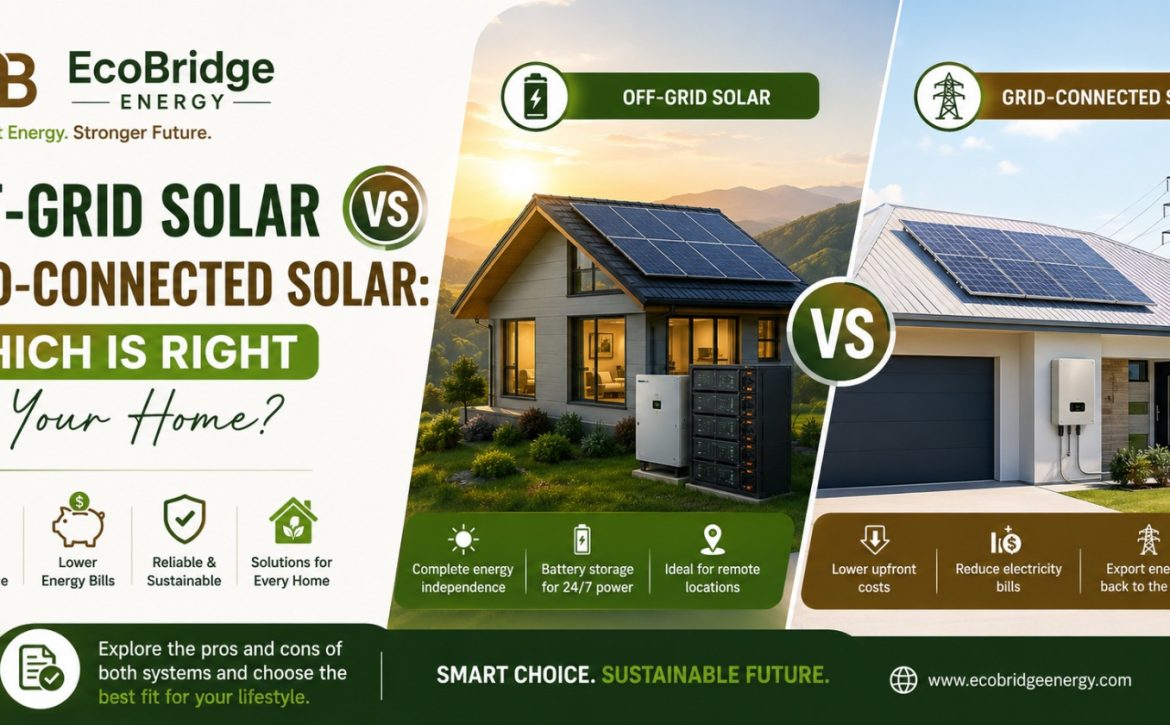
Off-Grid Solar vs Grid-Connected Solar: Which Is Right for Your Home?

Thinking about installing solar but unsure whether you should stay connected to the electricity grid or become completely energy independent?

Choosing between Off-Grid Solar vs Grid-Connected Solar depends on your location, energy consumption, budget, battery requirements and how much independence you want from the electricity grid.

For some homeowners, a grid-connected solar system with battery storage can provide excellent savings while keeping the grid available as a backup. For remote properties, farms and homes where grid access is limited or expensive, an off-grid solar system may be a better solution.

What Is Off-Grid Solar?

An off-grid solar system operates independently from the electricity grid.

A typical system includes:

  • Solar panels
  • Battery storage
  • An off-grid or hybrid inverter
  • Battery management equipment
  • Backup generation where required

The solar panels generate electricity during the day, while batteries store excess energy for use at night or during periods of low solar production.

Because there is no grid available as a backup, the system needs to be carefully designed around your household’s electricity consumption.

What Is Grid-Connected Solar?

A grid-connected solar system remains connected to the electricity network.

Solar panels generate electricity during the day, and your home can use that energy directly. Excess electricity can be exported to the grid, depending on your electricity plan and local requirements.

Adding a battery can allow you to store surplus solar energy and use it later when your panels aren’t producing enough electricity.

This can provide a balance between energy savings, battery storage and grid reliability.

Off-Grid Solar vs Grid-Connected Solar:

  • Feature Off-Grid Solar Grid-Connected Solar
  • Electricity grid Not required Required
  • Battery Essential Optional
  • Energy independence Very high Moderate to high
  • Backup during grid outage Built into system Depends on system design
  • System complexity Higher Generally simpler
  • Upfront investment Usually higher Usually lower
  • Suitable for remote properties Excellent Depends on grid availability
  • Generator backup Sometimes recommended Usually unnecessary

Which System Costs More?

An off-grid system generally requires more equipment because it needs enough solar generation and battery capacity to meet your electricity requirements without relying on the grid.

The cost can increase further if you need:

  • Larger battery storage
  • Additional solar panels
  • High-capacity inverters
  • Generator backup
  • Special installation requirements
  • Larger backup reserves for periods of poor weather

A grid-connected solar system can often be smaller because the electricity grid remains available when solar production isn’t enough.

However, the cheapest system isn’t necessarily the best system.

The right solution should be based on your actual electricity consumption and energy goals.

How Much Battery Storage Do You Need for Off-Grid Solar?

Battery sizing is one of the most important parts of an Off-Grid Solar vs Grid-Connected Solar .

A home using relatively little electricity may require a smaller battery bank, while a larger household running air conditioning, pumps, refrigeration, electric hot water or other high-consumption appliances may require significantly more storage.

You also need to consider how many hours or days of backup energy you want.

For example, designing a system only around average daily consumption may not provide enough energy during several cloudy days.

That’s why professional system design should consider:

Daily consumption + peak demand + solar production + battery capacity + backup requirements.

What Happens During Cloudy Weather?

This is one of the biggest considerations when going off-grid.

Solar production can fall significantly during periods of heavy cloud or poor weather. An off-grid system therefore needs enough battery storage and solar generation to maintain reliable power.

Some properties may also benefit from a backup generator.

A properly designed system should account for seasonal changes rather than relying only on average summer solar production.

Who Should Consider Off-Grid Solar?

Off-grid solar can be particularly attractive for:

  • Rural properties
  • Farms
  • Remote homes
  • Properties with limited grid access
  • New developments where grid connection is expensive
  • Homeowners seeking greater energy independence
  • Properties where extending the electricity network isn’t practical

If your property already has a reliable and affordable grid connection, completely disconnecting from the grid may not always provide the best financial return.

Who Should Choose Grid-Connected Solar?

Grid-connected solar may be more suitable if:

  • You already have a reliable grid connection
  • You want to reduce electricity bills
  • You don’t want to manage a completely independent energy system
  • You want solar without a large battery investment
  • You want the grid available during periods of low solar generation

You can also add battery storage later if your energy needs change.

What About Solar + Battery Instead of Going Completely Off-Grid?

For many homeowners, this can be the middle ground.

A grid-connected solar + battery system can provide significant energy independence while maintaining access to the electricity grid when required.

During the day, solar can power your home and charge the battery. At night, stored energy can be used instead of purchasing as much electricity from the grid.

Depending on the system and installation, battery backup can also provide power to selected loads during a grid outage.

So, Which One Is Right for You?

There isn’t one answer for every property.

Choose off-grid solar if your priority is maximum energy independence and your property is remote or unsuitable for a practical grid connection.

Choose grid-connected solar if your priority is reducing electricity costs while keeping the grid available as a reliable energy source.

Consider solar + battery if you want to reduce your reliance on the grid without completely disconnecting from it.

The most important step is understanding how much energy your property actually uses before deciding on system size.

Get a Solar & Battery System Designed for Your Property

Not sure whether off-grid, grid-connected or solar + battery makes the most sense for you?

Our team can assess your electricity usage, property requirements and energy goals to help determine the right system size and battery capacity.

Get your personalised solar assessment today.

Request a Free Solar & Battery Quote →

No two properties have the same energy requirements. Get a system designed around your consumption, your property and your energy goals rather than choosing a system based only on its advertised size.

Why Choose EcoBridge Australia?

EcoBridge Australia provides customised renewable energy solutions including solar panels, battery storage, and clean energy systems for homes and businesses. Their team helps homeowners assess their energy requirements and select a system designed for efficiency, reliability, and long-term value.

Contact EcoBridge Australia

EcoBridge Australia
Website: https://ecobridgeenergy.com/
Email:info@ecobridgeenergy.com


Frequently Asked Questions (FAQs)

1. Is off-grid solar better than grid-connected solar?

Neither option is better for every homeowner. Off-grid solar provides complete independence but requires a higher investment, while grid-connected solar is usually more affordable and suitable for most homes.

2. Can I install batteries with a grid-connected solar system?

Yes. Many homeowners add battery storage to grid-connected solar systems to store excess energy and use it at night or during outages.

3. Does off-grid solar work during cloudy weather?

Yes, but energy production is reduced during cloudy conditions. A correctly sized battery system helps maintain power availability.

4. How long do solar panels last?

Quality solar panels are generally designed to provide reliable performance for 25 years or more with proper installation and maintenance.

5. Is off-grid solar expensive?

Off-grid solar usually has a higher upfront cost because it requires batteries and additional equipment. However, it can save money in locations where grid connection costs are high.

6. Can solar batteries provide backup power during blackouts?

Yes, solar batteries with backup functionality can keep essential appliances running during power outages.

7. Which solar system is most common in Australia?

Grid-connected solar systems are the most common choice because they provide energy savings while maintaining access to the electricity grid.

8. How do I choose the right solar system size?

The ideal system size depends on your electricity usage, roof space, location, future energy plans, and whether you want battery storage.


Read More

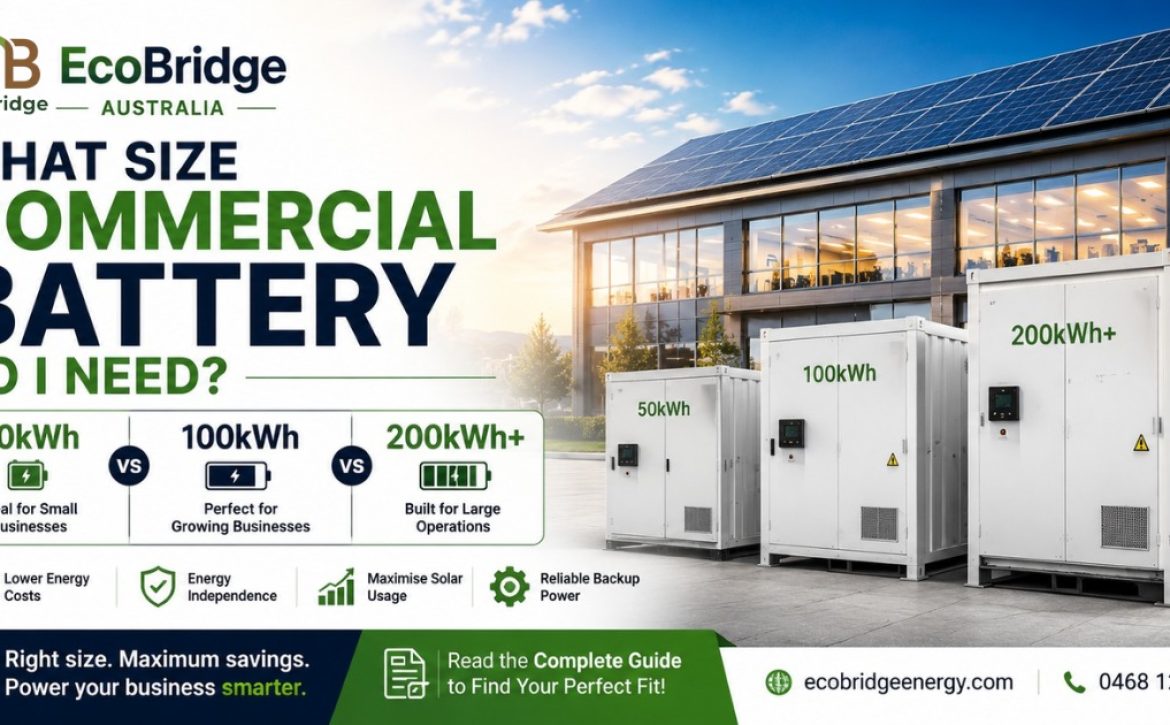
What Size Commercial Battery Do I Need? 50kWh vs 100kWh vs 200kWh+

Choosing a commercial battery is not simply a matter of picking the biggest system that fits your budget.

For Australian businesses, the right battery size depends on how much electricity you use, when you use it, how much solar you generate, your peak demand, available space and how you want the battery to operate.

A 50kWh battery may be more than enough for one business, while a larger warehouse, factory or hospitality business may benefit from 100kWh, 200kWh or considerably more.

So how do you know which option makes sense for your business?

In this guide, we compare 50kWh, 100kWh and 200kWh+ commercial battery systems, what each can potentially be used for, and the factors you should consider before investing.

Why Are Businesses Installing Commercial Batteries?

Solar panels can significantly reduce the amount of electricity a business purchases from the grid during daylight hours.

But there is a problem for many businesses:

Your electricity usage doesn’t always match your solar production.

A business may generate plenty of solar around midday but still consume electricity:

  • Early in the morning
  • Late in the afternoon
  • In the evening
  • Overnight
  • During periods of high production or demand

A battery allows excess solar generation to be stored and used later, helping businesses increase the amount of generated energy they can consume themselves.

For some businesses, battery storage can also form part of a broader strategy to manage periods of high electricity demand.

The Australian Government’s energy guidance notes that commercial batteries can help businesses store solar energy for later use and potentially reduce electricity purchases and peak demand, depending on the business and tariff structure.

50kWh vs 100kWh vs 200kWh+: What’s the Difference?

There isn’t one battery size that is right for every business.

Think of battery capacity as the amount of energy the battery can store.

For example:

  • 50kWh = up to 50kWh of stored energy
  • 100kWh = up to 100kWh
  • 200kWh = up to 200kWh

Actual usable capacity, charge/discharge limits and system performance depend on the battery technology, inverter, configuration and operating conditions.

Here’s a simplified comparison:

Battery size Often worth considering for Typical objective
50kWh Small businesses, offices, retail, smaller commercial sites Solar self-consumption
100kWh Medium commercial sites, larger retail, hospitality Greater solar utilisation + peak management
200kWh+ Large facilities, warehouses, factories, high-energy businesses Large-scale energy management

These are general categories rather than strict rules. A business shouldn’t select a battery purely based on its size.

Is a 50kWh Commercial Battery Enough?

A 50kWh battery can be a practical starting point for businesses that have moderate electricity consumption and a suitable solar system.

It can be particularly relevant for businesses that want to:

Store excess solar

Instead of exporting surplus solar generation during the day, the battery can store some of that energy for later use.

Increase solar self-consumption

If your business has electricity demand outside the strongest solar-generation hours, stored energy can potentially be used later.

Reduce grid reliance

Using stored energy when appropriate can reduce the amount of electricity purchased from the grid.

Keep the system relatively compact

A smaller battery generally requires less physical space than a larger commercial installation, although installation requirements vary considerably between products and sites.

Who might consider 50kWh?

Examples could include:

  • Small offices
  • Retail stores
  • Cafés and restaurants
  • Professional practices
  • Small warehouses
  • Workshops
  • Smaller commercial buildings

But the important question isn’t simply:

“Do I need 50kWh?”

It’s:

“How much energy does my business actually need to store?”

When Does a 100kWh Battery Make Sense?

A 100kWh battery provides roughly twice the nominal storage capacity of a 50kWh system.

For businesses with higher daytime solar generation and greater electricity consumption, this can provide more flexibility.

A 100kWh system may be worth investigating when a business has:

  • A larger commercial solar system
  • Significant daytime electricity consumption
  • Meaningful electricity usage after sunset
  • Higher daily energy consumption
  • Greater surplus solar generation
  • A need for more substantial energy storage

For example, imagine a business produces substantial excess solar energy during the middle of the day but continues operating well into the evening.

A larger battery may allow more of that solar energy to be shifted from the middle of the day into later operating periods.

However, bigger doesn’t automatically mean better.

If your business regularly has insufficient excess solar to charge a 100kWh battery, installing additional storage may not provide the expected financial benefit.

What About 200kWh+ Commercial Batteries?

Once you move into the 200kWh+ range, you’re generally looking at substantially larger commercial energy-storage applications.

These systems may be relevant for businesses such as:

  • Manufacturing facilities
  • Large warehouses
  • Distribution centres
  • Shopping centres
  • Large hospitality operations
  • Agricultural businesses
  • Cold storage facilities
  • High-energy commercial sites
  • Businesses operating for extended hours

A larger battery can provide considerably more stored energy, but the economics become increasingly dependent on the site’s actual electricity profile.

For these projects, battery sizing should generally be based on detailed energy data rather than a simple rule of thumb.

The Biggest Mistake: Choosing a Battery Based on Solar Size Alone

One of the most common mistakes businesses can make is thinking:

“I have a 100kW solar system, so I need a 100kWh battery.”

That’s not necessarily correct.

Solar capacity and battery capacity are two different things.

A 100kW solar system describes the potential power output of the solar array under appropriate conditions.

A 100kWh battery describes its nominal energy storage capacity.

Your battery should be assessed alongside:

  • Solar generation
  • Electricity consumption
  • Load profile
  • Peak demand
  • Operating hours
  • Electricity tariff
  • Export arrangements
  • Battery power rating
  • Available installation space
  • Future energy requirements

Your Electricity Bill Can Tell You a Lot

One of the easiest ways to start assessing battery requirements is to look at your business electricity bills.

But the total bill isn’t enough.

A proper assessment should ideally examine interval electricity data where available.

This can show:

  • When are you using electricity?
  • How much electricity are you using?
  • When does your demand peak?
  • How much solar are you currently exporting?
  • What happens outside your solar-generation hours?

These answers are much more useful than simply looking at your monthly electricity spend.

Battery Size vs Battery Power: Don’t Confuse the Two

This is particularly important for commercial systems.

kWh = energy capacity

kW = power

A 100kWh battery doesn’t automatically mean it can deliver 100kW of power.

For example, depending on the system configuration, a battery could have:

100kWh capacity + 50kW power

or another power-to-energy ratio.

Why does this matter?

Imagine a business has a large short-duration power requirement.

Having plenty of stored energy isn’t necessarily enough if the battery and inverter cannot provide the required power at that moment.

That’s why commercial battery design should consider both energy capacity and power requirements.

How Long Can a Commercial Battery Run My Business?

This is one of the most common questions businesses ask.

The answer depends on your actual load.

A simplified example:

If a business was consuming an average of 25kW, then a 100kWh battery could theoretically provide around:

100 ÷ 25 = 4 hours

However, this is only a simplified calculation.

Real-world operation depends on factors such as:

  • Usable battery capacity
  • Battery state of charge
  • Inverter efficiency
  • Maximum discharge rate
  • Simultaneous loads
  • Operating conditions
  • System controls

Therefore, you shouldn’t assume that a 100kWh battery will automatically provide four hours of backup or operation.

Should I Choose 50kWh, 100kWh or 200kWh+?

Here’s a simple way to think about it.

Consider 50kWh if:

Your business has moderate energy consumption and you’re primarily looking to increase solar self-consumption and shift some excess solar into later periods.

Consider 100kWh if:

You have a larger solar installation, higher electricity consumption and enough surplus solar or suitable operating economics to justify additional storage.

Consider 200kWh+ if:

Your business has substantial energy consumption, large solar generation, significant peak demand or extended operating hours that can make larger-scale storage worthwhile.

But don’t make the final decision from a generic table.

Your electricity data should determine the system.

What Does a Commercial Battery System Cost?

There isn’t a single price for a 50kWh, 100kWh or 200kWh commercial battery.

The installed cost can depend on:

  • Battery brand and technology
  • Inverter capacity
  • Number of battery modules
  • Switchboard upgrades
  • Electrical infrastructure
  • Installation complexity
  • Site access
  • Monitoring and control systems
  • Backup requirements
  • Civil works
  • Compliance requirements
  • Network requirements

That’s why comparing batteries purely on $/kWh can be misleading.

A cheaper battery may not provide the same power output, warranty, integration capabilities or installation requirements as another system.

Is a Bigger Commercial Battery Always Better?

No.

The objective isn’t to install the largest battery possible.

The objective is to install a battery that makes sense for the business.

For example, if a 200kWh battery frequently sits partially charged because there isn’t enough excess solar or suitable evening consumption, the additional capacity may not provide the expected return.

On the other hand, if a business consistently has substantial excess solar and significant electricity consumption later in the day, a smaller battery could leave valuable solar energy unused.

The right system is about matching storage to your energy profile.

What Information Do You Need to Size a Commercial Battery?

Before recommending a commercial battery, an installer or energy specialist will typically want information such as:

  1. Electricity bills

Ideally, several recent bills.

  1. Interval data

Where available, this can provide much better insight into your consumption pattern.

  1. Solar system details

Existing or proposed solar capacity, inverter specifications and expected generation.

  1. Business operating hours

A business operating 24/7 has a very different energy profile from one operating 8am–5pm.

  1. Site details

Roof area, switchboard configuration and available battery installation space can all matter.

  1. Your objective

Are you primarily looking to:

  • Reduce electricity costs?
  • Increase solar self-consumption?
  • Manage peak demand?
  • Reduce grid reliance?
  • Add energy resilience?
  • Prepare for future electrification?

The answer can influence the ideal system configuration.

What About Battery Backup?

If you’re considering a battery because you want protection during a grid outage, make sure you specifically discuss backup capability.

Not every commercial battery installation automatically provides whole-business backup.

The required system may depend on:

  • Essential loads
  • Switchboard configuration
  • Inverter capability
  • Battery power output
  • Automatic transfer equipment
  • Generator integration
  • Site electrical design

A business might therefore choose to back up only critical equipment rather than the entire facility.

The Right Commercial Battery Is About Your Business, Not a Number

A 50kWh battery isn’t necessarily better than a 100kWh battery.

And a 200kWh system isn’t automatically the best investment.

The right solution depends on the relationship between:

Solar generation → Business consumption → Battery storage → Grid usage

The goal is to design a system that works with your actual operating profile.

For some businesses, that could mean 50kWh.

For others, 100kWh may be more appropriate.

And for high-energy commercial facilities, a 200kWh+ system may be worth investigating.

Want to Know What Size Battery Your Business Actually Needs?

Rather than guessing between 50kWh, 100kWh and 200kWh+, get your business’s energy usage assessed against its solar generation and operating profile.

A commercial solar and battery assessment can help determine:

  • Recommended battery capacity
  • Required inverter power
  • Solar system size
  • Potential energy savings
  • Battery utilisation
  • Potential payback
  • Suitable financing options

Submit your business details and electricity information for a commercial solar + battery assessment.

[Get a Commercial Energy Assessment →]

Every site is different. Battery sizing, savings and payback should be confirmed using the business’s actual electricity consumption, solar generation, tariff and site conditions.

EcoBridge Australia – Contact Details

EcoBridge Australia

FAQs: What Size Commercial Battery Do I Need? (50kWh vs 100kWh vs 200kWh+)

1. How do I know what size commercial battery my business needs?

The right battery size depends on your daily energy consumption, peak power demand, backup duration requirements, and whether you’re using solar. Review your electricity bills and identify how much energy (kWh) your business uses during the hours you want battery support.

2. Who is a 50kWh commercial battery best for?

A 50kWh battery is ideal for small businesses such as retail stores, cafés, offices, clinics, salons, and small workshops. It can provide backup power for essential loads or reduce electricity costs during peak tariff hours.

3. Is a 100kWh battery enough for a medium-sized business?

Yes. A 100kWh battery is a common choice for medium-sized businesses, including restaurants, supermarkets, warehouses, schools, and manufacturing units with moderate energy needs. It offers longer backup time and greater savings through peak shaving.

4. When should I consider a 200kWh or larger battery system?

Choose a 200kWh+ battery if you operate a large commercial facility, factory, data center, hotel, hospital, or logistics hub with high energy consumption. These systems support larger loads, longer backup times, and integration with larger solar installations.

5. What’s the difference between kWh and kW?
  • kWh (kilowatt-hour): Measures how much energy the battery stores.
  • kW (kilowatt): Measures how much power the battery can deliver at one time.

A battery may store 100kWh but have a power output of 50kW or 100kW, depending on its design.

6. How long will a commercial battery provide backup power?

Backup time depends on the connected load. For example:

Battery SizeApproximate Backup
50kWh~5 hours for a 10kW load
100kWh~5 hours for a 20kW load
200kWh~5 hours for a 40kW load

Actual backup duration varies based on battery efficiency and depth of discharge.

7. Can I use a commercial battery without solar panels?

Yes. Commercial batteries can charge from the electrical grid and provide backup during outages or reduce demand charges. However, pairing a battery with solar usually increases long-term savings.

8. Can I expand my battery system later?

Many commercial battery systems are modular, allowing you to add additional battery units as your energy needs grow. Check compatibility with your inverter and battery management system before expanding.

9. How much can a commercial battery reduce electricity bills?

Savings depend on your tariff structure and usage pattern. Businesses can reduce costs through peak shaving, time-of-use energy shifting, solar energy storage, and avoiding high demand charges.

10. What factors affect the battery size I should choose?

Consider:

  • Daily energy usage (kWh).
  • Peak demand (kW).
  • Required backup duration.
  • Critical equipment that must stay powered.
  • Solar system size (if applicable).
  • Future business expansion plans